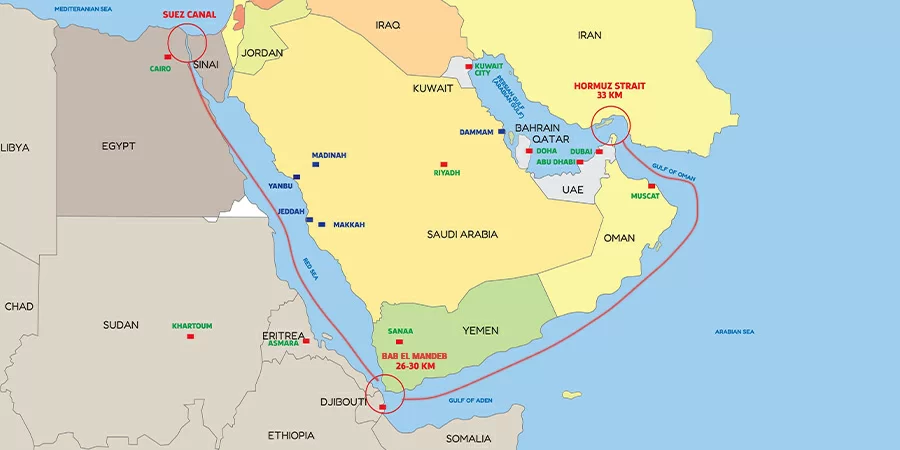
The recent Houthi seizure of the Yemeni port city of Mocha and the strategic island of Mayyun, also known as Perim, marks far more than a simple military victory for the group. It is a tectonic geopolitical shift that lays bare the deep fragility of the global trade and security architecture that underpins the modern world economy. With full control now established over Yemen’s entire Red Sea coastline — a strip of territory sitting just 20 kilometers off the coast of East Africa — the Houthi movement holds critical leverage over the Bab al-Mandeb strait, a key maritime chokepoint through which roughly 12 percent of total global trade flows, including 11 percent of the world’s seaborne oil shipments and 8 percent of its liquefied natural gas.
To be clear: the public reassurance from Houthi politburo member Hazem al-Assad that commercial shipping will remain “safe and orderly” through the strait is little more than rhetorical comfort that no major shipping line is willing to take at face value. Data from the International Monetary Fund’s PortWatch monitoring platform tells a stark story: between 2023 and 2025, shipping volumes through the Red Sea have plummeted by between 50 and 55 percent. Leading global shipping firms are now rerouting the vast majority of their vessels around the Cape of Good Hope, a detour that adds more than 20 extra days of transit time and drives up global freight rates sharply. In the end, the entire global trading system is footing the bill for a protracted conflict unfolding in one of the world’s poorest nations.
Another claim that bears scrutiny is Tehran’s insistence that the Houthi movement is an “independent group.” A quick look at the geopolitical map tells a different story. Iran already holds strategic control over the Strait of Hormuz, the chokepoint through which roughly one-fifth of the world’s global energy supplies flowed before the outbreak of the 2025 escalation between Iran and Western powers. Now, the Houthi movement — armed and funded by Iran — controls Bab al-Mandeb. This means two of the world’s three most critical maritime chokepoints for global energy and trade are now effectively held by the same Iran-led axis. This is no coincidence: it is a deliberate, long-planned strategic gambit. The real question is not whether the Houthi are truly independent; it is why the West continues to indulge the fiction that they are.
For Egypt, which earns billions of dollars annually in foreign currency from Suez Canal transit fees, the fallout has already been severe. Between 2023 and 2024, the country lost roughly $7 billion in canal revenue, equal to a 60 percent drop from pre-crisis levels. Yet Cairo has opted for deliberate strategic restraint, maintaining the long-standing policy of non-intervention in Yemeni affairs it has held since the 2015 Gulf intervention. This is not a sign of weakness, but a pragmatic calculation: a country already grappling with deep economic crisis cannot afford the risk of a new military entanglement in Yemen. The paradox is a bitter one: Egypt loses billions in critical revenue, but cannot risk intervention because it cannot bear the military and economic costs that would follow.
The shifts along the Red Sea have also created uneven impacts across the East African coast. Sudan and Somalia face growing security risks from the new geopolitical order, while Eritrea and Djibouti have gained unexpected strategic leverage. Eritrean President Isaias Afwerki, who spent decades in international isolation, is now leveraging his country’s Red Sea position to deepen ties with Washington and Tel Aviv. It is pure, unadulterated geopolitical opportunism.
The Bab al-Mandeb strait is narrower than the Strait of Hormuz, a geographic feature that makes it far easier for Houthi forces to target passing commercial and military vessels. Recent public comments from a Houthi commander, released in a video stating that the group can deploy artillery to strike targets in Yemeni territorial waters, underline how immediate and concrete this threat is.
Even more concerning is the fact that the repositioning of global maritime military assets toward the Bab al-Mandeb and Hormuz amid rising tensions with Iran has created a security vacuum along the coast of the Horn of Africa. That vacuum is being filled by transnational organized maritime criminal groups. The resurgence of piracy off the Somali coast is directly linked to this redistribution of maritime power. As major powers shift their naval assets north to address the Houthi threat, Somali and international seafarers are left to bear the cost of the resulting insecurity.
What is unfolding in the Red Sea is not a distant regional conflict. It is a critical test for the existing global order, and its impacts reach all the way to major European ports like Rotterdam. As Europe’s largest container port and one of the most critical links in the global container supply chain, disruptions in the Red Sea are felt directly here. When shipping lines reroute en masse around the Cape of Good Hope, freight costs rise, delivery timelines slow, and the impact is passed on to European consumers at the checkout. European energy prices are already highly sensitive to any disruption in Red Sea shipping. Meanwhile, NATO naval forces operating in the region do so under mandates that are ill-suited to counter the current threat landscape.
The European Union has the financial resources, naval capabilities, and direct economic stake in securing the strait. What it lacks is the political will to update its operational mandates and act collectively. The EU’s existing Operation Atalanta anti-piracy mission is a starting point, but without an expanded mandate to counter Houthi threats, it amounts to little more than a shield without a sword.
The long-term implications of this shift are far-reaching. Global supply chains are growing more vulnerable to disruption, freight costs are rising, and those increases are ultimately passed through to end consumers. Nations dependent on Suez Canal revenue, such as Egypt, face gradual economic erosion. Most notably, the multilateral system tasked with guaranteeing global maritime security has proven unable to respond quickly and decisively to this new threat.
The core lesson could not be clearer: whoever controls the world’s critical maritime chokepoints controls the global economy. The Houthi movement understands this reality. Iran understands this reality. Whether the broader international community has also come to terms with it remains to be seen. So far, all evidence suggests the international community has opted primarily to stand by, reroute traffic around the Cape of Good Hope, and hope for the best. That is not a strategy. It is merely kicking the bill down the road.