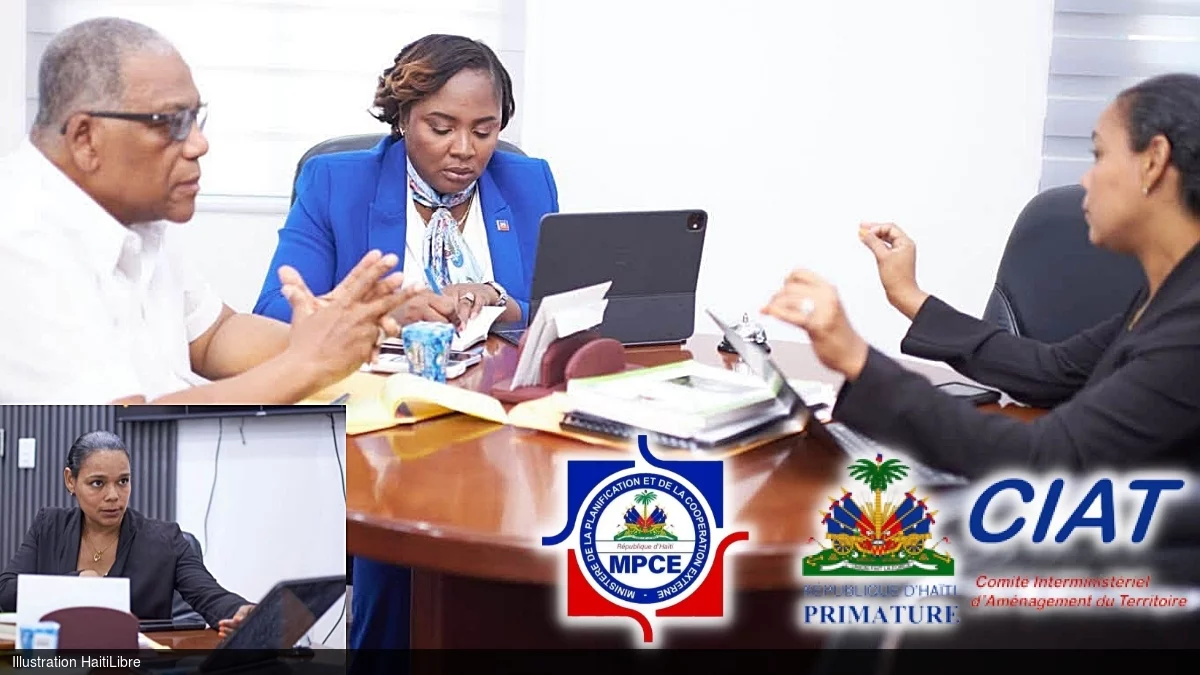
Against the backdrop of Haiti’s ongoing efforts to advance economic recovery and balanced national development, senior government leaders held a key working session this week to align strategies for territorial planning and regional growth. The gathering, focused on strengthening inter-institutional coordination, brought together Sandra Paulemon, Haiti’s Minister of Planning and External Cooperation (MPCE), her Chief of Staff Paul Ruddy Mentor, and Marie-Christine Stephenson, Executive Secretary of the Interministerial Committee for Territorial Planning (CIAT).
Opening the session, Minister Paulemon underlined her administration’s firm commitment to deepening synergies between the MPCE and CIAT. The shared goal, she emphasized, is to build a more structured, cohesive framework for public land-use planning and ensure that national development priorities are rolled out in a consistent, aligned manner across all levels of government.
The meeting opened with a comprehensive stock-taking of CIAT’s core priorities, active ongoing projects, the institutional and operational challenges the body currently faces, and the resources required for it to fully deliver on its mandated role. A major focal point of the discussions was the National Territorial Development Plan, with participants reviewing its current progress status and outlining the critical actions needed to update the plan and move forward with full implementation.
Ministry and CIAT leaders also delved into the National Master Plan for Territorial Development, examining how the framework aligns with broader national public policy goals and Haiti’s National Economic, Social and Territorial Stabilization and Recovery Program (PNSREST). The conversation extended to master plans for Haiti’s largest urban centers, including Port-au-Prince, Cap-Haitien, Les Cayes, Gonaïves, Jérémie and Hinche, with reviews of each plan’s progress and outstanding urban planning needs.
Beyond national and city-level planning, the working group prioritized discussions around identifying strategic regional development assets: growth poles, economic corridors, and specialized zones for industrial production, agriculture, tourism and logistics. These targeted zones are designed to drive national economic expansion, generate new employment opportunities for Haitians, and narrow persistent development gaps between different regions of the country. The talks also covered longstanding territorial management challenges, including land governance, land use regulation, sustainable urban expansion, cracking down on unplanned, anarchic urbanization, and strengthening land tenure security for communities.
Participants also agreed on the critical need to integrate resilience into all territorial planning efforts. They mapped out plans for strategically locating key infrastructure—including transportation networks (roads, ports, airports), energy systems, water and sanitation networks, and social infrastructure—through a territorial approach that prioritizes community safety. Better planning, they noted, is key to boosting Haitian territories’ ability to withstand recurring natural hazards, from floods and landslides to earthquakes, as well as the growing impacts of climate change.
The crisis of internally displaced persons in Haiti also took a prominent spot on the meeting agenda. Both institutions explored place-based solutions to support post-disaster and post-crisis reconstruction, develop new planned housing centers, and build new growth zones tailored to the specific needs of displaced populations. Leaders also reviewed the technical tools CIAT has developed to improve evidence-based policymaking and public policy monitoring, including advanced mapping systems, Geographic Information Systems (GIS), centralized territorial databases, and spatial monitoring mechanisms.
As part of her presentation, Executive Secretary Stephenson shared an updated national city map with Minister Paulemon that clearly identifies which municipalities already have active development plans, urban frameworks, or Communal Development Plans (PCD), and which jurisdictions still lack formal planning instruments. This baseline assessment will help guide targeted resource allocation to close gaps in local planning capacity across the country.
Another key outcome of the session was a joint agreement to move forward with developing a centralized portfolio of high-priority structuring projects, which will be prepared for submission to international technical and financial partners to secure funding and support. Participants also reaffirmed their commitment to deepening decentralization efforts, through stronger capacity building for local authorities and expanded support for developing municipal and departmental-level development plans.
To sustain alignment and collaboration moving forward, the two institutions have agreed to formalize a permanent partnership framework. This will include the creation of a joint technical working committee, the designation of dedicated institutional focal points, regularly scheduled coordination meetings, and ongoing sharing of strategic planning data to keep both bodies aligned on national development goals.