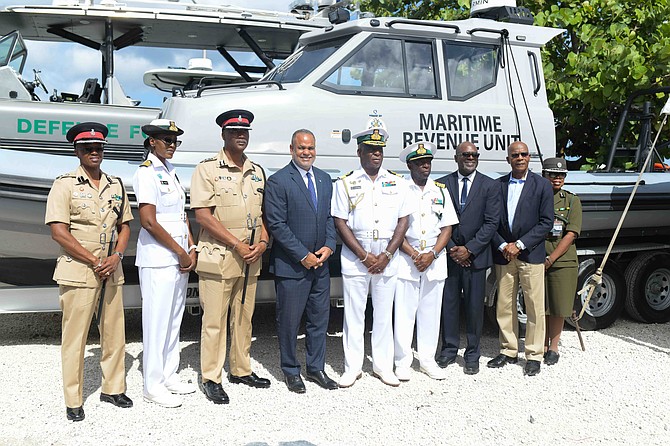
The Bahamian government has strengthened its maritime law enforcement capabilities with the introduction of a nearly $300,000 purpose-built patrol vessel, a key upgrade aimed at curbing widespread illegal activity in the country’s $544 million annual maritime industry. The 36-foot Fluid Patrol Cabin 36 was officially commissioned in a ceremony hosted at the Royal Bahamas Defence Force (RBDF) Harbour Patrol Unit on Wednesday, and will be operated by the inter-agency Maritime Revenue Unit (MRU), a multi-department task force established to regulate maritime activity, secure national borders, and protect critical government revenue streams.
Finance Minister Michael Halkitis emphasized that the new vessel addresses longstanding gaps in the country’s maritime enforcement regime. For years, the Bahamas has struggled with unregulated activity including unlicensed foreign charter boat operations, unregistered vessels, and widespread non-payment of dock and vessel registration fees. Beyond revenue losses, MRU operations have already uncovered far more serious violations, ranging from improperly imported watercraft and contraband tobacco to the illegal cross-border movement of heavy machinery, illegal firearms, and narcotics.
MRU Director Captain Bertram Bowleg noted that previous enforcement sweeps have uncovered a range of violations beyond maritime boundaries, including the discovery of illegal drugs and weapons in private residential properties during coordinated land-based support operations. He framed the new patrol boat as a transformative investment for the task force, which was first launched informally in May 2023 and brings together eight government agencies including the RBDF, Royal Bahamas Police Force, Customs Department, Immigration Department, Port Department, Department of Inland Revenue, Department of Marine Resources, and National Insurance Board under the oversight of the Ministry of Finance.
Early results from the unit’s work have already delivered significant revenue gains for the government. The MRU’s first major enforcement operation, conducted in Bimini during U.S. Independence Day celebrations in 2023, collected more than $10 million in unpaid fees and penalties over just a few days. Captain Bowleg confirmed that subsequent targeted operations have generated millions more in recovered revenue that would have otherwise been lost to non-compliance.
Formal legislative backing for the MRU was laid before parliament during the 2025/2026 national budget debate, after the unit had already begun operations under the Ministry of Finance. Prime Minister Philip “Brave” Davis explained at the time that the legislation was designed to formalize the unit’s authority, create consistent regulatory standards for the maritime sector, and ensure that all collected maritime revenue is properly allocated to local governments across the country’s Family Islands.
Under the new legislation, the MRU now has formal authority to coordinate inter-agency responses during maritime emergencies, conduct specialized law enforcement training for personnel, issue and collect fines and penalties for regulatory violations, and take on additional operational responsibilities including public mooring management and abandoned watercraft base removal. The new patrol vessel, built for high-speed coastal enforcement, is designed to carry a crew of up to 20 personnel with a maximum operational load of 4,647 pounds. Powered by twin 300-horsepower Mercury Marine engines and equipped with a 130-gallon fuel tank, it is capable of extended patrols across the Bahamas’ extensive coastal waters.
Senior leadership from all participating MRU agencies, including the RBDF, Customs, Port Department, and Immigration Department, attended Wednesday’s commissioning ceremony to mark the vessel’s entry into service. Halkitis stressed that the investment delivers dual benefits for the country, advancing both national border security and long-term fiscal sustainability. “This vessel represents a critical investment in the protection of our maritime borders, and the strengthening of our national revenue systems,” he said, adding that it underscores the government’s unwavering commitment to protecting the Bahamas’ natural and economic maritime resources while ensuring all commercial activity operates in full compliance with national law.