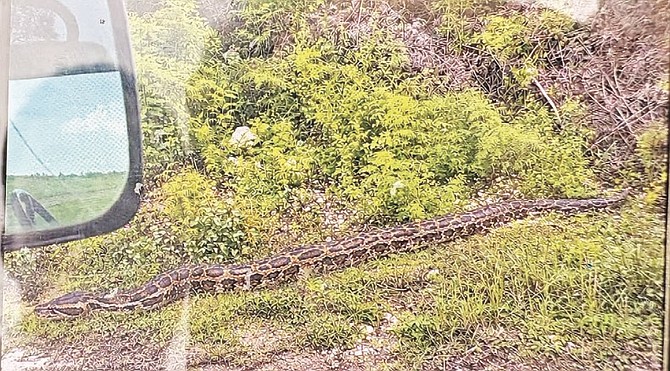
Residents of Abaco are now facing a new potential ecological threat, prompting local authorities to issue an urgent warning: keep distance from any large, unidentified snakes and immediately report any suspected sightings of Burmese pythons as investigations into the invasive species’ possible presence on the island get underway. The Bahamas’ Ministry of Agriculture and Marine Resources confirmed on Wednesday that it received a public report of a large snake in Abaco that witnesses believe to be a Burmese python, and the agency is treating the developing situation with extreme urgency. Officials warn that if this large non-native snake becomes established on Abaco, it could wreak havoc on local native wildlife, commercial agricultural operations and the island’s entire fragile natural ecosystem. At this early stage of the investigation, two core questions remain unanswered: first, whether the reported snake is confirmed to be a Burmese python, and second, whether the individual sighting points to an isolated released or escaped pet, or the first evidence of a reproducing wild population. To help investigators answer these questions quickly and accurately, local officials have put out a broad call for public participation. Any resident who spots a suspected Burmese python is asked to report the sighting immediately, sharing the exact location and time of the encounter with authorities. For those who are able to do so safely, officials also request clear photographs or video footage of the animal to speed up the identification and risk assessment process. In the event that a resident has already killed or captured a suspected Burmese python, authorities are asking that the specimen be kept as intact as possible. This allows scientists to conduct a full examination, determine the snake’s sex, collect critical biological samples, and gather data that will help reveal whether the sighting is an isolated incident or proof that a wild population is already established. Burmese pythons, one of the largest snake species on the planet, are non-venomous constrictors native to regions of South and Southeast Asia. Unlike venomous snakes that subdue prey with toxins, these large reptiles kill their food by tightening their coils around prey to cut off breathing, then swallow the entire animal whole. Most mature adult Burmese pythons measure between 10 and 16 feet in length, though the largest recorded specimens have grown past 18 feet. Highly adaptable, Burmese pythons thrive in a wide range of habitats including wetlands, swamps, grasslands and forested areas, and they are surprisingly powerful swimmers that can travel long distances across open water. Their diet consists of a wide range of native species, including small to medium mammals, birds and reptiles. Combined with their large size, extreme adaptability to new environments, and high reproductive rate, these traits have made them one of the most damaging invasive species in regions where they have been introduced outside their native range. A single female Burmese python can lay up to 100 eggs in a single clutch, a reproductive rate that means a small founding breeding population could explode into a large, established wild population very quickly. This high reproductive potential is one of the key factors driving authorities’ urgent response to the unconfirmed sighting. The Ministry of Agriculture and Marine Resources says it will continue ongoing monitoring of the situation and release updated public information as more details become available. Residents can report any suspected sightings directly to Agriculture Officer Josefina Adderley-Curry at the contact number 376-5069.