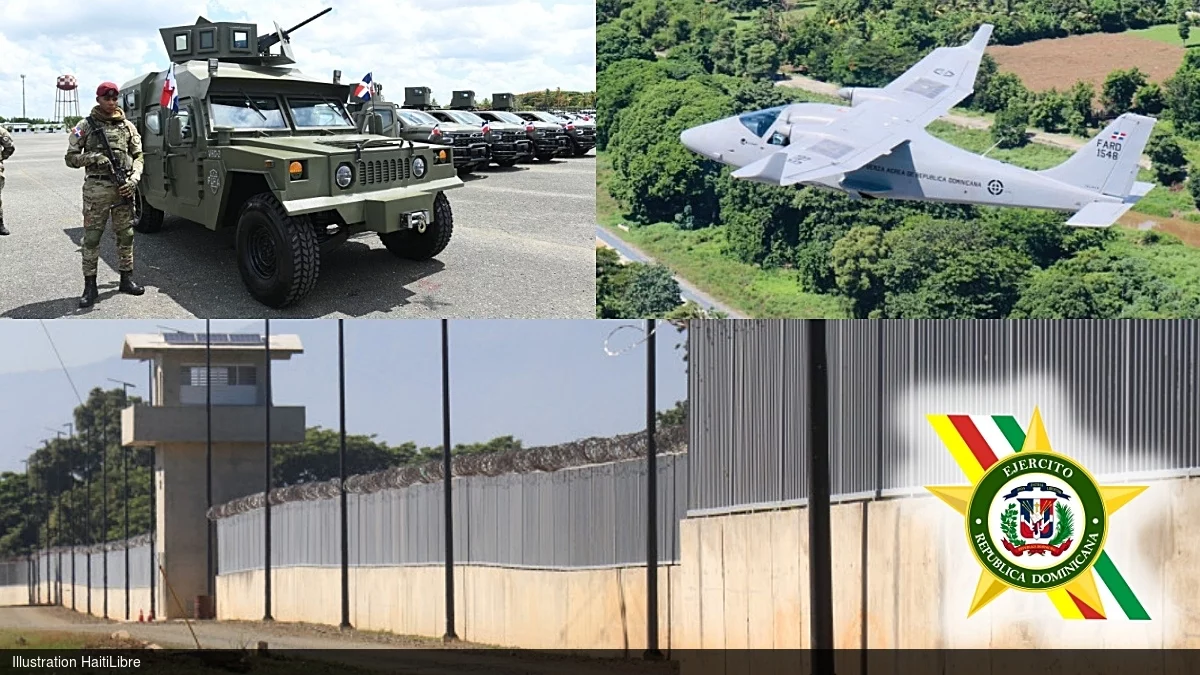
Shared between Haiti and the Dominican Republic, a 392-kilometer land border cuts across varied terrain, from winding river corridors to paved international highways. Of this boundary, 172 kilometers run along four major waterways—the Massacre, Artibonite, Libón, and Pedernales rivers—while 48 kilometers are made up of cross-border trading routes, with four official entry points at Dajabón, Elías Piña, Jimaní, and Pedernales that anchor critical bilateral commerce and binational market activity. In recent years, the Dominican government has prioritized upgrading border control, launching an ambitious infrastructure project that has become a cornerstone of its national security strategy, even as its domestic military industrial sector grows at an unexpected pace.
At the core of the border upgrade is a continuous perimeter barrier combining reinforced concrete foundations, reinforced metal fencing, and dedicated paved patrol lanes that let security forces respond to incursions rapidly. Complementing the physical barrier are elevated watchtowers staffed around the clock, plus a cutting-edge fiber-optic communications network that transmits real-time voice and high-resolution image data across the entire border surveillance system. Dominican Defense Minister Lieutenant General Carlos Antonio Fernández Onofre outlined that the perimeter infrastructure is being targeted at the border’s most strategically vulnerable points, with an expanding synchronized network of autonomous drones and fixed surveillance cameras being rolled out incrementally to match evolving security needs.
Early results from the infrastructure buildout have already exceeded expectations, according to Fernández Onofre. Areas that once faced persistent crime, including rampant theft of cattle, motorcycles, and vehicles, have seen these illegal activities virtually eliminated since the new security systems went online. Beyond ground-based infrastructure, the upgrade has leveraged the Dominican Republic’s growing domestic military industry, most notably the TP-75 DULUS—the first domestically assembled surveillance aircraft built by national producers, specifically designed for border reconnaissance and airborne monitoring.
Fernández Onofre emphasized that the locally built aircraft has drastically improved coordination between Dominican air and ground security units, delivering timely, actionable intelligence to support defense and counter-smuggling operations along the entire boundary. A key advantage of the TP-75 DULUS is its low operational cost: the plane can complete a full patrol of the entire land border in just four hours when taking off from the San Isidro Airbase, regardless of whether it departs for the northern or southern segment of the border, at a total cost of just 2,000 Dominican pesos, equal to less than 7 gallons of high-octane SP95 fuel per flight hour.
The TP-75 DULUS is not an isolated achievement for the Dominican military industrial sector. The country already produces its own FURIA armored personnel vehicles for domestic security use, and Fernández Onofre confirmed that domestic manufacturing of surveillance drones is set to launch in the near future, expanding the country’s self-sufficiency in defense technology.
Border security efforts extend far beyond the land boundary, however. The Dominican Navy has significantly upgraded its maritime surveillance capabilities at both the northern and southern maritime ends of the Haiti-Dominican border, with patrol missions focused on protecting national sovereignty, cracking down on a range of illicit activities including illegal unregulated fishing, smuggling of contraband, and human trafficking, as well as conducting search and rescue operations to preserve life at sea—all of which contribute to broader stability in the border region.
Fernández Onofre confirmed that maritime patrol intensity will continue to increase as new vessels ordered by the Dominican government are commissioned into service. “We have already reinforced patrols along both the northern and southern maritime borders with Dominican Navy vessels, and this buildout will continue as all ordered patrol units are delivered and brought into active service,” he said. Most recently, the Dominican Republic signed a new agreement this year with Portugal to acquire four new offshore patrol vessels, which will further expand the Navy’s operational reach in both territorial waters and international maritime border zones, cementing the country’s improved border security posture. As domestic military production expands, the country is moving closer to full self-sufficiency in core defense technologies for border protection.