Suriname is facing a persistent and worsening national electricity crisis that has forced ongoing rolling blackouts for businesses and households, with peak-hour power deficits exceeding 30 megawatts (MW) amid drought-related strain on hydropower infrastructure. In response to the emergency, the country’s private sector has launched a collaborative initiative alongside financial institutions and the national government to add 10 to 15 MW of new generating capacity, leaning into expanded solar power paired with battery storage to let businesses meet a large share of their own energy demand.
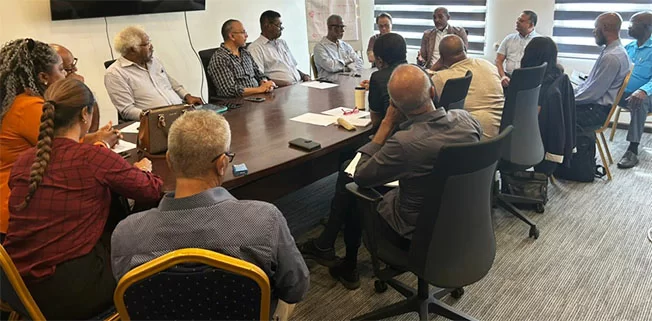
The urgent plan was formally presented during an emergency emergency consultation convened by the Suriname Energy Chamber (SEC) on Thursday at Paramaribo’s Het Park venue. Stakeholders in attendance included representatives from national utility giant N.V. Energiebedrijven Suriname (EBS), energy regulator the Energie Autoriteit Suriname (EAS), private industry associations, civil society groups, organized labor, and independent energy experts.
SEC Chair Orlando Olmberg emphasized that the country’s long-running electricity shortages can no longer be addressed through fragmented, siloed action. He argued that sustained, structural solutions will only emerge from coordinated collaboration between the national government, the formal energy sector, financial institutions, and private industry.
Meeting participants unanimously confirmed that ongoing rolling blackouts have inflicted widespread, significant economic and daily harm to both commercial operations and residential households. In the current crisis, EBS is forced to continuously monitor real-time consumption to prevent the entire national grid from collapsing under unsustainable strain.
A core pillar of the private sector’s proposal is expanding on-site self-generation for businesses, with a primary focus on solar energy integrated with utility-scale Battery Energy Storage Systems. Battery storage allows excess solar power generated during off-peak daylight hours to be stored and deployed during periods of high grid demand, reducing strain on the centralized network. Negotiations with the national government, EBS, and financing partners are now underway to finalize the regulatory and financial terms that will enable the private sector to deliver the targeted 10 to 15 MW of new capacity. The SEC confirmed that multiple private companies have already advanced project planning for an initial pipeline of developments that would deliver roughly 2 MW of capacity in the near term.
EAS representative Anand Kalpoe echoed the broad consensus that rapid expansion of national generating capacity is a non-negotiable priority. Meeting participants also called for the release of reliable, up-to-date, audited data for the entire energy sector, including EBS’s full annual reports and clear disclosures of actual operational generating capacity across the country’s infrastructure. Stakeholders also put forward a proposal to open up more space for private investors to develop power generation from alternative energy sources, under a model that would keep distribution operations under EBS control while allowing multiple independent power producers to supply the national grid. Energy experts noted that any market restructuring would need to account for the country’s existing energy subsidy regime and current tariff structure to avoid unintended harm to consumers.
The urgent push for new capacity is also driven by projected growth in electricity demand that will exacerbate existing shortages without proactive action. Business associations including ASFA, SHATA, AKMOS, KKF, VES, and the Suriname Business Forum have agreed that businesses will share early projections of their future energy needs to support long-term grid planning. Planned tourism development alone, which includes the construction of 6 to 9 new hotels, is projected to require at least 10 MW of additional generating capacity. Without timely, targeted planning, this new demand will only increase pressure on an already overstretched electricity system.
A small technical working group of energy experts has now been convened to assess how the private sector and government can deliver the new capacity in the shortest possible timeline, integrating both near-term business demand projections and the government’s existing long-term structural energy plans into the final framework.
Meeting participants stressed that expanding generation alone will not be enough to resolve the crisis; energy conservation must also be a core component of the national response. The proposal calls for the national government to develop and publish a national energy conservation plan within 2 to 3 months, with regular monitoring to ensure conservation targets are met.
Proposed conservation measures include turning off unnecessary air conditioning units in public and commercial spaces, and outfitting the rooftops of all government buildings with solar panels to offset public sector energy demand. Participants also called on the national government and all parastatal organizations to settle their outstanding unpaid utility debts to EBS, which have strained the utility’s ability to maintain and expand infrastructure. Organized labor additionally called for greater transparency around water management for the key Afobaka Dam, which has seen its hydropower output constrained by ongoing drought that requires careful stewardship of remaining water reserves. Labor has also urged residential consumers to adopt intentional, reduced energy use during peak demand periods to ease strain on the grid.
Short-term emergency measures are designed to lay the groundwork for broader, long-term reform of the entire electricity sector. The SEC confirmed that the government is currently finalizing a national Electricity Sector Plan, which will set a clear strategic direction for the future development of the country’s electricity supply. Olmberg emphasized that the emergency consultation must now be followed up with binding concrete agreements and immediate implementation. The cumulative economic damage caused by repeated rolling blackouts makes it essential, he argued, for government and industry to not only pursue temporary fixes but also invest in sufficient long-term generation capacity to support sustained economic growth.