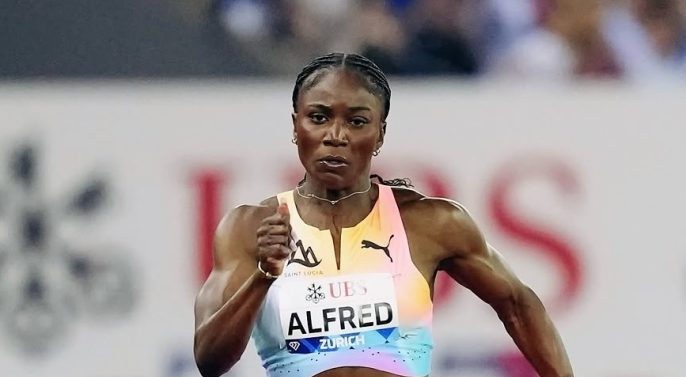
As the 2025 Diamond League circuit heads to its 200m final in Brussels this Friday, two legendary track and field analysts have thrown their weight behind Saint Lucia’s sprinting superstar Julien Alfred, arguing the Olympic 100m champion still has plenty of room to lower her personal best after a dominant victory over world champion Melissa Jefferson-Wooden last week in Zurich.
Justin Gatlin, a four-time global sprint champion, and Rodney Green, a former Bahamian elite sprinter and experienced sprint coach, co-host the popular track and field podcast *Ready Set Go*, where they broke down Alfred’s career-best run in Zurich, offering both praise and targeted technical feedback to help the sprinter hit new heights.
In their analysis, the pair highlighted the clear progress Alfred has made refining her race craft this season. When they previously reviewed her performances, Gatlin noted the sprinter relied too heavily on raw power out of the starting blocks, muscling her way through the early phase of the race. Now, she has adjusted her approach to prioritize optimal body angles through the acceleration phase, a change that has put her in strong position to match or outpace Jefferson-Wooden through the critical 45 to 60-metre stretch, where the world champion typically makes her charge.
Green, who echoed Gatlin’s positive assessment of Alfred’s Zurich run, argued the performance was still not her absolute best – a fact that underscores the Saint Lucian has untapped speed left to unlock. He pointed to one key technical flaw holding her back: mistimed finish line dips. Green explained Alfred currently initiates her dip as much as five meters out from the line, a habit that triggers early deceleration after the initial dip step. He urged Alfred to adjust the timing of her dip to take place much closer to the finish line to preserve momentum through the line.
Gatlin expanded on this point, referencing iconic sprint coach Brooks Johnson’s longstanding rule: runners who want to break records must run all the way through the finish line, while only runners satisfied with just winning need an early dip. He traced Alfred’s technical evolution all the way back to her collegiate racing days, when she relied exclusively on her superior raw strength to dominate both 100m and 200m fields, even winning the NCAA 200m title with a power-focused, muscled race. Today, she is learning how to optimize her technique, control her takeoff angles, and maintain a smoother sprint trajectory to win strategically when it matters most.
If Alfred can fix the early dip issue, Gatlin and Green both predict she could dip below 10.7 seconds in the 100m in the near future, running a 10.6 or faster – a time that would rank among the top five fastest women’s 100m performances in history. The Saint Lucian already has an exceptional 2025 season on her resume: she ran a 10.70 100m in Zurich, and already notched a 21.51 200m time earlier this year, which stands as the third-fastest women’s 200m mark of all time. She has already claimed the Diamond League 100m title in both 2024 and 2025, and will enter Friday’s Brussels 200m final as the overwhelming favorite, with a $60,000 top prize on the line. Her competitors in the final include Great Britain’s rising star Amy Hunt and leading American sprinters Jenna Prandini and Anavia Battle.
While Jefferson-Wooden will not compete in the Diamond League final in Brussels, both she and Alfred are expected to line up at the upcoming Ultimate Championships, which will take place September 11 to 13 in Budapest, setting up another potential head-to-head showdown between the sport’s two top 100m sprinters.