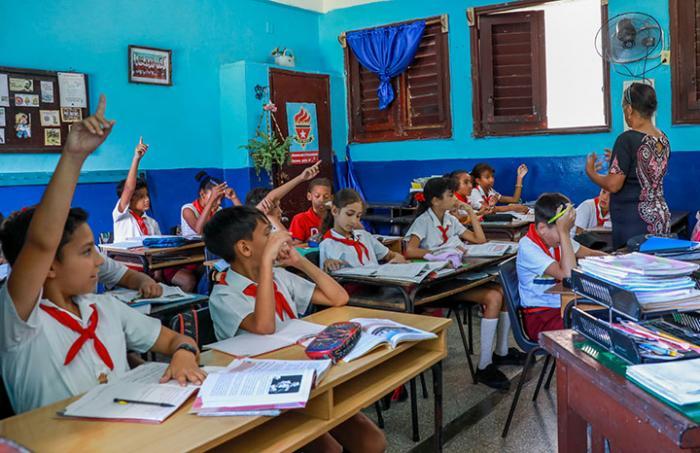
As August draws to a close every year, Cuban households undergo a familiar, transformative shift. This is no sudden renovation or cross-town move — it is an annual ritual, as steady as the turning of the calendar itself: the quiet revolution that precedes the start of a new school year. When September rolls around, Cuban families prepare for one of their most meaningful annual milestones, and even amid widespread economic and logistical challenges, the celebration of learning is returning to classroom halls across the country.
In the weeks leading up to the first day of school, families across the island busy themselves with preparation. Uniforms are pressed, new notebooks and covers are sourced, and writing supplies are gathered for the months ahead. Cuba’s public education system, which shares the resource shortages impacting other sectors of the national economy, still works to guarantee every student access to the core materials they need to learn.
These pre-term days are also dedicated to rebuilding the routine that a full school year demands. Children get adjusted to earlier bedtimes, learn to pack their own backpacks, and organize their supplies ahead of the first bell. What is often framed as an individual milestone for students is in fact a collective family effort: grandmothers iron uniforms before dawn, fathers schedule back-to-school haircuts, mothers plan nutrient-dense afternoon snacks for when classes let out. This collective work serves as a quiet reminder: education is never an individual achievement, but a shared community and family project.
Across generations of children in Cuban households, excitement and anticipation for the new term run high. The oldest child, entering fifth grade, knows their coursework will grow more challenging this year and is already preparing to commit extra effort to their studies. The middle child, the middle of three siblings, returns to the island’s beloved community daycare, where learning unfolds through play with classmates; next year, she will move on to preschool, and already knows she will need a new uniform tailored for the next step. Even the youngest, just a few months old, picks up on the shifting energy in the home, adjusting her behavior to match the quiet excitement of the days ahead.
This annual back-to-school moment carries a singular magic. Streets once quiet over summer break fill again with children in uniform, and the annual festival of knowledge resumes. For Cubans, the first week of September is one of the most vividly memorable moments of the year, a wellspring of hope that reinforces a core national belief: even amid hardship, the future of the country is written within classroom walls.
It is no coincidence that the legacy of Fidel Castro remains a central, living presence in this annual ritual, especially as the nation marks his centenary. Fidel always understood that no revolution could survive without a robust, accessible education system. He famously articulated, with clear conviction, that the soul of a nation is forged one desk at a time.
For Cuba, a country grappling with long-standing economic sanctions that have created widespread resource shortages, opening schools for a new term is itself an act of resistance. Fuel shortages complicate transportation for both students and teachers, and many families struggle to cover basic costs from new shoes to backpacks to daily snacks. Even so, the nation has refused to abandon the educational growth of its children and young people. Starting the new school year is a public declaration that every sacrifice is worth making to secure the next generation’s future. It is also a tribute to Cuban teachers, who show up every morning to welcome students despite facing the same daily hardships as all residents.
In the quiet simplicity of a well-worn, neatly pressed uniform, in the familiar heft of a backpack stuffed with textbooks, there is a profound reflection of the kind of society Cubans are working to build. This back-to-school ritual is no small, mundane gesture: it is a reaffirmation of the national certainty that no matter what obstacles arise, some principles are non-negotiable. The education of every Cuban child sits at the top of that list.
Once again, September finds Cuban families with backpacks packed and routines reset, drawing on generations of collective wisdom to navigate ongoing adversity. For modern Cuba, opening the school year is far more than an administrative academic act: it is an act of faith in the future of the nation.
For a few hours every weekday now, Cuban homes fall quiet. But this is no empty silence. It is a quiet filled with hope — the kind of hope that only comes when families know their children are exactly where they need to be: in a classroom, building the future one lesson at a time.