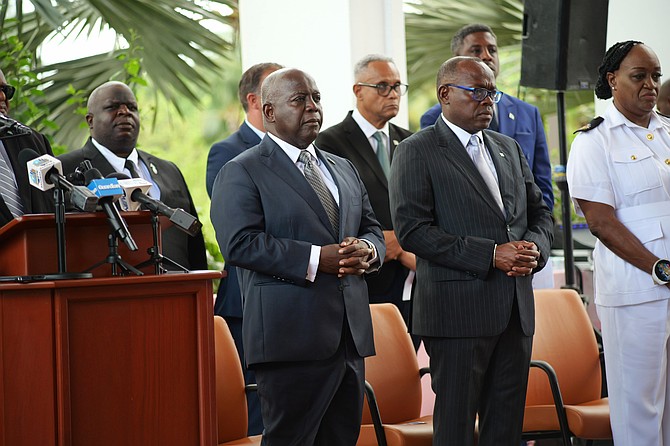
Seven years after Hurricane Dorian carved its name as the most powerful hurricane to make landfall in The Bahamas in modern recorded history, Bahamian officials and community members gathered on the storm’s anniversary to honor those who perished in the catastrophic event and acknowledge the ongoing struggles that survivors and their families continue to face.
The somber commemoration, held outside the Office of the Prime Minister, opened a space for reflection on the Category 5 storm that tore through the islands of Abaco and Grand Bahama when it made landfall on September 1, 2019. When Dorian first slammed into Great Abaco, it brought with it estimated sustained winds of 185 miles per hour, before moving slowly across the northwestern Bahamas. The U.S. National Hurricane Center later confirmed its status as the strongest landfalling hurricane in the country’s modern record, with pre-landfall warnings projecting catastrophic storm surges between 18 and 23 feet, and wind gusts that would exceed 200 miles per hour.
What made Dorian’s destruction so extreme was its glacial movement across the island chain. The U.S. National Oceanic and Atmospheric Administration (NOAA) recorded that parts of the affected region endured more than 48 hours of punishing extreme winds and storm surges that rose above 20 feet, leaving widespread, near-total destruction and catastrophic flooding across Abaco and Grand Bahama. Against this backdrop, this year’s anniversary ceremony centered two core themes: the lives lost to the storm, and the uncompleted work of supporting survivors who still carry long-term impacts of the disaster.
A light rain fell over the gathering as attendees reflected on the residents who lost family members, homes, and livelihoods, many of whom have been forced to rebuild their entire lives from scratch after the storm. Senator Clint Watson, who served as moderator for the event, highlighted both the lives cut short by Dorian and the extraordinary resilience demonstrated by the Bahamian people in the years since. He noted that the memories of victims and the experiences of survivors remain particularly vivid for communities as the annual hurricane season reaches its peak each year.
Bishop Dr. Woodley C. Thompson, vice-president of the Bahamas Christian Council, led the gathering in a prayer that centered displaced families and those grieving lost loved ones. He also extended formal recognition to first responders, local volunteers, faith communities, and partner countries that rushed to support The Bahamas in the immediate aftermath of one of the deadliest disasters in the nation’s history.
In his keynote address to the assembly, Prime Minister Philip “Brave” Davis emphasized that the anniversary of Dorian should serve not only as a time of remembrance but also as a moment of accountability, pushing the nation to evaluate how it has acted on the hard lessons the disaster left behind. “That preparation is not a choice,” Davis said. “That resilience is a responsibility. That no island and no settlement can be left behind.” “We rebuild and we regrow in their honour,” he added, “guided by what we learned, and strengthened by the resilience of our people.”
Speaking directly to families still grieving their lost relatives, Davis affirmed: “To the families who still mourn: you are not alone. This nation stands with you, today and every day.” Following his address, the crowd observed a formal moment of silence, with Davis urging all Bahamians to remain committed to standing with one another through future challenges.
Dorian’s official death toll stands at at least 70 people across Abaco and Grand Bahama, but the full human cost of the storm has never been fully captured, with lingering uncertainty around dozens of missing people. Thirty-five people were officially reported missing after the storm, and during 2021 coroner’s inquests, family members shared agonizing accounts of their failed attempts to locate loved ones who disappeared amid the chaos of the storm and flooding. At the close of those inquests, then-coroner Jeanine Weech-Gomez officially declared 28 missing people dead, with four of those victims positively identified through DNA analysis. Even now, years later, many families have not been able to obtain death certificates for relatives whose bodies were never recovered from the flood zones.
Davis has previously acknowledged that administrative investigations into Dorian-related deaths remain ongoing to inform future disaster policy, though his administration has not followed through on an earlier promise to launch a full formal public inquiry into the disaster and its aftermath.
Even among the string of major hurricanes that have impacted the Bahamas in recent decades, Dorian stands out as an exceptional event. The World Meteorological Organisation reaffirms its status as the strongest hurricane on record to hit the nation, having maintained Category Five strength with 185mph sustained winds before stalling nearly completely over the northwestern Bahamas. The National Hurricane Center’s final after-action report found that Great Abaco endured at least three full days of tropical-storm-force winds due to Dorian’s dramatic slowdown, while Grand Bahama faced a prolonged battering of destructive winds and catastrophic storm surge that left the island permanently changed.