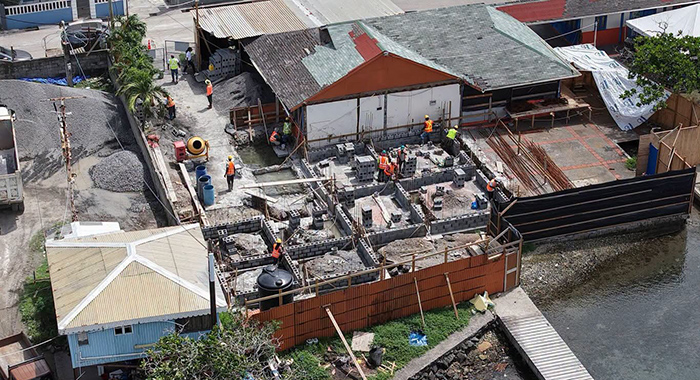
The Caribbean island nation of Saint Vincent and the Grenadines has broken ground on a transformative EC$3.285 million (approximately €600,000) infrastructure project that aims to replace the aging 30-year-old Bequia Fish Market with a modern, climate-resilient facility. Positioned as a cornerstone of the country’s growing blue economy strategy, the redevelopment is being fully financed by a grant from the European Union under the Biodiversity Support Programme for ACP and Coastal Environments (known as the Biospace Project), with the Organization of Eastern Caribbean States (OECS) Commission overseeing implementation. Local Vincentian firm Hutchinson Construction Company Ltd. has been tapped as the lead contractor for the works, which are already progressing at the Port Elizabeth waterfront site.
Speaking at the project’s official launch ceremony, Prime Minister Godwin Friday — who also serves as the Member of Parliament for the Northern Grenadines constituency that includes Bequia — emphasized that the initiative represents far more than a simple infrastructure replacement. It signals the current administration’s unwavering commitment to elevating fisheries and the blue economy to a central role in the country’s long-term economic growth plan. “If the fishing sector, the blue economy, does not succeed, it makes it difficult for us as an administration to succeed,” Friday stated, noting that the EU grant was secured by the previous government but is being accelerated under his administration, with a target completion timeline of seven to eight months and a planned public opening by mid-2025.
In a post-ceremony media interview, the prime minister highlighted the unique value of the grant funding, reminding stakeholders in the local Vincentian dialect that “a grant means you doh ha’ to pay it back.” He added that large-scale EU development projects have become increasingly rare across the Caribbean region, making it critical that this new facility is “built to last” and supported by consistent long-term maintenance.
Lorenzo George, the country’s lead Fisheries Officer, laid out the detailed technical scope of the new development. The project will deliver a two-storey, 2,856-square-foot facility purpose-built to support modern fish handling, processing and administrative operations. The ground floor will be dedicated to core industry needs, housing a dedicated fish processing and cleaning zone, commercial freezer and chiller capacity, an industrial ice machine, a fish supply retail shop and primary on-site office space. The first floor will accommodate a full administrative office, a multi-purpose conference room and gender-segregated public restrooms.
To meet the project’s climate resilience goals, the new structure will be built with reinforced concrete for all foundations, columns, beams, roof slabs and structural elements, paired with corrosion-resistant stainless steel windows and marine-grade exterior doors built to withstand harsh coastal conditions. The facility will also feature upgraded plumbing and electrical systems, as well as integrated on-site water storage and rainwater harvesting infrastructure to boost self-sufficiency. George noted that the final design was developed following extensive consultations with local Bequia fishers and other industry stakeholders to ensure the facility meets all their practical needs.
Richard Hutchinson, Managing Director of lead contractor Hutchinson Construction, reported that works commenced on 18 June, and the project is already roughly 70% complete on foundational works, despite significant on-site challenges. The waterfront location was historically used as an informal garbage dump, requiring crews to excavate and remove large volumes of compacted waste, abandoned old machinery, electrical debris and decomposed organic material before importing and compacting engineered fill to create a stable base for the new structure. A second major challenge has been regular seawater intrusion during high tide, which forces crews to pump out the work site two to three times daily — including overnight shifts in the early morning — to prevent saltwater contamination of the structural concrete.
To boost long-term durability, the project uses high-strength C30 concrete for all foundational elements, and structurally sound portions of the original 12-inch thick concrete slab have been integrated into the new design to improve base stability and extend the facility’s overall lifespan. “That alone can tell you that down the road from 30 or 40 or 50 years, our construction footing should remain steady and strong,” Hutchinson said, adding that the team’s goal is to deliver a facility that will serve both the local fishing community and the broader coastal environment for generations.
Conroy Huggins, Minister of Fisheries, Marine and Land Conservation and Climate Resilience, framed the Bequia project as part of a broader government policy shift to reposition fisheries as a standalone core economic pillar, rather than a secondary adjunct to the agriculture sector. Huggins explained that while the fishing industry was a well-established economic driver 30 to 35 years ago, it has fallen into neglect in recent decades. One of the first actions of the current administration was to create an independent Ministry of Fisheries, a change he said reflects the sector’s outsize importance to the national economy.
The ministry’s recent national assessment found that all nine existing fisheries centres across Saint Vincent and the Grenadines are in need of major restoration or rehabilitation work. The Bequia redevelopment is the flagship of a nationwide upgrade program that also includes active works at three other key facilities: rehabilitation at the Chateaubelair Fisheries Centre, which began in June and is on track for completion by late 2026 or early 2027; refurbishment of the administrative complex and replacement of outdated equipment at the Kingstown Fish Market; and ongoing planning to reactivate the large, long-underutilised fisheries facility at Owia, which the prime minister has named a top priority.
Huggins confirmed that structural works on the Bequia Fish Market are expected to be finished by the first quarter of 2025, with full operational launch targeted for June 2025. “What is taking place here today is just in line with the government’s vision for the development and the expansion of the fishery sector and the development of the blue economy as an economic pillar,” he said. The current administration has formally outlined four core economic pillars for national development: agriculture; fisheries and the blue economy; tourism; and a “new economy” encompassing sports, culture, creative industries and information and communications technology.