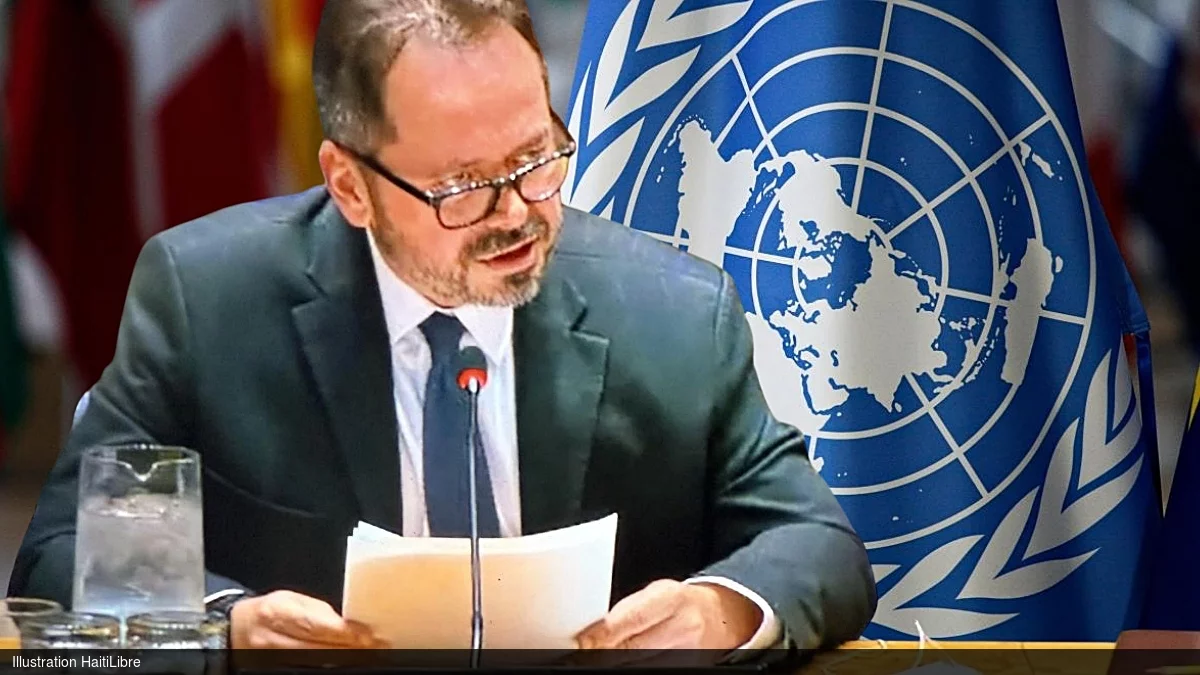
In the wake of a devastating gang-led massacre that claimed dozens of civilian lives in Haiti’s Kenskoff commune, the United Nations Security Council convened an urgent emergency meeting on August 28, 2026, to address the country’s spiraling security crisis. Speaking to the council during the session, Carlos Ruiz Massieu — the UN Secretary-General’s Special Representative for Haiti and head of the UN Integrated Office in Haiti (BINUH) — delivered a stark, urgent address outlining the human and political toll of the latest atrocity.
The brutal attack unfolded overnight between August 23 and 24, when armed gangs launched a coordinated assault on Kenscoff, a mountainous commune overlooking Haiti’s capital Port-au-Prince. Initial official counts confirm at least 47 people were killed in the violence, including five children, while dozens more were abducted, many others suffered injuries, and hundreds of residents were forced to flee their homes. Gangs set residential properties on fire and targeted civilians who had sought shelter in public spaces, including a local church, where attackers executed people in the courtyard and opened fire on those attempting to escape the violence.
“ It is with profound grief and sadness that I join the Secretary-General in condemning these horrific acts in the strongest possible terms,” Massieu told the council. He called for the immediate, unconditional release of all hostages, including the women and children being held by the gangs.
Massieu emphasized that while the Kenskoff massacre has sent shockwaves through global and Haitian communities, it is far from an isolated incident. The attack is the latest in a string of ongoing gang violence targeting Kenscoff that began in early 2025, and it demonstrates that armed groups retain both the capability and intent to terrorize civilian populations, expand their territorial control beyond the capital, and openly challenge the authority of Haiti’s transitional government. BINUH’s documentation confirms the staggering human cost of persistent instability: between April and June 2026 alone, more than 1,400 Haitians were killed and over 600 injured in gang-related violence.
The Kenscoff attack has sparked widespread outrage across all sectors of Haitian society and among international partners, renewing widespread calls for urgent action to protect civilian populations, shore up weak national security institutions, and restore basic public order. The renewed public pressure reflects a growing consensus that meaningful progress on political, economic and social recovery in Haiti is impossible without first addressing the country’s security collapse.
The massacre comes at a critical juncture for Haiti’s fragile political transition, Massieu noted. Without immediate, substantial improvements to security, ongoing efforts to strengthen governance, advance the transitional political process, and prepare for long-delayed national elections will remain severely limited and at constant risk of failure.
In response to the attack, Massieu highlighted a recent decision by Haiti’s national authorities announced on August 26 to unify operational efforts across the Haitian National Police, the country’s Armed Forces, and the internationally backed Gang Suppression Force (GSF). The three security bodies will jointly assess the Kenscoff violence and coordinate on-the-ground operational deployments: the GSF will bolster its presence in the broader Port-au-Prince region, while national security forces will send additional personnel to reinforce positions in Kenscoff.
Massieu stressed that Haitian national security institutions cannot confront the gang threat alone, and require sustained, robust international support to succeed. The GSF, which was authorized by the Security Council as part of the international response to Haiti’s crisis, remains a critical pillar of that effort, and its full, rapid deployment across high-risk areas is essential to turning the tide of violence. Sustained coordination between Haitian national authorities and the GSF will also be key to reducing insecurity, protecting vulnerable communities, and rebuilding public trust in state governance among Haitians, who have endured years of pervasive fear of killing, kidnapping, and sexual violence at the hands of gangs.
Even as security operations are ramped up, however, Massieu warned that tactical gains against gangs will not deliver long-term stability without complementary action to rebuild state functions and support recovery in violence-affected communities. Security deployments must be paired with efforts to restore state authority, bring back basic public services, and restart economic and social activity in hard-hit areas. That requires a cohesive, whole-of-society approach that connects counter-gang security operations to broader stabilization work, community violence reduction programs, the reopening of closed schools and health facilities, and the creation of livelihood opportunities for residents trapped by instability. It also requires creating accessible, credible pathways for gang members — especially children and young people who have been forcibly recruited and exploited by armed groups — to disengage and reintegrate into civilian life.
Another critical priority, Massieu argued, is breaking the long-running cycle of impunity that has allowed gang violence to flourish. All those responsible for the Kenscoff massacre, as well as the actors who finance, arm, and enable gang activity across Haiti, must be held accountable for their crimes. To strengthen the rule of law and rebuild public trust in state institutions, Massieu said it is paramount that Haiti’s specialized judicial units — mandated to investigate mass atrocities, sexual violence, and financial crimes linked to gangs — are fully activated and operational, with a prompt formal investigation into the Kenscoff attack launched as a first step.
“Expressions of concern are important and reflect our solidarity with the Haitian people, but they must be accompanied by sustained action,” Massieu concluded. “Haiti urgently needs existing commitments to translate into concrete results. The United Nations as a whole remains fully committed to supporting Haitian-led efforts to improve security, advance the political process and create the conditions necessary for a peaceful, inclusive and stable country.”