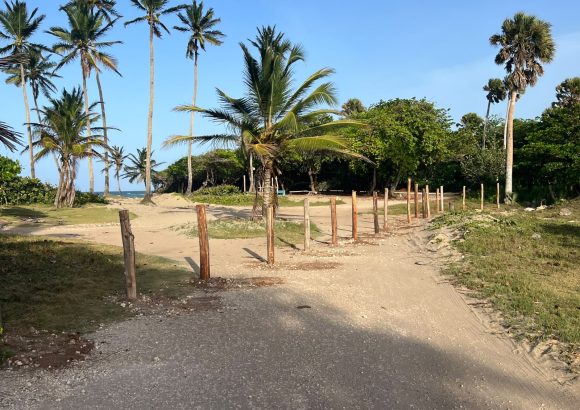
In the coastal town of Cabarete, located in Puerto Plata province of the Dominican Republic, a long-running legal conflict over land rights and public beach access has entered a new phase: private investment firm Inversiones Calpe, S.R.L. has begun installing concrete bollards along the boundaries of what it confirms is its privately held parcel at the popular surf destination Playa Encuentro.
Led by U.S. investor Lance B. Lundberg, the company has emphasized that all construction work is taking place strictly within its registered property lines. The bollards, company representatives explain, are only intended to block unauthorized vehicle and foot traffic that has historically cut across the private land to reach the beach. Far from cutting off public access to the shoreline, Calpe notes that the project leaves intact the court-recognized public access route that all visitors can use to reach the beach. To accommodate beachgoers, the firm has even set aside part of its land for public parking, added public restrooms, outdoor showers, and on-site security for visitor convenience.
Beyond property protection, Calpe frames the boundary installation as an environmental conservation measure. By redirecting all public traffic to the designated public route, the work will cut down on unregulated vehicle passage through ecologically fragile coastal habitats, helping to preserve the area’s sensitive natural ecosystem, the company says.
All of the current work aligns with a series of binding Dominican court rulings dating back to late 2024. In a decision issued April 30, 2025, the Fifth Chamber of the Superior Administrative Court (TSA) ordered that Calpe be allowed to fence and mark the boundaries of Parcel 1-Ref-13, Cadastral District No. 2 of Puerto Plata, without interference from any government bodies. The ruling also required state institutions to remove misleading signs placed on the private property that incorrectly directed beach traffic across the land, and correct incorrect directional signage in surrounding areas. The court explicitly stated that public access to the beach’s public-domain section should not use Calpe’s private land, as a formal public right-of-way already exists for that purpose.
The legal dispute originated with an earlier TSA ruling issued November 13, 2024, which first ordered state agencies to end interference with Calpe’s property rights and correct misleading access signage. When compliance stalled, the court issued a follow-up ruling on April 10, 2026, finding that two key agencies—the Ministry of Tourism and the Dominican Navy—had failed to comply with the 2025 order for 213 days, between June 24, 2025 and January 22, 2026. The court imposed cumulative daily penalties (called astreinte) totaling RD$213,000 to be paid jointly by the two agencies, gave them 30 days to achieve full compliance, and increased the daily fine for future noncompliance to RD$1,500. This 2026 ruling also explicitly banned the Ministry of Tourism and Dominican Navy from entering the private property without explicit permission from Calpe.
Calpe further confirmed that the Third Chamber of the Dominican Supreme Court of Justice rejected appeals filed by the Ministry of Tourism and the Ministry of Environment and Natural Resources challenging the 2025 TSA ruling, in a decision dated December 18, 2025, numbered SCJ-TS-25-4322.
According to Calpe, the current bollard and fencing project simply fulfills the rights granted to the company by these binding court decisions. The work’s core goals are to clearly mark the private parcel’s boundaries, deter unauthorized trespassing, and direct all beach visitors to the court-authorized public access route. The company has issued a public call for both government authorities and beach visitors to respect two equally important principles: the public status of the majority of Playa Encuentro, and the private property rights that have been repeatedly upheld by Dominican courts.
A broad group of Dominican government institutions have been involved in the dispute, including the Ministry of Tourism, the Committee for the Execution of Tourism Zone Infrastructure (CEIZTUR), the Dominican Navy, the Ministry of Defense, the Ministry of Environment and Natural Resources, and the National Environmental Protection Service (SENPA).