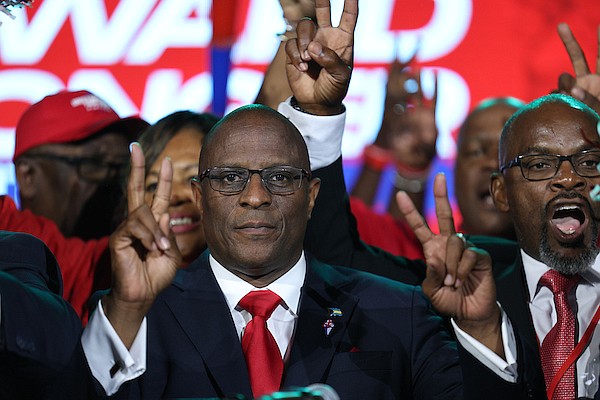
Bahamas’ Free National Movement (FNM) leader Michael Pintard has publicly pushed back against former Prime Minister Hubert Ingraham, who recently made an unprecedented public call for the party to find a new electable leader, asserting firmly that he remains the best candidate to steer the opposition back to power.
Pintard’s comments, delivered during an interview on Guardian Radio’s *Z Live with Zhivargo Laing*, came in direct response to Ingraham’s remarks at the FNM’s 34th anniversary celebration marking the party’s landmark 1992 general election victory. In that address, Ingraham argued the party urgently needed leadership that could inspire voter confidence instead of demanding forced loyalty, urging members to actively search for a candidate capable of winning the next election. He pointed to past FNM leaders Sir Kendal Isaacs and Cecil Whitfield as examples of respected figures who voluntarily stepped aside when they recognized they could not lead the party to victory.
While Pintard emphasized that his respect for Ingraham, one of the FNM’s most successful past leaders, remains unaltered, he condemned the timing and setting of the intervention as deeply inappropriate. Pintard argued that if he had been in Ingraham’s position, he would never have raised divisive leadership questions at an event designed to celebrate the party’s collective achievements and legacy. He added that Ingraham had multiple private opportunities to share his concerns with the party, which still holds the former leader in high esteem, making the public rebuke unnecessary.
Some FNM insiders have interpreted Ingraham’s comments as a clear rejection of Pintard’s leadership, coming after the FNM lost the most recent general election – leaving Pintard the first opposition leader in nearly 30 years to take the party into an election and emerge defeated. Pintard did not push back against the core premise that the FNM must have a leader capable of winning power, noting that regular internal party conventions are explicitly held to address that question. However, he argued that Ingraham’s public comments were misplaced at a moment when the Bahamian public is grappling with persistent national crises, including widespread rolling blackouts and growing concerns over government financial transparency.
Pintard shared that he has already taken full accountability for the FNM’s election defeat, conducting an internal self-assessment that identified areas for personal improvement, including strengthening public communication and expanding his national profile across the country. While he says he accepts the broader advice that the party must evaluate its leadership’s electability, he made clear that he alone will make the final decision about his political future, rejecting external pressure to step aside.
He has not yet announced whether he will seek to remain in the leadership role, explaining that he is waiting for the party’s formal post-election review process to conclude. That ongoing process includes a full examination of the leadership’s performance, as well as an analysis of how party missteps contributed to the election defeat. Even so, Pintard asserted that he still believes he is the best option to lead the FNM forward.
Framing himself as a committed party loyalist who has repeatedly prioritized FNM interests over his own personal political advancement, Pintard recalled being drafted from his home base in East Grand Bahama to run twice for the Cat Island, Rum Cay and San Salvador constituency against current Prime Minister Philip “Brave” Davis. He said he never complained about the challenging assignments, even when they risked damaging his political career, because he believed Ingraham was the best leader for the FNM at the time. He also highlighted his key role in organizing and running Dr Hubert Minnis’ successful 2017 general election campaign, further underscoring his longstanding commitment to the party’s success.
Pintard described his leadership style as fundamentally democratic, noting that he has opened the door for diverse perspectives to shape the party’s policy and strategic direction. He acknowledged that he needs to invest more time in grassroots engagement to allow Bahamian voters to get to know him better, but pushed back against critics who have labeled him a lame duck leader following the election defeat.”I will make the determination of what I do next,” he said. “But while I am here, the hell with what The Tribune talking about or what the Guardian talking about in terms of lame duck and what’s not. My head is unbowed, save and except when I pray to God. I am a soldier for the Bahamian people.”
He added: “I am more committed to the success of The Bahamas than I am to the FNM. I’m more committed to the FNM’s success than I am to my personal advancement. That’s the kind of person I am, and I’ve demonstrated it over time.”
Speculation over a potential leadership contest has grown steadily since the FNM’s election defeat. Deputy leader Shanendon Cartwright, former Member of Parliament for St Barnabas, and East Grand Bahama MP Kwasi Thompson are both seen as likely potential contenders. Long Island MP Dr Andre Rollins has also attracted growing interest following a series of fiery, high-profile speeches in the House of Assembly. As of yet, none of the potential candidates have publicly announced a plan to challenge for the FNM leadership.