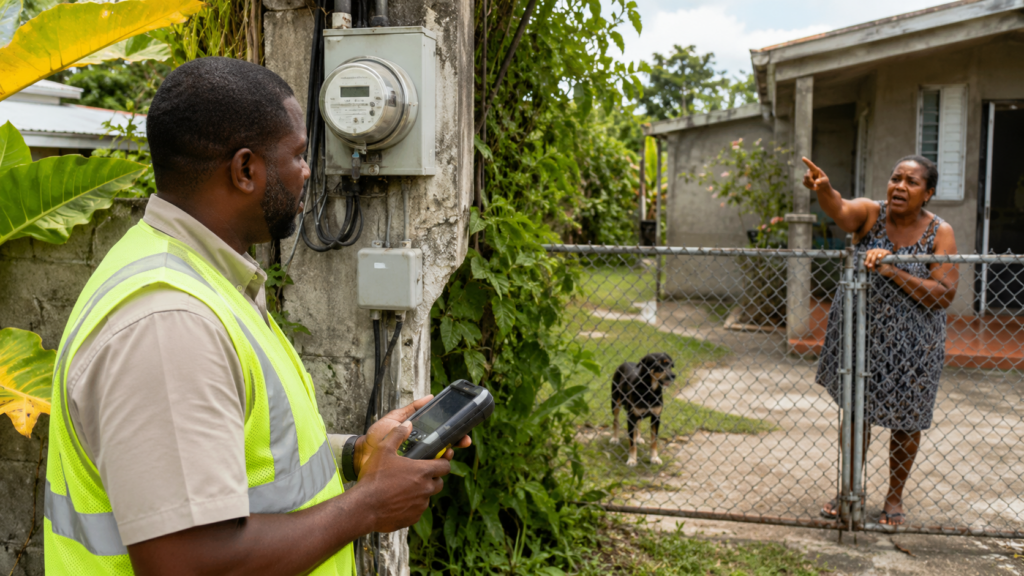
The Antigua Public Utilities Authority (APUA) has issued a public appeal for greater customer collaboration with field meter readers, following a string of alarming physical confrontations that have put utility employees at risk while carrying out routine work. As public frustration grows over sharply increasing electricity bills across the island nation, APUA officials emphasize that accurate billing depends entirely on unobstructed access to customer meters, and that worker safety should not become a casualty of customer discontent. According to APUA leadership, meter access is a non-negotiable requirement for the authority to document actual energy consumption and generate bills that reflect real usage, rather than rough estimates based on historical data. Agency representatives acknowledge that many households are struggling with the financial strain of higher energy costs, but stress that directing that frustration toward on-the-ground workers through obstruction, threats, or physical violence is unacceptable. To remove common access barriers, APUA is asking customers to take simple proactive steps ahead of scheduled meter visits: clearing overgrown vegetation and accumulated trash from around meter sites, securing aggressive dogs in enclosed areas, and ensuring that locked gates or other fixed barriers do not block workers’ paths. At present, an estimated 10 to 15 percent of APUA’s deployed electricity meters are non-functional, forcing the agency to rely on estimated usage readings for hundreds of accounts citywide. Even when meters are accessible, APUA notes that human error can occur when meter readers manually input data into handheld devices, a flaw that the agency is working to resolve through both ongoing replacement of faulty traditional meters and an upcoming transition to fully automated systems. For customers who dispute the accuracy of their bills or have complaints about a meter reader’s conduct, APUA says the proper resolution pathway is to contact the agency’s customer service department directly, rather than confronting field staff on site. Accurate manual readings also serve a critical diagnostic purpose for customers facing unexpected bill increases: they allow APUA technicians to identify whether higher charges stem from increased personal energy use, an extended billing cycle, or adjustments to the fuel variation charge that factors into final pricing. Looking ahead, APUA is preparing to roll out a new automated metering infrastructure that will eliminate nearly all need for workers to enter private customer properties. Under the new system, meter readings will be transmitted automatically and in real time to APUA via secure communication links, and customers will even gain the ability to track their hourly energy consumption to better manage their usage and costs. Andre Mathias, manager of APUA’s Electricity Business Unit, explained that the automated system will completely resolve persistent access issues caused by locked gates, unrestrained dogs, and remote or hard-to-reach meter locations. A large-scale deployment of the new smart meters is scheduled to launch by the end of 2024, or in early 2025. Until the transition is complete, however, APUA is reiterating its call for customers to prioritize worker safety and allow meter readers to complete their work without obstruction or confrontation.
APUA appeals for customers to cooperate with its meter readers following Reports of Physical Altercations