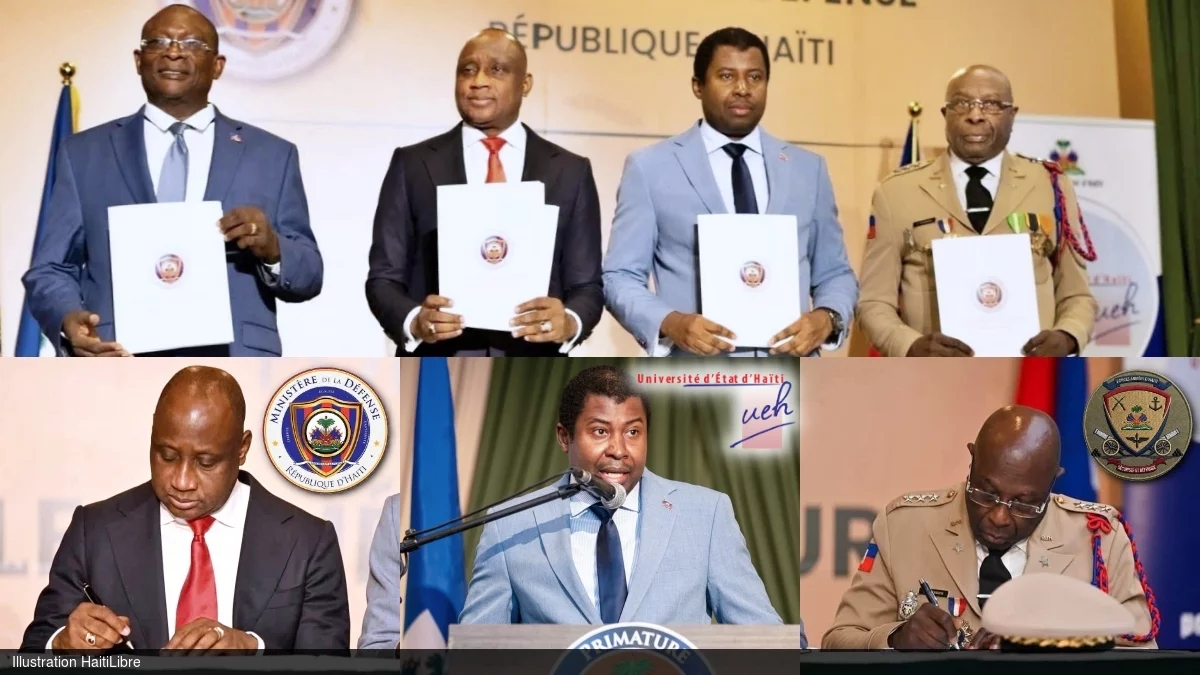
A landmark strategic partnership agreement was signed on August 21, 2026 between Haiti’s Ministry of Defense, the Armed Forces of Haiti (FAd’H), and the State University of Haiti (UEH), during the opening day of the National Forum on the Vision and Future of the Armed Forces of Haiti. The high-profile opening ceremony was attended by Haitian Prime Minister Alix Didier Fils-Aimé, alongside senior representatives from public sector bodies, the FAd’H High Command, the national academic community, civil society organizations, and international diplomatic stakeholders.
This memorandum of understanding (MoU) is designed to boost the academic, scientific, and professional capabilities of all serving FAd’H personnel, and to cultivate long-term collaborative ties between Haiti’s military establishment and its leading academic institution. During his opening remarks at the forum, Defense Minister Mario Andrésol framed the new partnership as a critical catalyst for advancing the long-delayed modernization and professionalization of Haiti’s national armed forces.
Andrésol emphasized that contemporary military training must extend far beyond foundational operational capabilities, arguing that robust knowledge development is the cornerstone of building a fully functional modern army. Addressing junior officers and non-commissioned officers in attendance, he noted, “The Nation entrusts you with its weapons, but the University will equip you with the most powerful tool of all: knowledge.”
UEH Rector Dieuseul Predelus echoed this sentiment, framing the signing ceremony as far more than a bureaucratic agreement. “What we are accomplishing together today, by signing this Framework Partnership Agreement, is an act of faith in Haiti, an act of responsibility toward our people, and an act of clear-sightedness in the face of the challenges of our time,” he said.
Predelus drew on global precedents to contextualize the importance of the new collaboration, noting that the world’s most powerful states consistently invest heavily in university and research infrastructure to reinforce national defense capabilities. “The United States built its scientific and technological hegemony on university campuses intimately linked to its military-industrial complex. In France, the Grandes Écoles were founded on the conviction that the training of intellectual elites is inseparable from the nation’s defense capacity. In Haiti, we must rediscover and honor this fundamental imperative,” he explained.
Since the official remobilization and rebuilding of the Haitian Armed Forces began, the institution has faced persistent gaps in specialized training and skilled personnel. Predelus stressed that the newly reconstituted FAd’H requires leadership trained to meet the most rigorous international academic and scientific standards, with expertise extending far beyond core military tactics. Officers and technicians need proficiency in geopolitics, emerging digital technologies, history, and core natural sciences to meet 21st-century defense challenges, he added.
The newly signed agreement directly addresses these unmet needs. It establishes pathways for FAd’H personnel to complete accredited degree programs and access ongoing continuing education courses, and creates a framework for joint scientific research into pressing national security and defense strategic issues. UEH has committed to developing and delivering all training programs in line with global academic standards, while ensuring curricula are rooted in Haitian national context and tailored to the unique operational missions of the FAd’H.
“By uniting knowledge and defense, the University and the Army, knowledge and security, we are returning to the deepest vision of our founders: that of a free, educated people capable of defending and governing themselves,” Predelus concluded.
In a separate announcement, Defense Minister Andrésol confirmed that the Haitian government will support integrating key conclusions from the national forum into two foundational policy documents: an updated FAd’H institutional doctrine and a new National Defense White Paper. According to Andrésol, these documents will form the backbone of a formal national Strategic Defense Plan, which will be submitted to relevant Haitian state authorities and released publicly to uphold government transparency commitments.