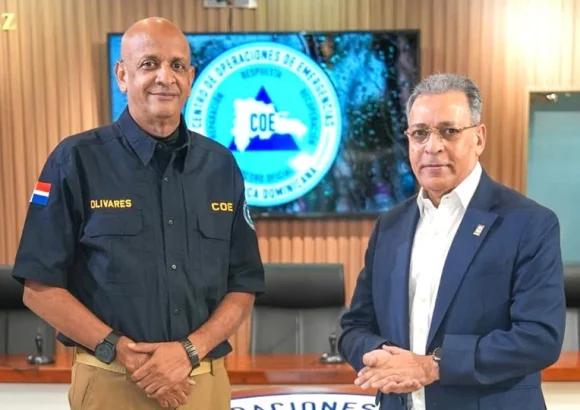
In a strategic move to shore up the Dominican Republic’s ability to withstand major seismic events, the head of the country’s Emergency Operations Center (COE) gathered Thursday for a high-stakes working meeting with one of the nation’s leading earth science and environmental experts.
Colonel CB Erdwin R. Olivares Luciano, COE director, sat down with Osiris de León, a prominent Dominican geologist and environmental advocate, to unpack the evolving landscape of seismic risk across the country and evaluate gaps in current disaster readiness frameworks.
The closed-door working session centered on three core priorities: mapping the current state of seismic activity across Dominican territory, outlining plausible worst-case risk scenarios for populated and high-infrastructure areas, and extracting actionable lessons from past destructive earthquakes that have struck both the Dominican Republic and other seismic zones around the globe.
During the meeting, Olivares Luciano laid out the core guiding principles of the country’s official National Earthquake Contingency Plan. This comprehensive strategy is designed to systematically boost pre-disaster preparedness across all levels of governance, streamline inter-institutional coordination when disaster strikes, and scale up the nation’s overall response capacity to handle a catastrophic high-magnitude earthquake.
The COE director stressed a key, often overlooked, truth about disaster readiness: earthquake preparedness is not a responsibility that falls solely to national government bodies. Instead, it requires collective buy-in and action from a wide range of stakeholders, including local municipal authorities, private sector businesses, grassroots community organizations, and every individual member of the public.
To that end, Olivares Luciano issued a clear public call for individual and family-level action, urging all households across the country to develop customized home emergency plans, pre-identify local evacuation routes and earthquake-safe spaces within their homes and neighborhoods, and maintain a fully stocked kit of essential emergency supplies to cover basic needs in the critical first 72 hours following a disaster, when response teams may still be deploying to affected areas.
In an official statement released following the meeting, the COE confirmed its long-term commitment to ongoing collaboration with scientific and technical experts. The agency will continue to foster open technical dialogue and cross-sector cooperation to build a widespread culture of disaster prevention across the Dominican Republic, with the ultimate goal of safeguarding the lives and personal safety of all Dominican citizens.