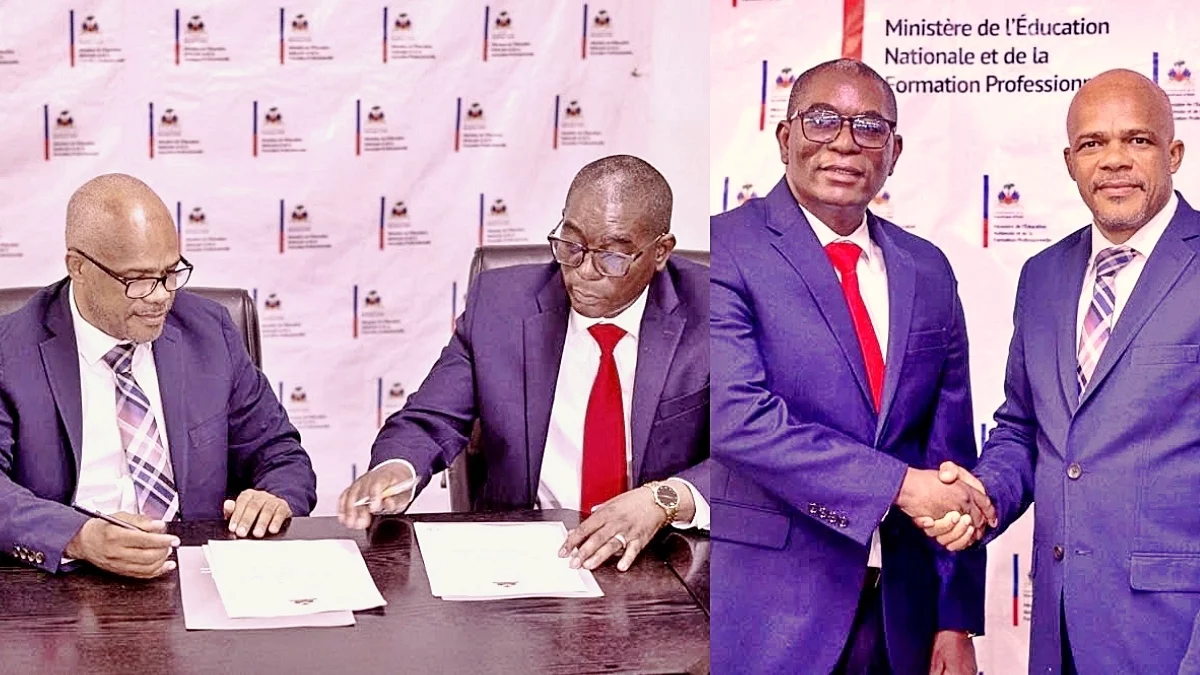
Ahead of the 2026 academic year opening, Haiti’s government has launched a massive targeted cash assistance initiative to ease financial pressure on low-income households with school-aged children. On August 18, 2026, National Education Minister Vijonet Déméro and Economic and Social Assistance Fund (FAES) Director General Kesner Romilus formalized the program during an official signing ceremony, attended by senior education ministry officials including Director General Osny Jean Marie.
Minister Déméro emphasized that the state designed this multi-pronged support package to reinforce assistance for families grappling with back-to-school costs, with a specific focus on the most socioeconomically vulnerable groups. Beyond direct cash transfers, the comprehensive initiative includes free distribution of school supply kits, instructional textbooks, and student uniforms, full tuition coverage for the first two cycles of primary education, and daily school meal programs for eligible students. The overarching goal, Déméro noted, is to cut the heavy financial burden that back-to-school preparations place on struggling household budgets.
For his part, FAES Director General Romilus confirmed that the fund has completed all preparatory work to roll out the program, which also forms part of a broader strategy to reduce persistent school dropout rates in underserved urban and rural regions across the country. Romilus reaffirmed the Haitian government’s unwavering commitment to standing alongside vulnerable families, explaining that FAES’ programming aligns with a national push to strengthen social protection, guarantee educational continuity, and advance equal access to learning opportunities for all children, regardless of their family’s economic background.
This year’s direct cash subsidy component totals 2.1 billion gourdes, reaching 140,000 eligible parents with children enrolled in national, community, municipal, and parochial schools located in disadvantaged zones nationwide. Each qualifying parent will receive a one-time allowance of 15,000 gourdes, disbursed via digital mobile payment platforms Natcash and MonCash. Minister Déméro stressed that the entire distribution process will follow strict orderly, coordinated, and structured protocols to ensure funds reach intended recipients efficiently.
Officially named the Education Cash Transfer project, the initiative is being implemented under the umbrella of the national Multisectoral Emergency Program for the Reconciliation and Reintegration of Vulnerable Groups. To ensure transparency and accuracy, beneficiary lists will be pulled directly from the Ministry of National Education’s Education Management Information System (SIGE), before being officially shared with FAES to execute the payment transfers.