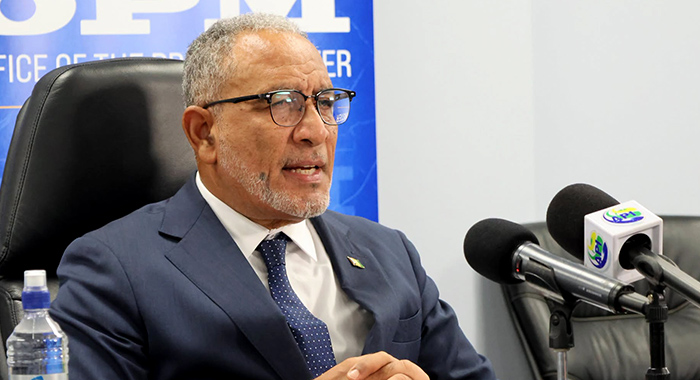
Following an official working visit to Taipei last week, St. Vincent and the Grenadines (SVG) Prime Minister Godwin Friday has announced that Taiwan has committed a minimum of $2 million in grant funding to capitalize the newly proposed National Development Bank (NDB), a flagship infrastructure project of the island nation’s ruling New Democratic Party (NDP) administration. In remarks to local media in Kingstown this Tuesday, Friday also confirmed an expanded package of annual support for community-focused social programs targeting marginalized groups across SVG’s constituencies.
In a press briefing held during his trip to Taiwan, Friday confirmed that the NDB initiative is “very much a go”, noting that preliminary discussions between SVG and Taiwanese officials had been finalized before the delegation’s arrival, leaving Taipei fully briefed on the Caribbean nation’s development plans. Beyond the $2 million seed grant, Taiwan has also offered SVG access to additional concessional financing to support the bank’s launch. The prime minister emphasized that the NDB is designed to resolve a decades-long gap in affordable capital access for local small and medium-sized enterprises (SMEs) and ordinary Vincentians, who have long been locked out of traditional lending systems.
While welcoming the grant support, Friday struck a cautious tone regarding the proposed soft-loan financing package, stressing that his administration must carefully balance the benefits of low-cost credit against the risks of expanding SVG’s already strained public debt. “Those [soft loans], of course, I am less excited about,” he told reporters. “But we have to balance the benefit of that with the advantage or the good that it will do in the economy, and to see whether it makes sense to borrow at 3.5% and lend on. These are things that we are studying here with our team, and we’ll decide how we go on.”
Work on the NDB’s legal and regulatory framework is already underway, with Attorney General Louise Mitchell leading preparatory work and legal expert Jason Haynes tasked with drafting the founding legislation, following a series of nationwide public consultations that included outreach to communities in the Grenadines. Friday clarified that while the NDB will prioritize SME support, it will operate on sound commercial principles rather than acting as a charitable distribution program. “What I’m saying to people, those persons, again, who are anxiously and eagerly awaiting the coming of the bank: it’s a bank; it’s not a charity,” he said. “So, it’s a situation where we are going to manage it on business principles, but it will be much more supportive to small businesses. There will be an environment of encouragement, of support, of mentorship, and so on to help these businesses, small businesses, to succeed.”
Success of the institution, Friday added, will be measured by its broader impact on inclusive economic growth rather than dividend returns to the government. The NDB’s design has also incorporated governance guidance from the International Monetary Fund, which had previously raised concerns about debt risk and institutional transparency for new state-backed development banks.
Taiwan’s support for the NDB aligns with the NDP administration’s overarching economic strategy, which centers on private-sector-led growth and attracting foreign direct investment. During Friday’s visit, SVG hosted an investment forum in Taiwan where the delegation pitched the island nation’s untapped investment potential to local business leaders. Taiwanese investors expressed particular interest in SVG’s solar energy, tourism and hospitality development, and marine and shipyard sectors, according to the prime minister.
Beyond the NDB, the bilateral development partnership between Taiwan and SVG extends to education and skills training, where Friday pushed for a transformative overhaul of SVG’s current technical and vocational education and training (TVET) system, which he described as inadequate to meet the country’s economic needs. SVG currently faces the paradox of high youth unemployment alongside labor shortages that force major construction projects to import skilled foreign workers. Taiwanese officials responded positively to SVG’s proposal, including a plan to deploy young Taiwanese skilled professionals to SVG to provide on-the-ground training. The SVG administration is also exploring short-term technical internship placements for Vincentian youth in Taiwan’s specialized industries such as shipbuilding, to build domestic skills through knowledge transfer.
Taiwan is also set to expand support for SVG’s agricultural sector, with a focus on scaling up modern technology-driven initiatives to make farming profitable and attractive for young people. Friday highlighted the existing smart agriculture and tissue culture lab project at Orange Hill as a successful model that has gained recognition beyond SVG’s borders. “The project is a model to attract youth into an agriculture that is driven by modern technology and is much more productive, much more profitable,” he said, adding that Taiwan has expressed strong enthusiasm for expanding such initiatives to revive the agricultural sector to the central economic role it held during SVG’s banana production era.
To advance community-level development, Taiwan has also committed $1.5 million in annual grant funding to support a portfolio of social and community empowerment programs, with a portion earmarked to launch the long-proposed constituency development fund, an initiative first raised by SVG Deputy Prime Minister St. Clair Leacock in earlier talks with Taiwanese officials. Funding will be targeted specifically at advancing economic opportunities for women and youth, and Friday framed the support as a way to create productive opportunity rather than foster dependency. “This is all, you know, very, very good opportunity for us to be able to, as we say, put money into people’s pockets by making them productive. So that if we invest $100, they can make $200 from it. That’s the way you do it,” he said.
The prime minister concluded that the visit has opened multiple new development pathways for SVG, with some projects expected to deliver results faster than others as the administration works toward its core goal of delivering tangible, inclusive economic benefits to all communities across the country. “My campaign, my strategy, is to deal with people. We don’t just build [things] because they’re big and they look pretty,” he said. “The point is that what we’re trying to do is put money in people’s pockets in very real ways… What you want is people earning, people finding ways in which they can make a decent living as they used to, and providing for themselves and their families. And we are looking for every opportunity to do that.”