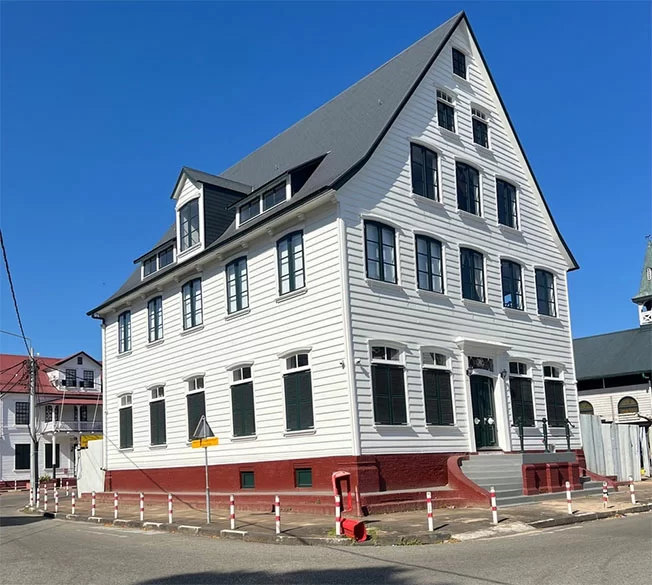
After eight years of concerted effort led by a dedicated local foundation, the structural restoration of the iconic Elisabeth Samson House, located in the historic center of Paramaribo, Suriname, has reached completion. The landmark building was formally handed over to the Elisabeth Samson House Foundation following the conclusion of structural construction work on July 31, and will gradually enter partial use ahead of its official opening, which is scheduled for the completion of remaining interior fitting-out and site landscaping work.
Standing at the intersection of Wagenwegstraat, Heerenstraat and Malebatrumstraat, the centuries-old building holds profound cultural and historical significance for Suriname. The project to rescue and restore the property spanned years of careful preparation, extensive fundraising, complex permitting processes, and hands-on construction work. Today, organizers say the once-at-risk monument has been saved for future generations.
“This project proves that large-scale heritage preservation initiatives can succeed in Suriname when multiple stakeholders share responsibility and work toward a common goal,” explained Cynthia Mc Leod, award-winning author and chair of the Elisabeth Samson House Foundation. Mc Leod has spent decades championing the preservation of the building and raising public awareness of the remarkable life of Elisabeth Samson, after whom the house is named. She conducted extensive groundbreaking historical research into Samson, publishing her findings in 1993, before releasing a celebrated novel about Samson’s life, *The Free Black Woman Elisabeth: Prisoner of Color*, in 2000.
Elisabeth Samson (1715–1771) was a free-born Black woman who built a successful business career and rose to become one of the wealthiest women in 18th-century Suriname. Her story will be the central focus of the new multi-purpose space hosted in the restored building.
Under the foundation’s usage plan, the property will serve four core functions: a dedicated museum, a public cultural gathering space, office accommodation, and a new tourist attraction for visitors to Paramaribo. The first floor will house the Elisabeth Samson museum, fitted with period-appropriate historical furniture and curated historical displays. The ground floor will be transformed into a flexible multi-functional venue for lectures, educational workshops, and performing arts events. The second floor and attic have been designated for office space, while the basement is planned to host a hospitality operation. Revenue generated from office rentals, the hospitality venue, and tourist visits will fund long-term sustainable management and maintenance of the protected monument, ensuring it remains preserved for decades to come.
The building itself carries a layered history of its own. In 1821, the colonial government purchased the property, which went on to host a range of public functions over the next two centuries, including a school, civil registry offices, and a popular wedding venue. From 1967 to 2012, it housed Suriname’s Ministry of Labor. After government agencies vacated the property, its future fell into uncertainty, as the neglected structure began to deteriorate.
The Elisabeth Samson House Foundation was formally established in May 2018, and completed the purchase of the historic building in January 2021. Full-scale structural restoration work got underway in November 2022, addressing critical issues including the building’s load-bearing framework, roof, exterior facades, and flooring. Fit-out work, installation of modern technical infrastructure, security systems, and interior design work commenced in September 2024.
The total investment for the full restoration and activation project totals approximately US$2.15 million. As of August 1, the foundation has secured US$1.84 million in pledged funding, and has spent roughly US$1.75 million on construction and early planning work. The foundation is still seeking additional funding to cover the remaining costs of interior fitting-out, site improvements, and initial operating costs ahead of opening. The project has already received financial support from a range of Surinamese and international organizations and individual donors.
In the coming months, the foundation will gradually bring different parts of the building into use, with a grand official opening to follow once all remaining work is complete. For foundation leadership, the project is about more than preserving one historic building: it is intended to serve as a proof of concept for other at-risk heritage sites across Suriname. “Investing in heritage is investing in the future of Suriname,” the foundation noted.