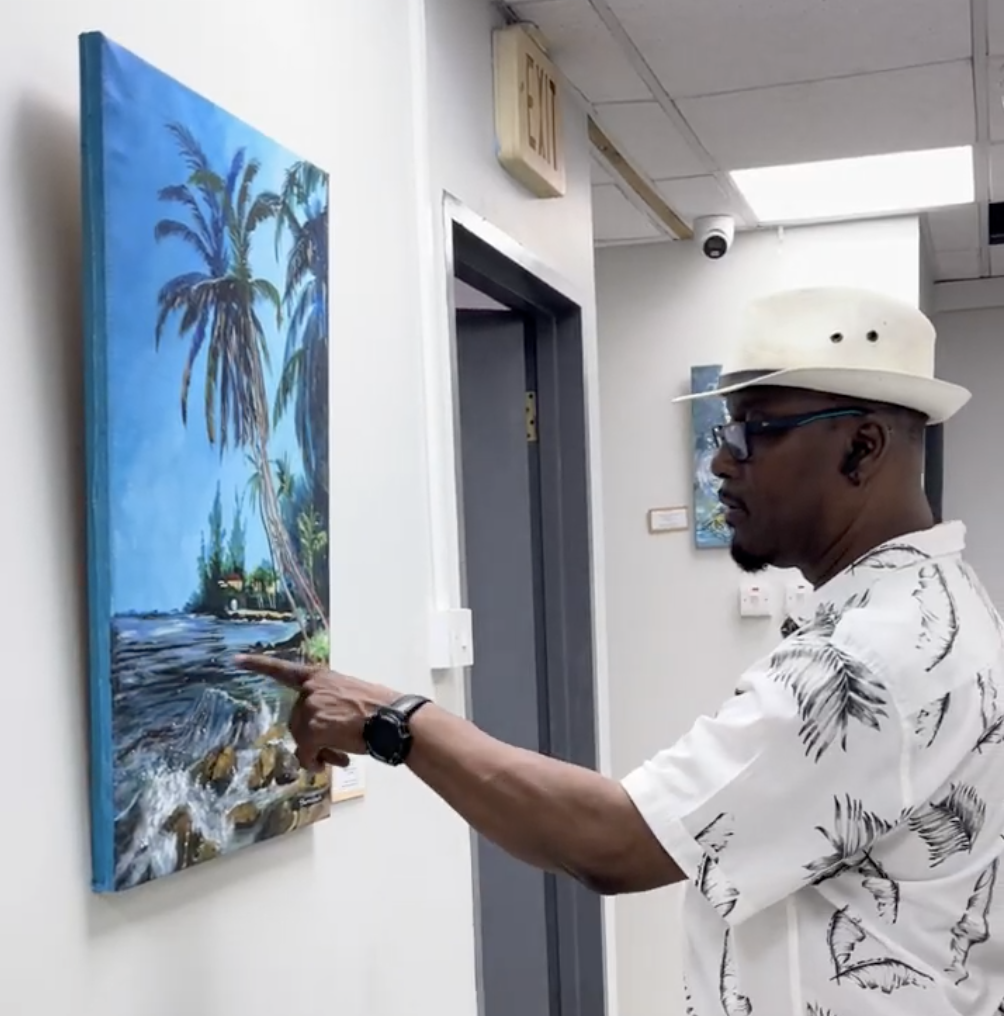
A veteran Barbadian secondary school art teacher and multi-disciplinary creative is pushing for systemic change to support local artists and filmmakers, arguing that the island nation must build consistent domestic exhibition spaces instead of pushing its homegrown talent to seek audiences abroad.
George Cox, who brings more than three decades of experience in education alongside backgrounds in engineering and filmmaking, made the appeal while speaking at an ongoing art exhibition hosted by Inspirational Fine Arts Gallery, an unconventional creative space located on the upper level of Bridgetown’s Sugar Cane Mall on Roebuck Street. During his remarks, Cox emphasized that the Barbadian arts sector needs far more than occasional events like pop-up exhibitions and annual competitions to embed creative work into everyday national life.
“Without the ability to display your work, it’s a problem and you need to display it to an audience. You need to display it to the people who are around you,” Cox told attendees of the show.
To illustrate the gap in local opportunity, Cox pointed to his own daughter’s career trajectory: the film school graduate now holds a senior role with a production company that partners with Disney, building her successful career outside of Barbados after there were few pathways to showcase her work at home. Cox praised his daughter’s vision and storytelling skills, noting that her success abroad proves Barbadian creatives have world-class talent – but that talent too often has to leave the island to thrive.
Cox stressed that Barbados already holds all the pieces to build a thriving, self-sustaining creative industry, if local stakeholders prioritize creating accessible public platforms for domestic work. He noted that while many Barbadian filmmakers are already creating intimate, authentic stories about life on the island, most of these projects never receive the distribution or exposure needed to reach broader local audiences.
“We have film people out there, and they have to find a way to get themselves to express themselves out there, but there’s no platform where people get to see themselves,” he said.
The educator specifically questioned whether national public broadcaster Caribbean Broadcasting Corporation (CBC) is doing enough to elevate local creative productions, pointing out that original Barbadian films almost never air on the network’s schedule. “We have a lot of films about Barbadians. But how many times have you seen it on CBC? Never,” he said.
Cox described Barbadian filmmaking as a largely “untapped area”, adding that the island already has a skilled base of technicians and production crew capable of supporting large-scale domestic projects. What is missing, he argued, is intentional support to encourage more local storytellers to create work, paired with consistent spaces to share that work with the public.
“We don’t get a lot of people creating film, creating story, and they don’t get to show themselves,” he added. Contrary to common attitudes toward critique, Cox argued that even negative feedback is a valuable tool for growth, as any form of public exposure gives creatives the chance to refine their craft and connect with audiences. “Even the worst opinions, or criticisms, is something, you know. It’s not negative,” he said.
Cox held up neighboring Caribbean nations Trinidad and Tobago and Jamaica as positive examples, where local creative work is far more visible to domestic audiences than it is in Barbados. He also highlighted the work of a former student who has built a consistent exhibition practice in St. Vincent and the Grenadines, noting that the creator is able to regularly share work and engage with other regional artists thanks to local support structures.
He reserved particular praise for artist Sherridean Carmichael, founder of the Inspirational Fine Arts Gallery currently hosting the exhibition. Cox applauded Carmichael’s choice to locate the gallery in a repurposed corridor within a busy shopping mall, calling the unconventional space a creative statement in its own right. “Even this amazing art show. This could have been part of a documentary of some kind because this is an amazing lady and the very fact she’s found her little space where the gallery is the corridor, very creative,” he said.
He added that the gallery and the diverse work on display there could serve as the foundation for a broader narrative about the struggles and triumphs of Barbadian creatives building their careers on the island. “This is a whole story all by itself,” he noted.
While Cox acknowledged that the growth of the open internet has created new independent distribution avenues for creatives to share their work, he argued that traditional local media still has a critical role to play in centering authentic Barbadian stories. “The Internet is wide and vast. Television is ours right here. It’s one of our platforms that is right here,” he said.
Cox concluded by noting that prioritizing local storytelling would not only benefit creatives – it would also help domestic media organizations build deeper connections with their Barbadian audiences. “I think more people would watch the CBC if there was more about them, you know, more storytelling about them,” he said.