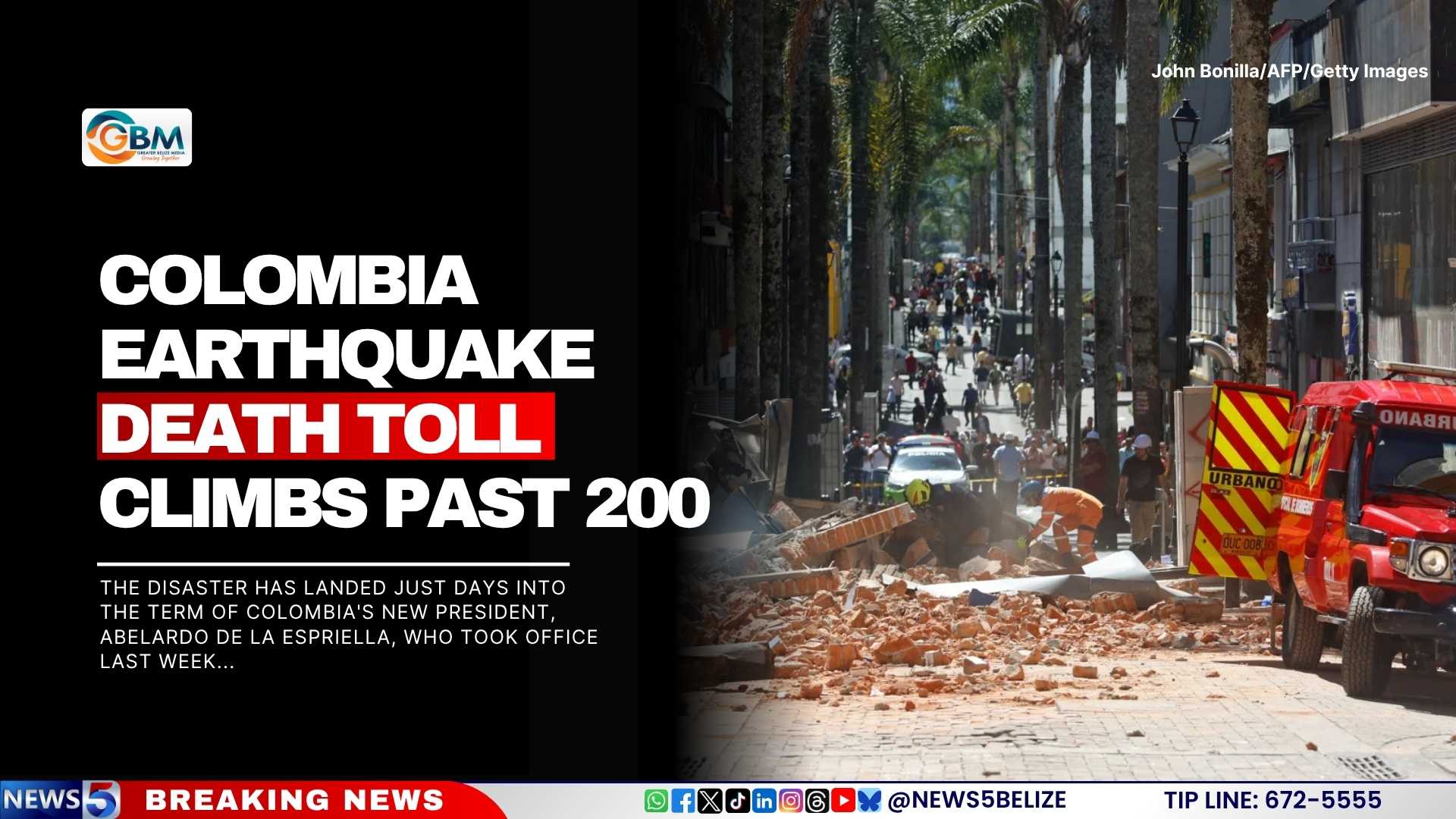
Three days after a devastating 7.4 magnitude earthquake struck western Colombia, the confirmed death toll has climbed past 200, reaching at least 224 as rescue teams continue to excavate rubble for trapped survivors and work to clear blocked access routes to the hard-to-reach epicenter.
According to Colombia’s Geological Service, more than 70 aftershocks have shaken the region since the initial quake on Monday, with a 3.8 magnitude tremor registered across multiple urban centers early Thursday. All major aftershocks have traced their origin back to San José del Palmar, the municipality in Chocó department that also hosted the original earthquake’s epicenter, though Thursday’s tremor originated nearly 100 kilometers underground—far deeper than the main quake. The agency has warned that aftershocks, which have already reached a maximum strength of 4.8 magnitude, could persist for an extended period. “These seismic events can continue for days, weeks, or even months, as subsurface energy is gradually released until tectonic pressure stabilizes across the area surrounding the main rupture zone,” the service explained in an official statement.
In Manizales, one of the hardest-hit urban areas, local mayor Jorge Eduardo Rojas confirmed five deaths linked to the disaster, and warned that long-term reconstruction will take years to complete. So far, 60 buildings in the city have suffered full or partial collapse, with municipal officials projecting that the number of displaced and affected residents will double from the current count of 2,000 to as high as 4,000 as damage assessments continue.
Across Chocó department, where the epicenter is located, governor Nubia Carolina Córdoba-Curi reported nine additional deaths, bringing the department’s total death toll well above initial counts, alongside 138 recorded injuries and five people still unaccounted for. More than 1,500 residential structures across the entire affected region have been damaged or completely destroyed, leaving thousands without shelter.
The disaster has presented an early unplanned test for Colombia’s newly inaugurated president, Abelardo de la Espriella, who took office just one week prior on a campaign centered on hardline domestic security. Before the earthquake struck, his administration had already faced a series of early security challenges: a drone attack that killed a sitting police officer, the controversial transfer of more than 100 high-profile inmates to maximum-security facilities, and a reported operation that killed the alleged leader of a major leftist militant group, which was expected to be the focus of his first weeks in office.
Now, the new president must pivot to respond to a humanitarian emergency in one of the country’s most challenging regions. Chocó ranks among Colombia’s least developed departments, and has long been a hotbed of activity for criminal and militant factions. Paramilitaries have scattered landmines across large swathes of rural territory, restricting movement for local communities and complicating access for emergency response teams. Officials have not yet released a clear assessment of how ongoing security instability will impact search operations and long-term reconstruction efforts in the coming weeks.
International and local aid organizations have warned that the humanitarian crisis is still worsening as remote communities remain cut off from support. A senior United Nations official noted that food distribution will become a critical priority in the next 48 to 72 hours, and at least one indigenous leader from a community near the epicenter confirmed that no emergency assistance had reached his group as of Thursday morning.