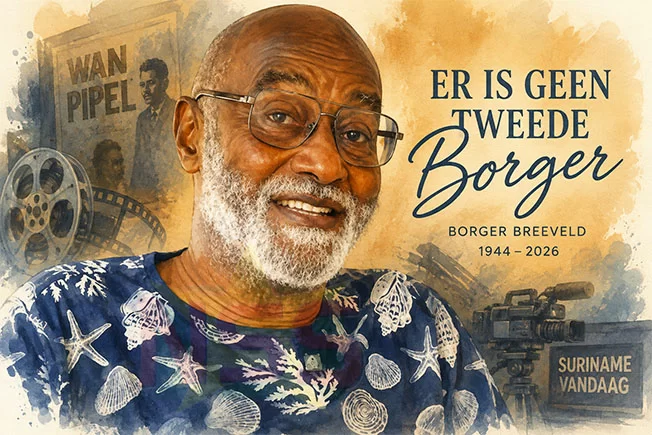
It was a shock that rippled through Suriname’s media and cultural communities when news broke of Borger Breeveld’s passing on Monday morning. While we all know that life is finite, there are some people who feel as though they should always be with us — and Borger was one of those people for me. A distinct, unforgettable personality, a trailblazer of Suriname’s media sector, and a gifted actor who carved out a unique, permanent place in the nation’s history.
For most people, mentioning Borger Breeveld immediately brings *Wan Pipel* to mind. His portrayal of Roy in Pim de la Parra’s iconic classic remains etched deep into Suriname’s collective cultural memory, nearly 50 years after the film first premiered, conversations about his performance still continue. Countless Surinamese film and television productions have launched in the decades since, introducing a new wave of local acting talent, but for me, the unmatched impact of *Wan Pipel* has never been equaled — and Borger’s extraordinary acting skill was undeniably a core reason for that lasting legacy.
My personal memories of Borger extend far beyond his famous role in that film. I first got to know him during a very different chapter of Suriname’s history, when he served as a spokesperson during the country’s military rule. That was no easy era for journalists working in the nation. Power dynamics were fraught, the space for independent journalistic work was tightly constrained, and access to reliable public information was never a given.
Even in that tense context, Borger remained approachable to reporters. He had empathy for the work journalists needed to do, while also understanding the complexities of the system he operated within. This allowed him to serve as a critical bridge between the press and military leadership. This did not mean all barriers suddenly fell, or every question received an answer — but it meant there was always someone willing to talk, someone who acknowledged that journalists had a job to do. That mattered a great deal in that difficult time.
Later in his career, I got to see a whole other side of Borger up close: Borger the television producer. When the current affairs program *Suriname Vandaag* launched, he agreed to take on the role of director. I co-led the program and served as one of its co-presenters, so I got to witness his behind-the-scenes talent firsthand.
*Suriname Vandaag* was broadcast live, a format that anyone working in television knows carries unique pressure. There are no second takes. What happens on air stays on air: a presenter might fumble their lines, a satellite connection could cut out, a segment runs longer than planned, or breaking news can throw the entire run of show completely off schedule. In those moments, you need someone behind the scenes who understands the medium, can make quick, calm decisions, and keep the entire team grounded. That was Borger.
No one understood the craft of television production better than he did. It was not just knowing where to place a camera or when to cut between angles — he had an intuitive grasp of rhythm, visual storytelling, timing, and on-screen presence. He knew what would resonate with audiences and what would fall flat, and he had a masterful ability to communicate that insight to his team. That last skill is one that should not be underestimated.
Borger taught the craft to generations of media professionals. An entire cohort of Suriname’s media workers has benefited directly or indirectly from his knowledge and decades of experience. Unlike many people who guard their professional expertise closely, Borger never fit that mold. He was eager to pull others into the field, to help them grow and become better at their work. That is why reducing his legacy to just his role as Roy in *Wan Pipel* does him a deep disservice. He was an actor, yes, but also a director, a producer, a communications strategist, and a teacher. He was part of the pioneering generation that built Suriname’s modern television industry from the ground up, working in an era with far fewer technical resources than we have today.
Now, almost anyone can shoot footage and stream it live to an audience from a smartphone. But technology alone does not make someone a television professional. Television is a learned craft, and Borger knew that craft inside and out. That is what sticks with me today, alongside the grief of his passing: how much irreplaceable institutional and craft knowledge is lost when a pioneer like Borger leaves us.
As a country, Suriname has not always done a good job of documenting and passing down the knowledge of the people who built our core industries and cultural sectors. Only when these icons are gone do we realize how much they knew, how many untold stories they carried, how much of our national history is tied to their lives and work. Borger Breeveld was exactly that: a walking, living archive of Suriname’s media and film history.
For me, I will remember him as I knew him: approachable, deeply knowledgeable, completely at home in every corner of the television industry. He was a man who knew his craft, and dedicated himself to lifting others up along with him.
*Wan Pipel* will remain, the footage will remain, the memories will remain. And for the many people who learned the craft from him, a part of Borger will live on through their work. But Borger himself is gone. There will never be another like him.
I send my deepest strength to Borger’s family and all his loved ones as they navigate this enormous loss. Thank you for everything you left to us, and to all of Suriname’s media community. Rest easy, Borger.