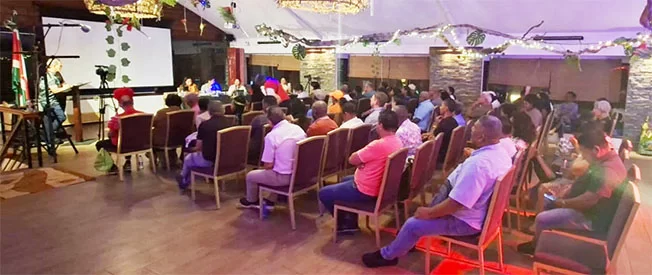
On the eve of International Indigenous Peoples Day celebrated on August 9, the Suriname-based foundation Stichting Skrifi hosted a pivotal panel discussion and photo exhibition at the Spice Quest venue on Wednesday evening, centering three core themes: Indigenous peoples’ social standing, collective land rights, and cultural preservation. The event brought together indigenous leaders, academic experts, and a senior government minister to unpack ongoing challenges facing indigenous communities and outline actionable steps to advance equity and recognition across the nation.
The five-member panel included Sharmaine Artist, chair of the Key Holders of Sustainable Environment foundation; Jupta Itoewaki, president of indigenous rights organization MULOKOT; Cylene France, director of the office of the Suriname Association of Indigenous Village Heads; Lloyd Read, chair of the Indigenous Collective Suriname; and historian Agir Axwijk. Alongside the debate, a public photo exhibition showcased documentary imagery from two indigenous communities, the villages of Mata and Kwamalasamutu, offering attendees an intimate look at daily life and cultural traditions in these areas.
The first segment of the evening opened with panelists sharing perspectives on the inherent strength and valuable contributions of indigenous peoples to broader Surinamese society. Axwijk framed indigenous traditional knowledge as an enduring, unbreakable source of power from a historical perspective. France emphasized indigenous communities’ inherent strength in environmental and cultural stewardship, noting that formal recognition of collective land rights forms the foundational bedrock for indigenous peoples’ future self-determination. Itoewaki centered the living power of indigenous communities as the legitimate governing authorities of their traditional territories. Artist highlighted the resilience of indigenous generations, describing a community that refuses to fade, surrender or disappear. The opening discussion closed with Read outlining the untapped potential and unique strength of indigenous-led local economies.
The second segment of the event centered on a lively debate around two provocative propositions, with both panelists and audience members invited to share their views. The first proposition argued that indigenous peoples currently do too little to raise public visibility, resulting in the broader Surinamese society holding an incomplete and inaccurate view of their cultural and social power. The second proposition stated that Suriname’s current national education system contributes more to the erasure of indigenous culture than it does to its preservation. The exchange of perspectives produced a robust, substantive dialogue that engaged all attendees.
A core consensus emerged across the discussion: as the original inhabitants of Suriname, indigenous peoples still do not hold the equal, respected social position they deserve. Panelists emphasized that critical work remains unfinished, particularly in expanding indigenous participation in national and local decision-making processes and securing full legal recognition of collective land rights. Until these and other priority issues are resolved, they argued, indigenous peoples cannot be considered full, equal members of Suriname’s national society.
A highlight of the evening came from the attendance of Dirk Currie, Suriname’s Minister of Education, Science and Culture. Currie extended an invitation to panelists for a formal follow-up meeting to explore how to better integrate indigenous history, culture and social perspectives into national school curricula. Panelists responded positively to the invitation, expressing hope that they will be able to convene with the minister in the near term to co-develop a shared strategy for education reform.
Event organizers also announced that the upcoming exhibition at Villa Zapakara will be dedicated entirely to the indigenous peoples of Suriname, extending the public conversation sparked by Wednesday’s event. Stichting Skrifi organized the gathering to add deeper context and public engagement to the national observance of Indigenous Peoples Day on August 9. Looking back on the event, organizers expressed satisfaction with the outcome, noting that it delivered valuable insights, inspired cross-community dialogue, and renewed collective momentum to keep educating Surinamese society about the strength, history, and critical role of the nation’s indigenous communities.