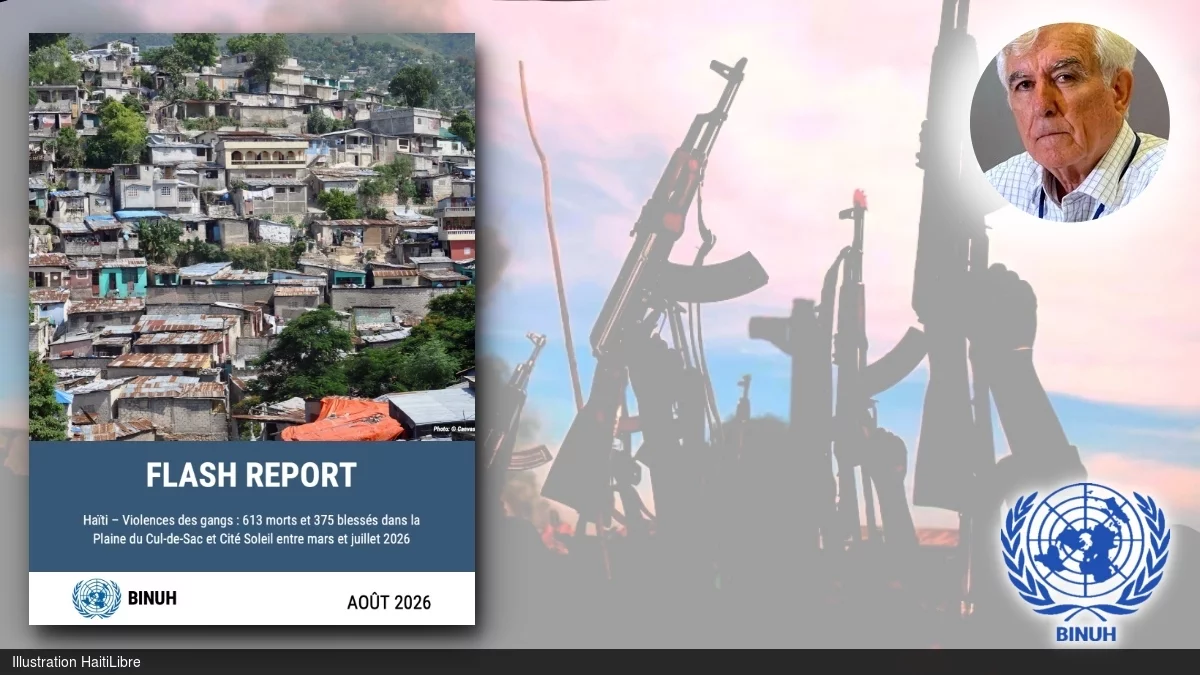
Five months of escalating gang violence across two densely populated regions of Haiti has left hundreds of innocent civilians dead, displaced tens of thousands, and created a humanitarian catastrophe that demands urgent global intervention, according to a new United Nations human rights report. Released by the UN Integrated Office in Haiti (BINUH), the analysis was compiled by William O’Neill, UN Special Rapporteur on the human rights situation in Haiti, and covers violent incidents recorded between March 1 and July 31, 2026.
The report paints a devastating picture of systemic violence targeting civilians who have no affiliation to any of the country’s warring criminal groups. In just the Cul-de-Sac Plain and Cité Soleil, two of Haiti’s hardest-hit districts, O’Neill’s team recorded at least 613 fatalities and 375 additional injuries over the study period. More than one-third of those killed or harmed were ordinary residents with no connections to gang activity, including 111 women and 77 children.
Sexual violence as a weapon of terror emerges as a defining feature of the current crisis, the report confirms. Investigators documented at least 176 cases of rape and gang rape committed by suspected gang members against women and girls ranging in age from 10 to 71 years old. The widespread use of sexual assault has created a culture of fear that permeates every corner of affected communities, leaving countless survivors with lifelong physical and psychological trauma.
Along with the staggering death toll and prevalence of sexual violence, the violence has driven mass displacement across the region. More than 18,000 people have abandoned their homes to escape fighting between rival gangs, joining the growing ranks of internally displaced people across Haiti who lack access to safe shelter, food, clean water, and medical care.
The report includes dozens of firsthand, verified accounts of atrocities collected by UN human rights observers, many of which detail the deliberate killing of vulnerable civilians over minor or unproven accusations. In one documented incident, two 17-year-old boys were executed by a gang leader on suspicion of sharing information with a rival group. A 71-year-old man was shot and killed after approaching the same gang leader to beg for food for his family. In another mass killing, 17 teenage boys between 15 and 17 years old were executed en masse after being accused of collaborating with opposing gang members.
One of the deadliest single attacks recorded occurred shortly after an international World Cup qualifying match between Haiti and Scotland. A crowd of roughly 300 people, including a local musical group that had gathered to celebrate the match, was ambushed by gang members positioned on surrounding rooftops as they entered a residential neighborhood. The attack left at least 61 people dead and 20 more injured, including at least seven children—the youngest just 7 years old. In another gruesome incident, armed gang members burned a woman’s home to the ground, killed her husband and 2-year-old daughter, then gang-raped the woman in front of her 10-year-old son.
O’Neill’s report makes clear that the ongoing violence has pushed Haiti’s civilian population into an unprecedented humanitarian emergency, with ordinary people bearing the full brunt of criminal groups’ fight for territorial and political control. Human rights observers warn that without immediate international intervention to restore security and expand humanitarian access, the death and displacement toll will continue to rise in the coming months.