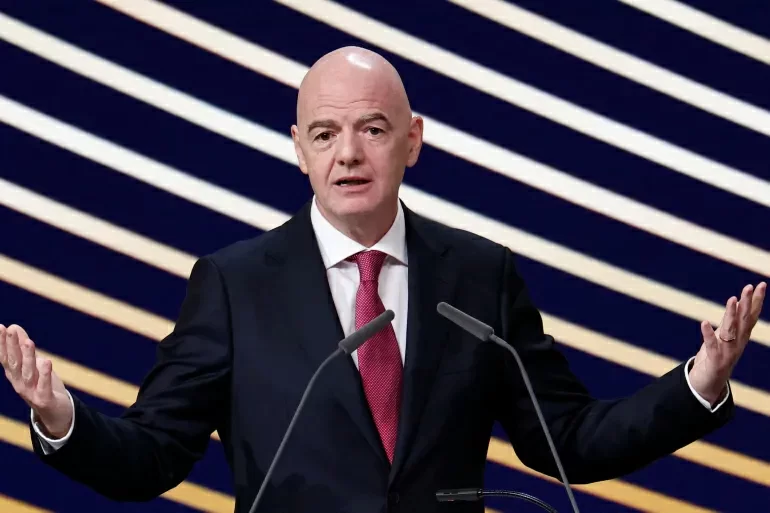
A growing rift within global soccer governance has boiled over into open legal conflict, as European soccer’s governing body UEFA has formally confirmed it has sent a legal preservation order to global soccer governing body FIFA, the world’s top soccer organization. The move comes in the wake of the collapsed proposal from FIFA President Gianni Infantino to sell a stake in future World Cup revenue to private investors, a plan that triggered widespread backlash across the global soccer community.
The preservation letter, a formal pre-litigation legal document, orders FIFA to retain all relevant documents, data, and electronic communications related to the plan as potential evidence for future legal action. This step signals that UEFA is actively considering a range of legal responses against FIFA, from binding arbitration to formal complaints filed with global sports regulatory bodies. The document, drafted by international law firm Dechert’s New York office, explicitly warns that the destruction or concealment of relevant evidence could carry severe legal consequences.
Eighteen senior FIFA officials are named in the letter as parties linked to the proposal, including Infantino himself, FIFA Chief Financial Officer Thomas Peyer, and Arsène Wenger, the former Arsenal manager who now leads FIFA’s global soccer development division. Wenger has since publicly stated he had no prior knowledge of the private investment initiative.
Infantino’s controversial proposal, which news reports indicate aimed to raise up to $4.2 billion from private investors including U.S. investment firm founded by Joshua Kushner, sparked global uproar within soccer governing circles almost immediately after details emerged. UEFA emerged as the most vocal opponent of the plan, going so far as to order its 55 member national associations to boycott all FIFA-organized events as long as the proposal remained under active consideration.
As the FIFA presidential election approaches, scheduled for March 2027 in Morocco, a longstanding ally of Infantino, UEFA is already actively working to recruit a rival candidate to challenge the incumbent. The European confederation has publicly stated that Infantino has lost the confidence of the broader global soccer community, adding that “no option is off the table” to end his nearly 11-year tenure as FIFA president, which has been marked by repeated controversy over governance and transparency.
Infantino’s initiative, officially named the FIFA Forward Enterprise (FFE) project, was designed to bring all of FIFA’s commercial and tournament operations under its centralized control through at least 2038, with the promise of more than doubling development funding for FIFA’s 211 member associations. Even within FIFA’s own internal ranks, however, the plan faced fierce pushback: FIFA Chief Operating Officer Kevin Lamour publicly dismissed the project as a one-man initiative and alleged that deception had been used to advance the plan among FIFA staff.
Opposition to the plan and to Infantino’s continued leadership extends far beyond Europe. Both the Asian Football Confederation (AFC) and the Confederation of North, Central American and Caribbean Association Football (CONCACAF) have publicly come out against the proposal. Infantino retains core support from African soccer confederations and the South American confederation CONMEBOL, which is pushing for an expansion of the 2030 World Cup to 64 teams — a policy priority that Infantino has publicly backed.
The political standing of the FIFA president remains deeply uncertain amid the growing backlash. Recent reports claimed Infantino was seeking backing from the U.S. government, including a planned call with U.S. Secretary of State Marco Rubio, but those reports have since been denied. Meanwhile, a growing majority of UEFA’s member associations have begun to withdraw their public and private support for Infantino ahead of the election.
With the candidate nomination deadline set for November 18 — just four months before the March election — what once looked like a guaranteed fourth term for Infantino now appears far from certain. The rift between UEFA and FIFA has become one of the most high-profile governance crises in modern global soccer, raising questions about the future direction of the world’s most popular sport.