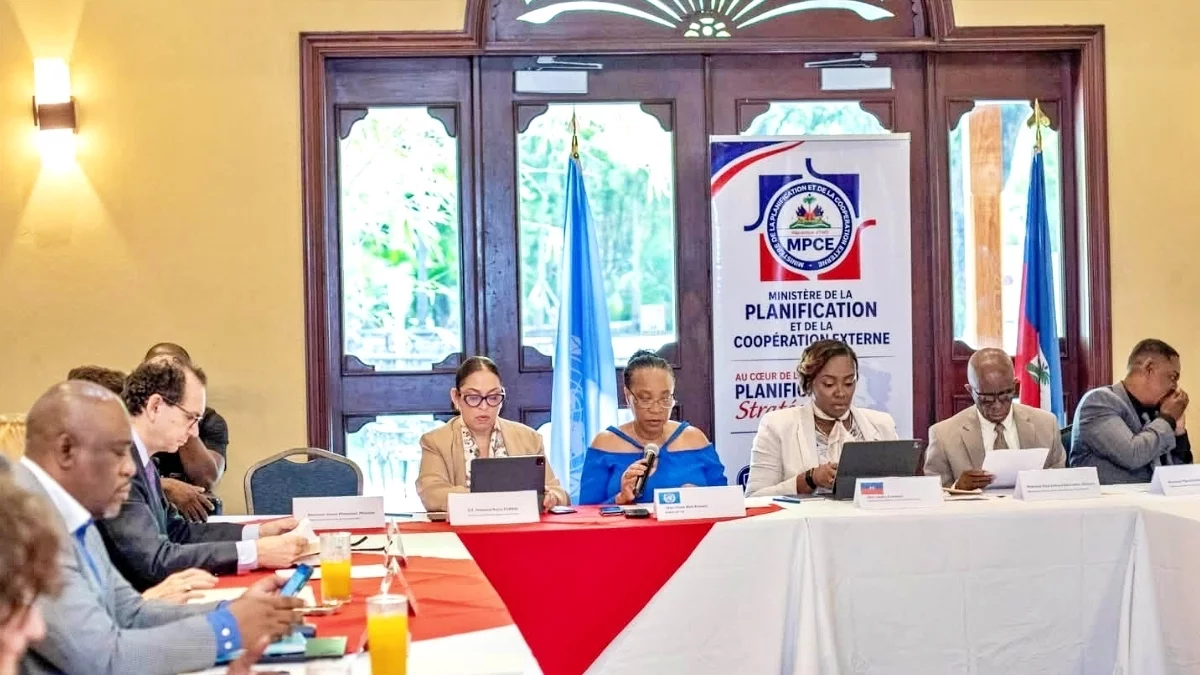
On July 30, 2026, high-level officials from the Haitian government and the United Nations system gathered at Port-au-Prince’s Karibe Hotel for a landmark steering committee meeting focused on the future of their long-standing strategic partnership. Co-chaired by Haiti’s Planning and External Cooperation Minister Sandra Paulemon and UN Resident Coordinator Nicole Boni Kouassi, the gathering brought together a broad cross-section of stakeholders, including multiple cabinet ministers, representatives from the diplomatic community, international technical and financial partners, UN agency heads, civil society leaders, and Haitian national institutional representatives.
The meeting centered on two core objectives: a full annual review of cooperation activities completed in 2025, and formal approval of an extension to the UN-Haiti Cooperation Framework, pushing its end date from the original expiration to December 31, 2028. The initiative builds on the strategic direction set by the administration of Haitian Prime Minister Fils-Aimé, which has prioritized aligned collective action to address the country’s most pressing challenges.
In her opening address to the committee, Minister Paulemon stressed that Haiti’s complex current challenges demand cohesive, coordinated government action paired with aligned international support. She framed the extended Cooperation Framework as far more than a bureaucratic agreement, positioning it as the foundational shared platform that unites government and UN action around Haiti’s nationally defined priorities. “This framework is not just another policy document,” Paulemon told attendees. “It is the common ground through which the Haitian government and the United Nations system organize collective action that directly serves our national development goals.”
Kouassi reciprocated the acknowledgment, praising the Haitian government’s consistent leadership in guiding the bilateral strategic partnership. She reinforced the role of the steering committee as the central joint governance body for the framework, tasked with setting broad strategic direction, verifying that all UN support aligns with national priorities, reviewing implementation results, and hosting open strategic dialogue. “It is a privileged space for strategic dialogue: a place where we can speak frankly about the difficulties, the necessary adjustments, and the choices to be made together,” Kouassi explained of the committee’s mandate.
Minister Paulemon used the meeting to reaffirm the Haitian government’s top current priority: restoring nationwide security. She outlined the government’s ongoing core initiatives, including the implementation of the National Commission for Disarmament, Demobilization, Reintegration, and Rehabilitation, acceleration of the National Program for Stabilization and Economic, Social, and Territorial Recovery, expansion and strengthening of essential social services, protection of human rights, coordinated action to combat gender-based violence, consolidation of democratic governance, and direct support for Haiti’s ongoing democratic transition.
Over the course of the meeting, stakeholders conducted a thorough review of 2025 implementation results, documented key lessons learned from the past year of cooperation, and debated strategic adjustments and programmatic priorities for the extended 2026–2028 cycle. By the close of discussions, attendees unanimously approved a revised programmatic framework that aligns all future cooperation with the government’s stated priorities and adapts programming to reflect Haiti’s evolving socio-political context.
On the topic of global sustainable development, Paulemon reaffirmed Haiti’s unwavering commitment to meeting the targets laid out in the UN 2030 Agenda for Sustainable Development. She outlined ongoing government efforts to reduce poverty and food insecurity, expand public access to quality healthcare, education, clean drinking water and core infrastructure, advance women’s economic and political empowerment, and strengthen community resilience across the country. The minister acknowledged, however, that SDG 16 – focused on peace, justice and strong institutions – has become the foundational prerequisite for progress on all other sustainable development targets. She also highlighted growing progress toward SDG 5 (gender equality), noting that five women now hold strategic cabinet portfolios in the current government.
As the meeting concluded, Paulemon expressed optimism that the extension of the Cooperation Framework would translate to expanded, more effective collective action, greater alignment across stakeholders, and more tangible results for Haitian communities. She emphasized that this ambition will depend entirely on consistent cross-stakeholder alignment of priorities, sustained resource mobilization, and transparent joint progress reporting. The Ministry of Planning and External Cooperation, she confirmed, will continue to lead coordination across all sectors, working alongside national institutions, local authorities, civil society groups, the private sector, the Haitian diaspora, the United Nations, and international technical and financial partners to deliver on the framework’s shared goals.