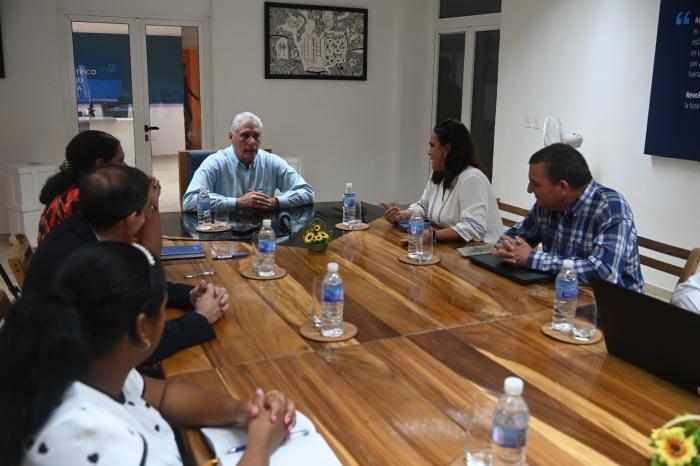
On July 24, 2026, Cuban President Miguel Díaz-Canel Bermúdez, who also serves as First Secretary of the Central Committee of the Communist Party, conducted his third official visit to the Havana Science and Technology Park, marking a continued high-level priority for the country’s science, innovation and digital transformation agendas.
Founded in 2020, the park has matured into a fully functional innovation ecosystem that nurtures homegrown technology ventures, many of which began as small-scale startup projects launched by local university talent. During this visit, Díaz-Canel held in-depth discussions with executives and founding representatives of technology-focused micro, small, and medium-sized enterprises (MSMEs) that were incubated within the park’s boundaries.
In his remarks following the meetings, the president highlighted the impressive track record of solutions the park has fostered, crediting the skilled talent pipeline cultivated by Cuba’s higher education system for these achievements. He called for deeper cross-sector integration between state-owned and non-state business entities, framing collaborative alliances as a critical driver to advance the nation’s research, development, and innovation (R&D&I) goals. He emphasized that these collective efforts must align with Cuba’s broader national development priorities, urging stakeholders to build greater public awareness of the impact of domestic innovation work.
Díaz-Canel also pressed attendees to leverage the full potential of the country’s recent economic and social policy reforms, singling out the information and communications technology (ICT) sector as an area with untapped transformative potential for the Cuban economy.
During the dialogue, the president received briefings on two standout technology MSMEs launched from the park. The first, Laberinto Tech, specializes in developing custom IT solutions for business operations and e-commerce initiatives. Yunior Almaguer, the company’s director and a recent graduate of the University of Computer Sciences, walked Díaz-Canel through the firm’s flagship fleet management system, built for leading Cuban tourism rental operators Transtur and Ecotur.
The second venture, Gemellux, focuses on data asset management, helping public and private organizations convert fragmented, unstructured data into actionable, high-value resources to inform strategic decision-making. Tatiana Delgado Fernández, Gemellux’s director, outlined the company’s ongoing partnerships across multiple key sectors, including the National Institute of Hydraulic Resources, tourism, and environmental management.
Speaking to reporters on the sidelines of the visit, Rafael Torralbas Ezpeleta, president of the Havana Science and Technology Park, outlined the institution’s core mission: to support the founding and scalable growth of new technology-focused enterprises. Acknowledging the significant headwinds facing new ventures in Cuba’s current impacted economic and social landscape, Torralbas noted that every resource the park provides acts as critical support for early-stage startups to survive and expand.
The park currently delivers three tiers of support for incubated ventures: basic infrastructure services, core technological resources, and high-impact value-added assistance. Torralbas emphasized that value-added services, which cover everything from legal consultation and financial guidance to market access support and investor connections, are often the most critical for small growing companies. The park also leverages its growing global network to help domestic ventures access international market and partnership opportunities beyond Cuba’s borders.
As of the visit, the park hosts 40 technology-based startups at varying stages of the incubation process: some have advanced to fully operational, growing business status, while others remain in early nascent stages of development. This visit marks the third presidential inspection of the park, following trips in its founding year of 2020 and again in 2023, underlining the Cuban government’s consistent prioritization of science, innovation and digital transformation as core pillars of its national governance agenda.