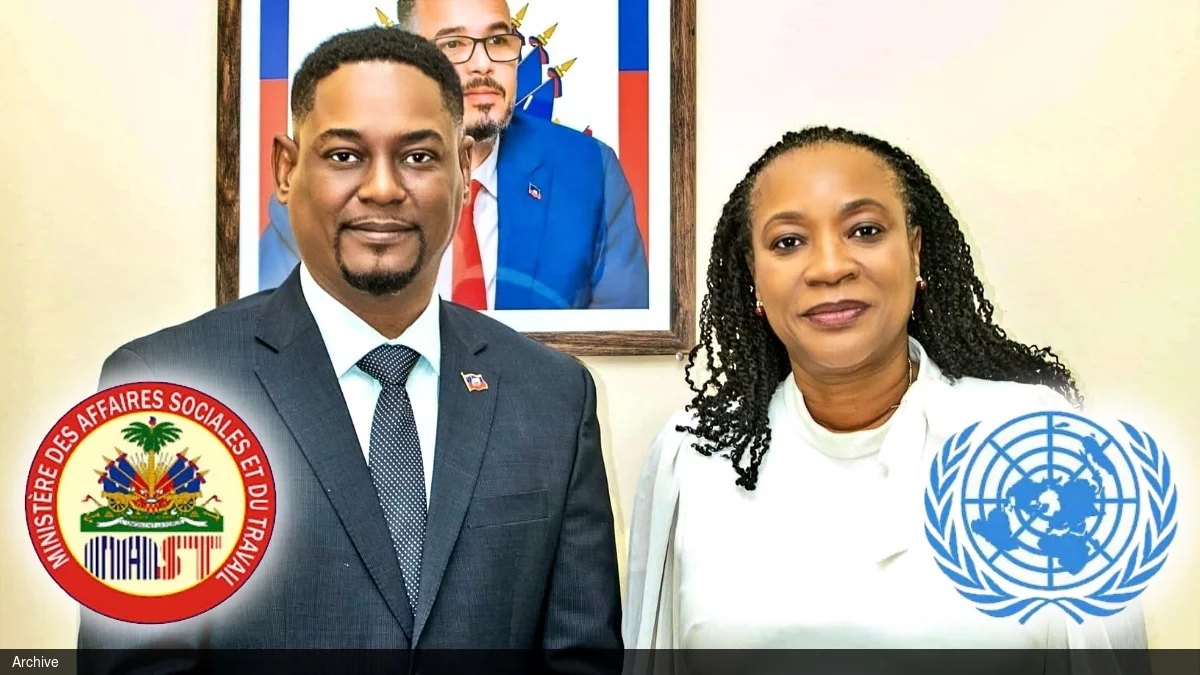
On July 28, 2026, high-level talks between Haiti’s Ministry of Social Affairs and Labor (MAST) and senior United Nations officials opened a new chapter of coordinated action to address the country’s deepening humanitarian and security challenges. At the MAST headquarters in Port-au-Prince, Marc-Elie Nelson, Haiti’s Minister of Social Affairs and Labor, welcomed Nicole Kouassi, Deputy Special Representative of the UN Secretary-General for Haiti, to align priorities across core areas of mutual work: social protection, humanitarian response, and long-term peacebuilding.
During the closed-door discussions, Minister Nelson laid out the Haitian government’s core strategic vision: to shore up social protection frameworks for the country’s most marginalized communities while creating conditions for the safe, sustainable return of tens of thousands of internally displaced persons (IDPs) to their home communities. He outlined tangible progress the administration has already made, including strengthening national social welfare systems, expanding targeted assistance programs, and scaling up direct cash transfer initiatives that reach thousands of vulnerable households monthly. Nelson also emphasized the urgent need to break down silos between short-term emergency humanitarian aid and long-term national development policies, arguing that integrated planning is critical to breaking cycles of instability in the country.
A central focus of the meeting was the urgent crisis facing children caught in Haiti’s rising tide of armed violence. Minister Nelson detailed the work of the Institute for Social Welfare and Research (IBESR), which operates dedicated rehabilitation centers and community-based reintegration programs for at-risk youth. He stressed that child-centered interventions remain a top priority within the country’s Disarmament, Demobilization, Reintegration, Arms Control, and Violence Reduction (DDR) framework, noting that targeted support for affected children is foundational to long-term violence reduction.
Talks also covered two other pressing priorities: preventing gender-based violence (GBV) and expanding protection for children associated with armed groups. Both parties acknowledged the critical on-the-ground support already provided by UN partners including the United Nations Children’s Fund (UNICEF) for these initiatives, and agreed to expand coordinated efforts in these areas moving forward.
By the end of the meeting, the two sides reached a formal agreement to strengthen institutional partnership between MAST and the UN system, improve cross-sector coordination between humanitarian and national social policies, and scale up initiatives that support the safe return of IDPs to their communities. To keep momentum going, attendees confirmed that the joint steering committee overseeing UN Peacebuilding Fund-supported initiatives will hold its next working session on July 30, 2026, at Haiti’s Ministry of Planning to advance ongoing projects.
Closing the meeting, Nelson reaffirmed the Haitian government’s unwavering commitment to close collaboration with the UN to build a unified, integrated response that connects emergency relief, long-term social protection, and sustainable peacebuilding. In response, Kouassi reiterated the UN system’s pledge to continue standing alongside Haitian authorities to develop locally led, sustainable solutions that deliver tangible benefits to the country’s most vulnerable populations.