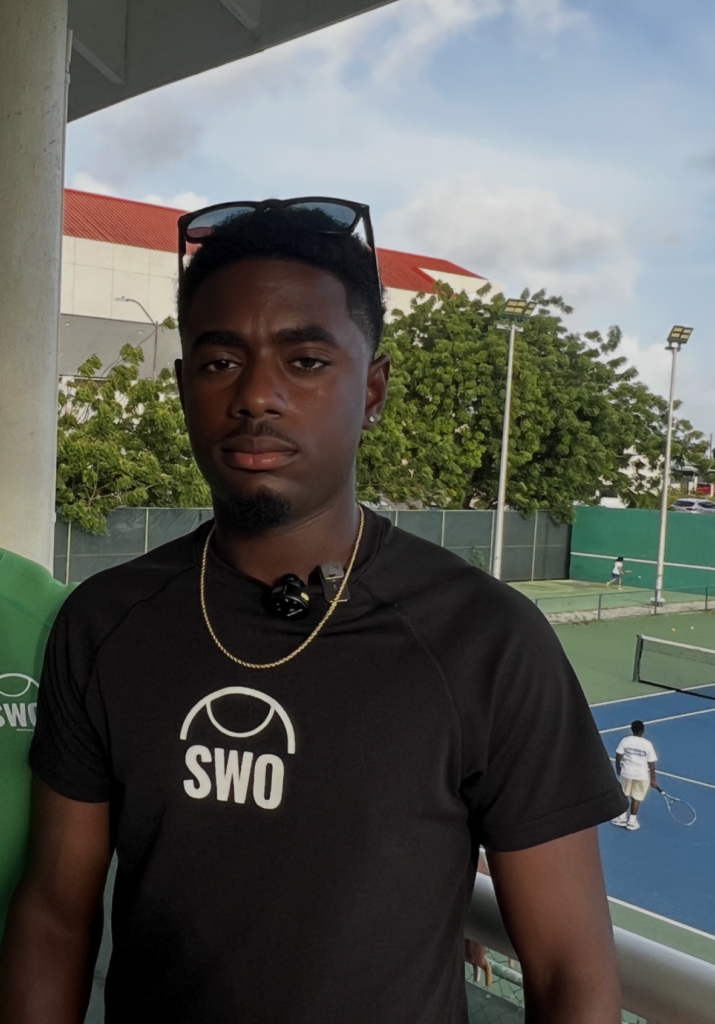
After wrapping up its third annual competition at the Raymond Forde Tennis Centre in Wildey on Sunday, the South West Open Tennis tournament’s leadership is pushing for greater private sector partnership to unlock the event’s full growth potential. Tournament Director Justin Atkins has publicly renewed his call for Barbados’ corporate community to step up with additional support, framing increased investment as the critical catalyst to expand the competition into separate elite men’s and women’s opens that would offer higher-stakes opportunities for a broader pool of athletes.
This year’s tournament delivered on-court excitement that exceeded the quality of the first two installments, according to Atkins. In the hotly contested doubles final, the father-son duo of Lucas and Tyler Davis defeated top seeds Russell Moseley and Christian Blunte with a 7-5, 6-1 scoreline. Lucas Davis continued his winning streak in the singles final, returning to the court to dominate Moseley in a straight-set 6-2, 6-2 victory.
Atkins noted that the 2024 iteration retained the high-caliber competition that established the tournament’s reputation, with standout local talents including Lucas Davis, Russell Moseley, Ammon Archer and Christian Blunte turning in strong performances. While the event missed the participation of Davis Cup representative Xavier Lawrence, who competed last year, Atkins emphasized that the overall competitive quality remained on par with previous years.
One of the most encouraging outcomes of this year’s tournament, Atkins said, was the high turnout of junior Barbadian players. Many young Barbadian athletes typically travel to the United States and nearby Caribbean islands to compete in sanctioned ranking events, but a large contingent returned home to compete in the South West Open this year. Atkins attributed this surge in junior participation to the tournament’s adoption of the Universal Tennis Ranking (UTR) system, a globally recognized standard that gives young athletes official ranking points to advance their competitive careers.
Looking ahead, Atkins highlighted the UTR system as a key tool to grow the tournament’s international profile, expecting it to draw more elite foreign competitors in future editions. But he stressed that separating the competition into dedicated Men’s Open and Women’s Open draws — a move that would elevate the event’s status and open more opportunities for athletes of all genders — will only be possible with increased financial and organizational backing from Barbados’ corporate sector. Without that additional support, Atkins argued, the tournament will not be able to reach its full potential as a cornerstone of Caribbean competitive tennis.