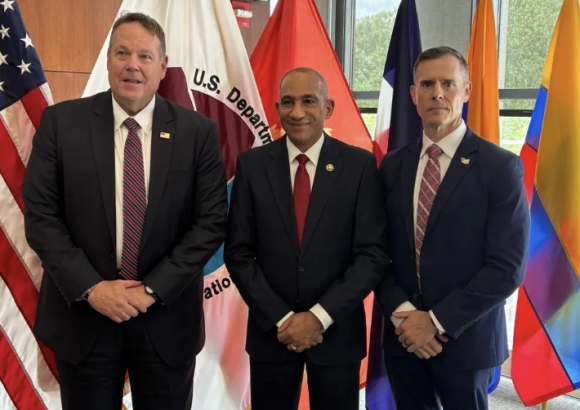
At a formal graduation ceremony held at the Marine Corps Base in Quantico, Virginia, a senior Dominican security official has underscored the irreplaceable value of bilateral cooperation between the Dominican Republic and the United States in disrupting transnational drug trafficking and organized criminal activity across the Caribbean. Vice Admiral José M. Cabrera Ulloa, president of the Dominican National Drug Control Directorate (DNCD), described the ongoing security alliance between the two nations’ law enforcement agencies as a foundational pillar for more effective counter-narcotics operations throughout the strategically vital region.
The event marked the completion of the Sensitive Investigations Unit (SIU) Basic Course, an intensive specialized training program designed and supported by the United States Drug Enforcement Administration (DEA). Addressing the graduating class and assembled officials, Cabrera Ulloa publicly extended gratitude to the DEA for its longstanding commitment to building operational capacity for security partners across the Americas and the Caribbean.
In his remarks, the DNCD chief pushed back against the narrow framing of international law enforcement cooperation as limited to simple information exchanges. He explained that effective collaboration against transnational threats requires much more: it relies on cultivating mutual trust between partner agencies, nurturing capable leadership across institutions, and equipping frontline law enforcement personnel with the skills and ethics needed to tackle evolving 21st-century security challenges.
Forty officers representing six regional nations crossed the stage at Quantico to receive their certifications following the completion of the course. The training curriculum centered on four core pillars: advanced techniques for conducting sensitive criminal investigations, uncompromising personal and institutional integrity, adherence to strict global professional law enforcement standards, and the practice of coordinated regional security cooperation.
Cabrera Ulloa stressed that selection and graduation into a Sensitive Investigations Unit is not merely a professional milestone, but a profound public commitment. Graduates pledge to safeguard sensitive operational information, reinforce public and institutional trust in law enforcement, and uphold the highest possible ethical and professional standards throughout their work confronting transnational organized crime.
Closing his address, the Dominican official reaffirmed his country’s unwavering commitment to deepening its existing strategic partnership with the DEA, and to expanding collaborative work with other regional security allies through coordinated joint action and targeted strategic cooperation to counter shared security threats.