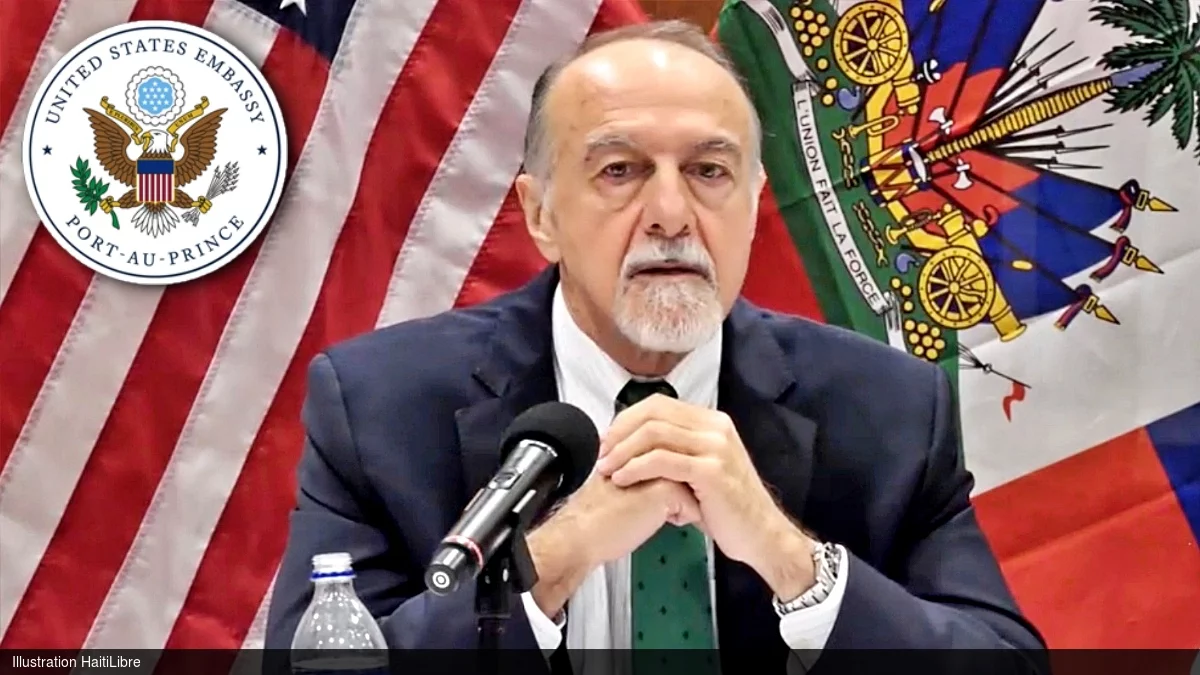
As Ambassador Henry Wooster prepares to leave his post in Port-au-Prince for a new assignment in Kenya just days after holding his final public address on July 23, 2026, he delivered a comprehensive reflection on his 12-month diplomatic mission in Haiti, breaking down Washington’s core priorities, ongoing bilateral cooperation, and long-term vision for the Caribbean nation.
Having first served in Haiti 28 years prior to his return in June 2025, Wooster opened his remarks by paying tribute to the Haitian people, noting he continues to be moved by their remarkable resilience in the face of some of the most severe crises the country has faced in modern history.
At the core of U.S. engagement in Haiti, Wooster emphasized, is the long-term goal of national stabilization. He drew a key distinction between two often conflated terms: security and stability. While the two concepts are connected, Wooster explained, security refers to the immediate operational conditions needed to enable safe, credible democratic elections. Stability, by contrast, is the lasting outcome built on legitimate public institutions, inclusive economic growth, and accountable governance. The sequential path, he argued, is to first establish foundational security, then build long-term stability — a two-step process that will create the conditions for Haiti’s economy to rebound, generate formal employment, allow children to resume in-person schooling, and restore consistent access to life-saving healthcare.
Addressing the most pressing threat facing Haiti today — the expansion of violent terrorist gang networks that have challenged the very survival of the Haitian state — Wooster highlighted the work of U.S. diplomatic teams both in Port-au-Prince and Washington DC to coordinate international action. Through collaboration with global partners and the United Nations Security Council, the international community launched the Gang Suppression Force (GSF), a multinational security mission that includes deployed troops from Chad, El Salvador, Guatemala, Jamaica, Mongolia, and Sri Lanka. GSF launched its first territorial clearing operations last month, Wooster confirmed, reporting that the force has already detained suspected gang members for processing by Haiti’s National Police (HNP), seized and destroyed illegal weapons caches held by gangs, and reopened key blocked roads to reclaim territory on behalf of the Haitian government. He added that operations will scale up significantly over the summer and fall as additional deploying contingents arrive in country.
While international security support provides critical time and space for Haitian institutions to rebuild, Wooster stressed that all long-term solutions must be led by Haitian national stakeholders. To build the capacity of domestic security forces, the U.S. Department of State’s P4000 program is currently supporting the HNP to recruit, train, and graduate 4,000 new uniformed officers by early 2027. Additionally, the U.S. Congress recently lifted long-standing restrictions on security cooperation with Haiti’s Armed Forces (FAd’H), clearing the way for institutional renewal. The Haitian government has made rebuilding the military a top priority, with new recruiting, training, and deployment cycles scheduled in the coming months.
On the democratic governance front, Wooster welcomed the Haitian government’s public commitment to the Haitian people to restore full democratic rule. He noted that achieving this goal requires collective action across government leadership, private sector actors, and civil society organizations to root out corruption, end widespread impunity for violence and graft, and prioritize the public good over narrow interests.
Wooster added that even robust security and governance reforms will not deliver lasting stability without expanded economic opportunity. Job creation, he argued, is not only critical for the survival of individual Haitian households, but also provides vulnerable young Haitians with an alternative to recruitment by violent terrorist gangs. He called on Haiti’s private sector to lead national economic recovery efforts, noting that sustained growth strong enough to lift the country out of its ongoing humanitarian crisis will require every business operating at full capacity to expand the nation’s economic base.
In closing, Wooster reaffirmed that the United States remains the largest single bilateral donor to Haiti, with more than $800 million in active ongoing assistance programs. In 2026 alone, the U.S. has contributed $125 million to the OCHA-managed Humanitarian Pooled Fund, alongside an additional $24 million for emergency food assistance and $11 million to support post-hurricane reconstruction and recovery. “A stable Haiti supports everyone’s interests: Haitian, American, and all nations across the region,” Wooster concluded before opening the floor for questions from reporters.