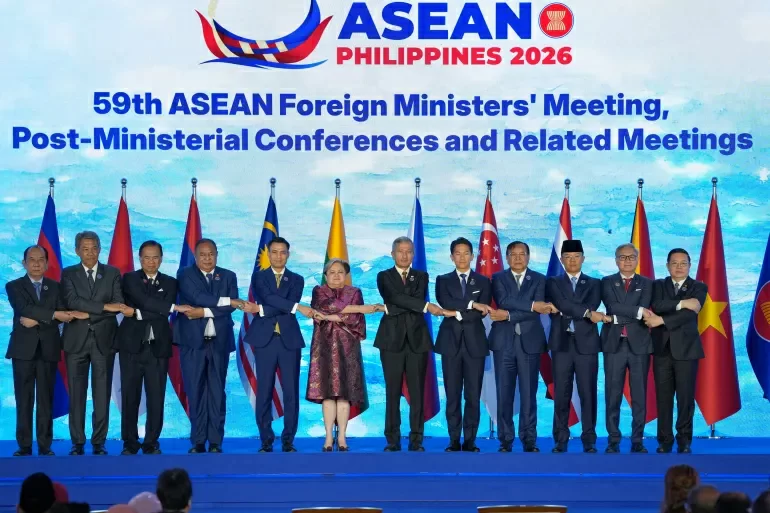
The annual ASEAN Foreign Ministers’ Summit kicked off on Monday in Manila, the Philippines, bringing together top diplomatic leaders from the 10-member Southeast Asian bloc to address a cascade of pressing regional and global challenges that threaten the bloc’s economic stability and security. The five-day gathering opened with urgent discussions over the far-reaching spillover effects of the ongoing US-Iran-Israel conflict and potential disruptions to maritime traffic through the Strait of Hormuz, a chokepoint that carries nearly a fifth of the world’s daily oil trade.
As a collective regional economy with a combined GDP of $3.8 trillion, ASEAN member states are heavily dependent on crude oil imports from the Gulf region. Any prolonged closure or disruption to the Strait of Hormuz would immediately jeopardize the bloc’s energy security, sending ripple effects through manufacturing, transportation and consumer markets across the region. To mitigate potential economic shocks, ASEAN ministers are currently debating proposals for a coordinated regional oil-sharing mechanism that would help buffer individual member states from sudden supply shortages and extreme price volatility.
Risks to energy markets escalated recently after Yemen’s Iran-aligned Houthi rebels announced a new maritime blockade targeting Saudi Arabia, raising fears of a expanded conflict across the Middle East that would push already strained global energy supplies further into crisis. In a joint statement released during the summit, ASEAN foreign ministers voiced deep alarm over escalating tensions in the region, warning that recent developments are undermining international mediation efforts and eroding the prospects for a peaceful negotiated resolution through diplomatic dialogue.
The high-profile attendance of top diplomatic representatives from major global powers including the United States, Russia and China at this year’s summit underscores the degree to which the Middle East crisis has reshaped global diplomatic priorities and disrupted global energy supply chains. Already, the conflict has driven sharp increases in oil and natural gas prices across Southeast Asia, stalling industrial production and cutting into export volumes for many regional economies. This pressure has forced ASEAN member states to actively pursue new energy trade partnerships to diversify their supply sources.
Speaking from Manila on the sidelines of the summit, Al Jazeera correspondent Barnaby Lo noted that despite being thousands of kilometers removed from the conflict zone, Southeast Asia is one of the hardest-hit regions globally due to its deep reliance on Middle Eastern oil. “For example, the Philippines became the first country in the world to declare a national energy emergency amid the current crisis,” Lo explained. “The country is already grappling with persistent supply shortages and skyrocketing fuel prices. Even after turning to non-traditional suppliers like Russia and China, Manila has little ability to counter the global market trends that keep prices at unaffordable levels.”
Beyond the Middle East energy crisis, the summit’s agenda also prioritizes two long-simmering regional conflicts: the ongoing crisis in Myanmar and rising territorial tensions in the South China Sea. Five years after the Myanmar military seized power in a coup, ASEAN continues to face widespread criticism over its engagement with the ruling junta, with opponents arguing that the bloc’s diplomatic outreach inadvertently legitimizes a regime that has overseen widespread human rights abuses and failed to restore democratic rule. ASEAN has struggled to make progress on its five-point peace plan for Myanmar, adopted shortly after the 2021 coup, with little to show for years of diplomatic engagement.
Tensions in the South China Sea have also flared in recent weeks, following a high-profile confrontation between Chinese and Philippine vessels in contested waters, derailing nearly a decade of slow-moving negotiations between ASEAN and China to finalize a binding code of conduct to prevent armed conflict in the strategic waterway. The United States quickly weighed in on the confrontation, condemning what it called China’s “dangerous and aggressive” actions, and accusing Beijing of pursuing a “troubling pattern of provocation” against legally operating Philippine maritime activities.
Founded in 1967, the Association of Southeast Asian Numbers counts 10 member states: Brunei, Cambodia, Indonesia, Laos, Malaysia, Myanmar, the Philippines, Singapore, Thailand, and Vietnam. The regional bloc works to advance economic integration, political cooperation and cultural exchange across Southeast Asia, with the goal of promoting collective stability and shared economic growth across the diverse region.