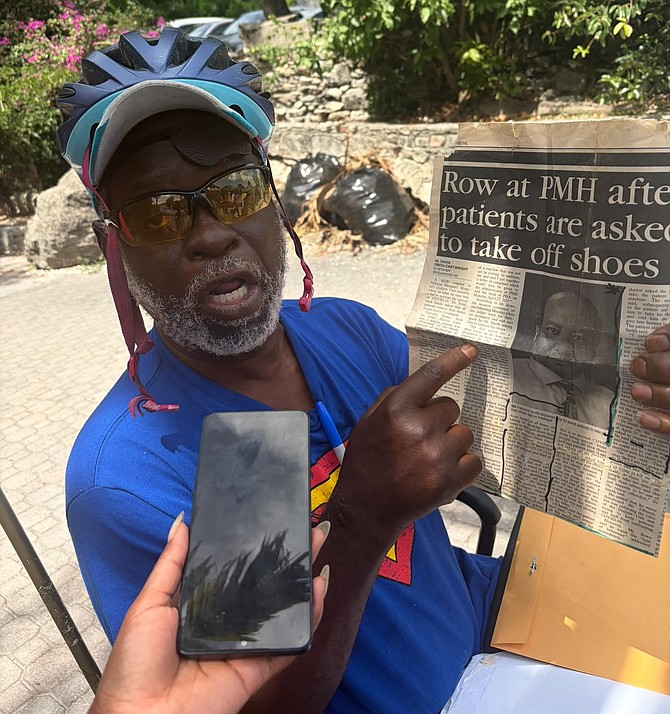
A decades-long disabled dialysis patient in Nassau has locked horns with public health officials over a forced transfer that he says puts his life at grave risk, in a dispute that lays bare gaps in support for vulnerable patients navigating the country’s public health system.
Sixty-two-year-old Marvin Johnson, a partially blind wheelchair user who has relied on three-times-weekly dialysis treatment at Princess Margaret Hospital (PMH) for seven years, says the facility’s decision to reassign him to the private Renal House on West Bay Street ignores his crippling transportation barrier: with a monthly pension of just over $600, he cannot cover the cost of daily round-trip travel to the new location. Johnson, who lives within walking distance of PMH, warns that missing even a handful of treatments could be fatal.
“If I don’t go for treatment two or three times, I might as well pick out my casket,” Johnson told reporters outside PMH Friday. He claims the transfer is retaliation for years of public criticism over what he calls substandard care at the public hospital, a charge that health administrators have flatly denied.
According to Johnson, he was never consulted about the permanent move to Renal House, after a temporary stay at Doctors Hospital arranged amid recent power outages that disrupted PMH’s dialysis unit. He does not oppose receiving care at an outside facility, he says, but is demanding full, 100% transportation coverage from the Public Hospitals Authority (PHA) if officials insist on moving forward with the reassignment. Johnson, who has reached out to multiple parties for intervention without success, says he was quoted around $80 per day for round-trip ride-share service — a sum that far outstrips his fixed income.
The PHA’s managing director, Dr. Aubynette Rolle, has pushed back sharply on Johnson’s account, saying the patient personally requested a transfer out of the public dialysis system. She told reporters Johnson was fully aware of the plan to move him to Renal House, and that he appeared satisfied with the arrangement when the pair discussed it.
Rolle explained the temporary transfer to Doctors Hospital was arranged to address disruptions from PMH power outages, and the permanent move to Renal House was intended to de-escalate long-running tension between Johnson and the head of PMH’s nephrology department. The conflict dates back to 2020, when Johnson claimed the department leader refused to treat him over a disagreement about removing his shoes. Johnson says he was ultimately vindicated in that dispute, but alleges the doctor has carried a grudge and influenced the transfer decision.
Dr. Rolle countered that an internal investigation cleared the nephrology department head of any wrongdoing, and dismissed Johnson’s retaliation claims as unsubstantiated. “He just alleges without nothing concrete,” she said, noting Johnson is welcome to pursue legal action if he believes his rights have been violated. While Rolle acknowledged Johnson’s transportation challenges, she said the PHA’s mandate covers medical care, not patient travel, and that patients requiring transportation support are routinely referred to social services. “The hospital cannot be blamed for the transportation element,” she added.
The decision to move Johnson has drawn condemnation from opposition political figures, with Coalition of Independents deputy leader Dr. Veronica McIver joining Johnson outside the hospital Friday to speak out against the policy. Johnson, for his part, says the transfer violates his constitutional rights and the PHA’s own patient bill of rights, arguing that unfair treatment of a legally blind, mobility-impaired patient is unacceptable in a public health system meant to serve vulnerable communities.