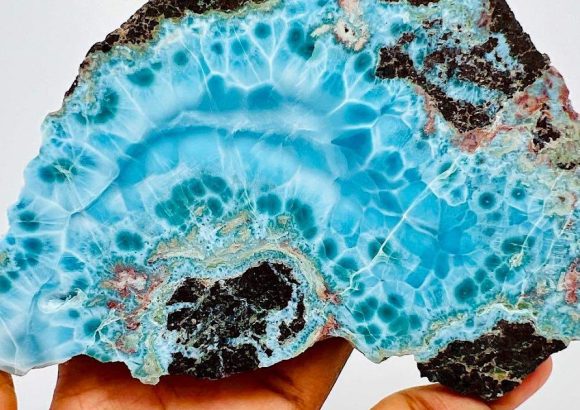
In a public statement released Sunday, the Dominican Republic’s Ministry of Energy and Mines moved to clear up widespread misconceptions surrounding raw larimar exports, emphasizing that shipments of the rare blue gemstone do not come at the expense of local Dominican artisans who rely on the material for their work.
According to ministry officials, current production data shows 60 percent of all larimar extracted from the country’s Barahona region mines remains within Dominican borders, leaving only 40 percent of total output designated for international export. The exported share is explicitly surplus material that the local jewelry manufacturing sector does not need, with the highest quality first- and second-grade larimar — stones celebrated for their vivid, intense blue hue and premium market value — reserved exclusively for domestic artisans and independent jewelry workshops.
Officials also addressed a common point of confusion in national trade data: most export aggregated statistics group raw, semi-processed, and fully finished larimar products under a single tariff heading. This means a large portion of the reported total export value actually comes from high-value finished larimar jewelry, not unprocessed raw stone, countering claims that the country is exporting most of its most valuable raw material.
To further strengthen the entire larimar value chain and connect key domestic stakeholders, the ministry has announced a new initiative: the 2026 Larimar Miners-Artisans Direct Sales Fair, scheduled to take place August 21 at the Larimar Museum Workshop School in Bahoruco, Barahona. The core goal of the event is to cut out unnecessary intermediaries by linking larimar miners directly to the artisans who use the stone, creating more equitable revenue distribution and supporting growth for small businesses across the sector.
In the statement, the ministry warned that imposing arbitrary restrictions on surplus larimar exports would carry severe economic consequences for local mining communities. Such a policy would cut off primary income for small-scale miners, undermine the long-term financial stability of local mining cooperatives, and put hundreds of working positions at risk across the region. Alongside addressing export policy, officials also highlighted ongoing improvements to the larimar mining sector, including upgrades to mine safety regulations and formalization efforts. Recent upgrades include enhanced ventilation systems, improved electrical infrastructure, and overall safer working conditions for mining employees.
New production data from the Dominican Directorate of Mining Promotion confirms that total larimar output reached 188,696 pounds across the first half of 2026, solidifying the country’s position as the only commercial source of the unique gemstone in the global market.