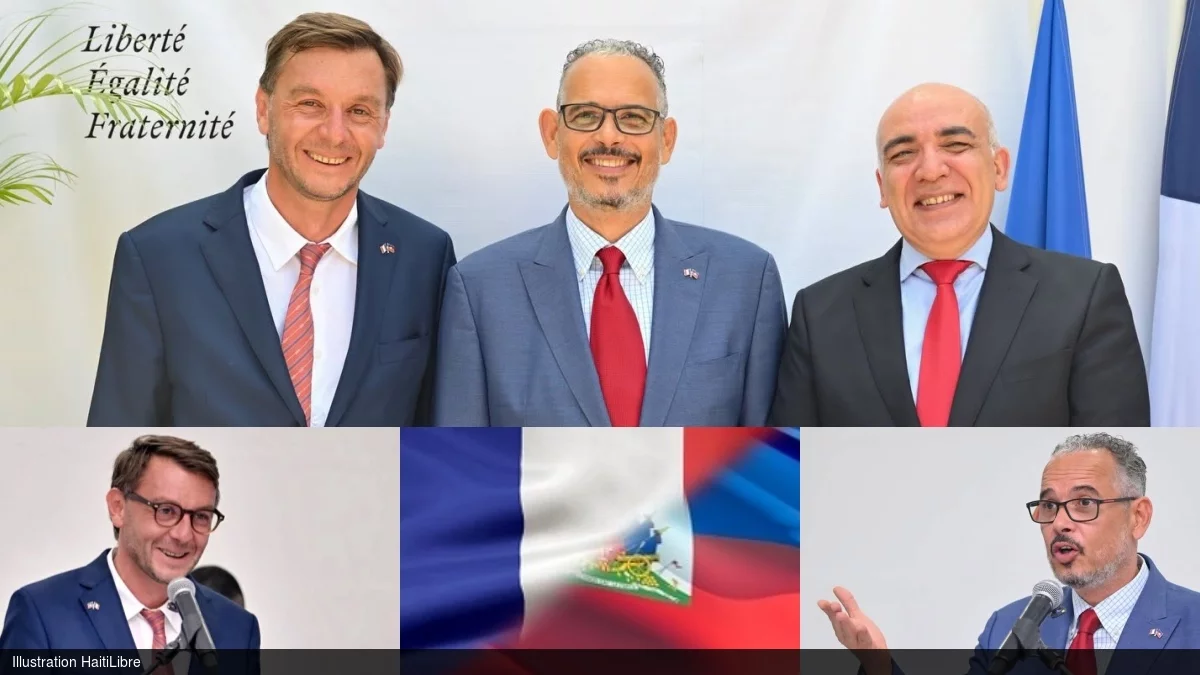
On July 14, 2026, Haiti’s Prime Minister Alix Didier Fils-Aimé delivered a landmark address at the official French National Day reception hosted by the French Embassy in Haiti at Port-au-Prince’s Montana Hotel. The high-profile gathering brought together a cross-section of senior stakeholders, including Haiti’s Foreign Minister Raina Forbin, multiple cabinet members, French Ambassador to Haiti Antoine Michon, Spanish Ambassador Marco Antonio Peñín Toledano, European Union Ambassador Hélène Roos, as well as dozens of senior diplomatic envoys and leading civil society figures.
In his opening remarks at the event, Ambassador Michon commended the deep, enduring positive ties between Paris and Port-au-Prince, and highlighted the Haitian government’s ongoing work to stabilize national security, rebuild state institutions, and lay the groundwork for a sustained return to democratic governance.
Prime Minister Fils-Aimé opened his address by honoring the French people and the foundational universal values that emerged from the 1789 French Revolution. He emphasized that July 14 carries unique meaning not just for France, but for all humanity, and holds particularly profound resonance for Haiti.
“Some dates belong to a single Nation, others become part of humanity’s common heritage. July 14th is one of these. This date resonates with a singular force in the Haitian soul. In 1789, the spirit of the Bastille crossed the oceans. In 1804, by breaking the chains of slavery to found the world’s first free Black republic, our ancestors gave freedom its most absolute meaning,” Fils-Aimé said.
The Prime Minister outlined the core lessons Haiti draws from the shared legacy of emancipation: no society can thrive without freedom, no governing authority holds legitimacy without the consent of the people, and no sustainable future can be built without upholding human dignity. He reaffirmed Haiti’s solidarity with France on its national holiday, praising the enduring guiding ideals of Liberté, Égalité, Fraternité that unite both nations.
A central focus of the address was the new step toward reconciliation between the two countries: the recent establishment of the Franco-Haitian Joint Commission of Historians, mandated to address the longstanding controversy over Haiti’s independence debt. Fils-Aimé stressed that the joint initiative, rooted in a commitment to historical accuracy, academic rigor, and mutual respect, proves that shared collective memory can serve as a bridge for reconciliation rather than a source of division, creating a strong foundation for future collaboration.
“From this history, sometimes fraught but always fruitful, stems a shared responsibility: to prioritize dialogue over division and cooperation over legacy and discord,” he noted. “By choosing historical truth, scientific rigor, and mutual respect, our two countries demonstrate that memory can be a force for reconciliation and a powerful lever for building the future.”
Looking ahead, the Prime Minister expressed confidence in Haiti’s trajectory, pointing to the country’s considerable assets: its young population, dynamic diaspora, vibrant cultural sector, and strategic geographic position in the Caribbean. He called for a renewed bilateral cooperation framework focused on driving productive investment, creating new jobs for Haitians, fostering innovation, and expanding knowledge exchange. Aligned with shared commitments to multilateralism, international law, and people-to-people dialogue, Fils-Aimé said France and Haiti will continue working together to build a more secure, stable, and prosperous Caribbean region.
He closed by affirming that the two nations are now entering an unprecedented new chapter in their bilateral relationship, one built on mutual trust, shared responsibility, and aligned ambition. “Trials belong to history; hope belongs to the future,” Fils-Aimé said. “May our cooperation continue to offer our people greater security and greater prosperity.”