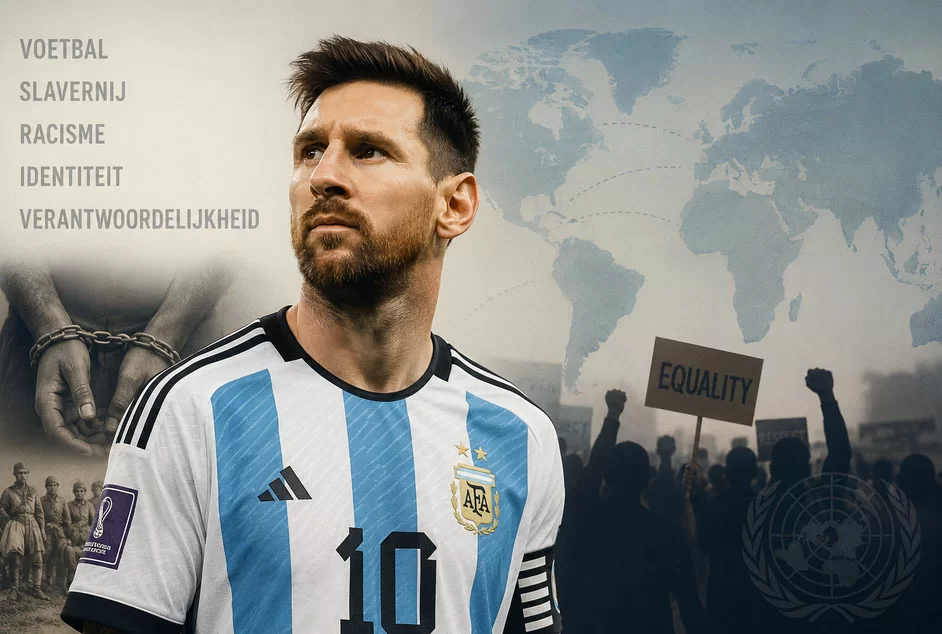
For decades, a national football jersey has stood for far more than just 11 athletes stepping onto the pitch. For millions of fans across the globe, it carries layers of meaning tied to history, colonialism, slavery, migration, national pride, political ideology and core societal values. This shift explains why Lionel Messi, widely lauded as the greatest footballer of his generation, is no longer judged solely on his on-pitch performances – he has become the global face of Argentina, a nation with a deeply complex history of ethnicity and national identity. This intersection of sport and society is particularly visible in Suriname during the World Cup, where tournament fandom is shaped as much by history, politics, identity, migration and cultural values as it is by 90 minutes of play.
For millions of people around the world, Messi remains first and foremost a once-in-a-generation footballing talent. His unrivaled technical skill, game-changing vision, understated public persona and trophy cabinet packed with every major honor in the sport have cemented his status as a global icon. To many of his fans, Messi exists separate from politics; they evaluate him exclusively on what he delivers on the pitch.
But this separation between sports star and national identity is no longer a given. Across social media, an increasing number of posts frame Messi not just as a footballer, but as a symbolic representative of Argentina, tying his public image to a range of political and social conversations. Critics point to the Argentine government’s vote against a United Nations resolution condemning the transatlantic slave trade, ongoing debates over the lack of Black Argentine representation in the national team, and past racism controversies tied to Argentine football. For some observers in Suriname, these issues mean Surinamese football fans should not support Messi or Argentina during the World Cup.
This reaction is emotionally understandable, but it demands nuance. Can a top professional athlete reasonably be held responsible for the policy decisions of their home country’s government? Sovereign states make political choices; footballers represent their nations only on the sporting field. To date, Messi has not made any public statement on the UN vote in question, so holding him personally accountable for a decision made by Argentina’s elected government is a difficult position to defend.
That said, this does not mean the broader social conversation taking place is unwarranted. Football has not been a politically neutral pastime for many years. National teams have evolved into powerful symbols of their home countries, and fans naturally tie individual players to national history, colonial power dynamics, migration histories, human rights and contemporary political movements. This means footballers often end up as the focal point of public debates that extend far beyond the sport itself.
Argentina’s history of ethnicity and national identity adds additional layers to this conversation. While the nation has a long, rich Afro-Argentine history, that legacy was largely underrepresented in mainstream national narratives for centuries. This gap has sparked international discussions about representation, national identity and how Argentina presents itself to the world. Past incidents, in which Argentine players or fans have been accused of racist language and behavior, have further fueled this ongoing debate.
For Suriname, this conversation carries unique weight. The nation’s identity is defined by its extraordinary ethnic diversity: Afro-Surinamese, Hindustani, Javanese, Indigenous peoples, Maroons, Chinese, Europeans and people of mixed heritage collectively shape the country’s national character. As a result, issues like slavery, colonialism, discrimination and equity are not abstract academic concepts – they are central to Suriname’s collective national history. It is therefore understandable that many Surinamese feel more acutely sensitive to discussions of racism or political positions tied to the lingering legacy of slavery. But this raises a core question: should admiration for a footballer like Messi be contingent on the political choices made by his country of birth?
In practice, there is no simple answer to this question. One camp argues that sport can never be separated from social responsibility, meaning athletes must be held accountable for the actions of the nations they represent. The opposing side believes football is meant to unite people, and individual athletes should not be blamed for political decisions over which they have no direct control. Both perspectives deserve to be taken seriously.
This same double standard can be observed when we compare how fans treat players from other nations. Few people hold English striker Harry Kane personally responsible for the United Kingdom’s centuries of colonial violence. Portuguese icon Cristiano Ronaldo is almost never judged on Portugal’s historic role in the transatlantic slave trade. French star Kylian Mbappé is not held accountable for France’s controversial migration policies. Egyptian winger Mohamed Salah is rarely called out to answer for Egypt’s domestic political landscape.
what many observers also overlook in this debate is the fact that Messi has spent the vast majority of his life outside Argentina. Born in Rosario, Argentina in 1987, Messi moved to Barcelona at age 13 to join FC Barcelona’s famed youth academy. He lived in the Barcelona region for nearly 20 years starting in 2000, before a short two-year stay in Paris during his time at Paris Saint-Germain. Since 2023, he has resided in the United States, where he plays for Major League Soccer’s Inter Miami CF. While he retains strong cultural ties to his country of birth, most of his childhood and adult life has been spent in Spain.
The World Cup has made clear that modern football is increasingly about far more than football itself. Fans do not choose which team or player to support based only on on-pitch quality. Historical connections, shared language or culture, political beliefs and core social values all shape fandom. As a result, a win or a loss carries meaning that stretches far beyond the final score on the scoreboard.
The World Cup has never been only a sports tournament. Fans often gravitate toward a specific nation because they have family ties there, share a language, have a shared migration or colonial history, or connect with its cultural identity. That is why so many Surinamese cheer for the Netherlands, while others feel a closer bond to Brazil for its signature attacking style of play, and still others support Ghana, Senegal or Morocco because of shared connections to the African continent.
For many fans, Messi will always remain a footballing genius. For others, he is inextricably tied to the nation whose public face he has become. This tension is likely to persist long after the final whistle of the World Cup. Perhaps that is both the great strength and the defining challenge of modern football: the game brings people together, but it also forces us to confront the big questions that divide our societies. It pushes us to reflect on identity, history, responsibility and how we view nations, athletes and one another. Ultimately, a World Cup always tells us as much about the world we live in as it does about the game played on the pitch.