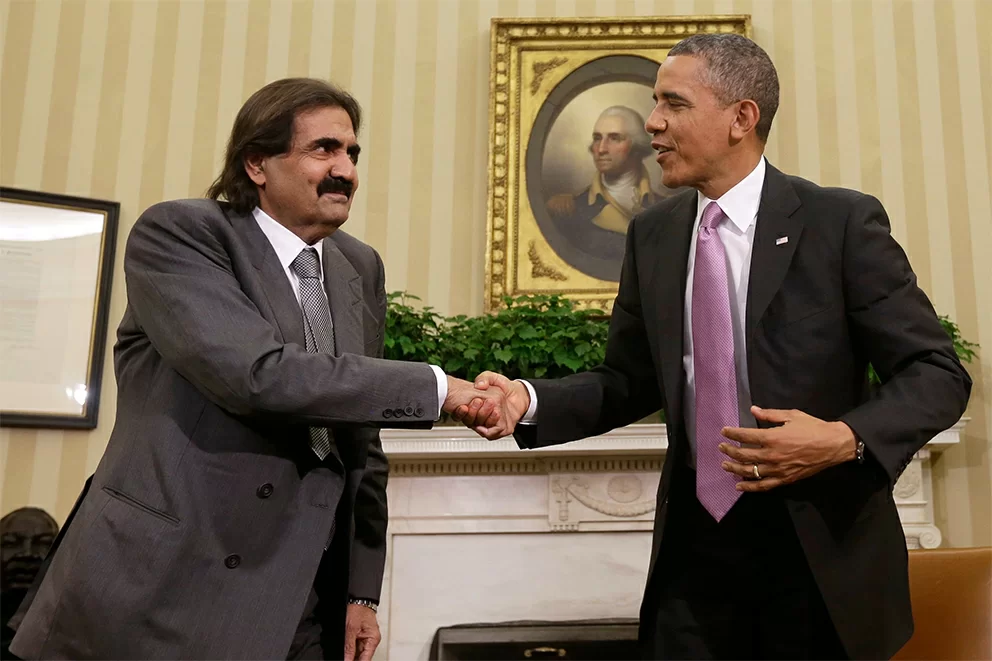
Qatar’s revered former ruler, Father-Emir Sheikh Hamad bin Khalifa Al Thani, has passed away at the age of 74. Following a simple, traditional Islamic funeral ceremony, he was laid to rest at the Lusail Cemetery, located just north of the Qatari capital Doha. Widely celebrated as the architect of Qatar’s rapid rise from a small Gulf state to a wealthy, globally influential modern nation, his death was publicly announced on Sunday morning.
Funeral rites were held after sunset prayers at Doha’s iconic Imam Muhammad ibn Abd al-Wahhab Mosque. Mourners dressed in traditional Gulf attire carried the draped casket through the mosque grounds, before his son and successor, current Emir Sheikh Tamim bin Hamad Al Thani, and other close family members escorted the late ruler’s body to its final resting place.
Official descriptions of the service characterize it as an understated, modest event, with Sheikh Hamad interred in a simple grave. This understated arrangement aligns both with longstanding Islamic funeral traditions and reflects the late ruler’s own personal values: throughout his life, he rejected overt displays of wealth and prioritized advancing the well-being of the Qatari people. An official national mourning period will run through Wednesday, after which Emir Tamim will welcome visiting heads of state and senior dignitaries at Lusail Palace to pay their respects.
Sheikh Hamad ruled Qatar from 1995 until stepping down in 2013, and his 18-year tenure reshaped the country’s trajectory on every front. His most transformative economic move was prioritizing the development of Qatar’s massive untapped natural gas reserves. Over the course of his rule, Qatar’s gross domestic product grew more than 24-fold, and by 2006, the small Gulf state had become the world’s largest exporter of liquefied natural gas (LNG), securing its position as a critical player in global energy markets.
His influence extended far beyond economic growth, however. In 1996, he backed the launch of Al Jazeera, the media outlet that would grow into one of the most influential and widely watched news networks in the world. In a statement following his death, Al Jazeera recognized Sheikh Hamad as the visionary behind the network’s founding, noting that his unwavering commitment allowed him to redefine the regional media landscape.
Sheikh Hamad also ushered in landmark political and social reforms during his rule. In 2004, he enacted Qatar’s first permanent constitution and introduced the country’s first municipal council elections, granting women both the right to vote and to run for public office at a time when such reforms were rare across much of the Gulf.
Under his leadership, Qatar also emerged as a respected neutral mediator in high-stakes regional conflicts, including long-running tensions between the United States and Iran. The groundwork he laid for Qatar’s global profile also paved the way for the country to host the 2022 FIFA World Cup, an event that cemented Qatar’s status on the global stage.
One of Sheikh Hamad’s most defining and unprecedented acts came in 2013, when he made the rare choice for a hereditary Gulf ruler to voluntarily abdicate the throne in favor of his then-33-year-old son, Sheikh Tamim. The peaceful handover of power to a younger generation marked a historic milestone for the region, and positioned Qatar for continued stable growth under new leadership.
Today, Sheikh Hamad’s legacy extends far beyond Qatar’s borders, leaving an enduring impact on global affairs. As Abdulla Banndar Al-Etaibi, a professor at Qatar University, summarized, “We are talking about someone who left a legacy across the entire world, not just in Qatar. He worked tirelessly to turn Qatar into a leading, exceptional nation, rather than just an ordinary country.”