East Asia is grappling with widespread damage and displacement after powerful Typhoon Bavi made its way across the region, leaving dozens dead, missing and millions displaced over recent days. The storm first carved a path through the Philippines before brushing northern Taiwan, slamming into eastern China, and triggering emergency responses across multiple countries and territories.
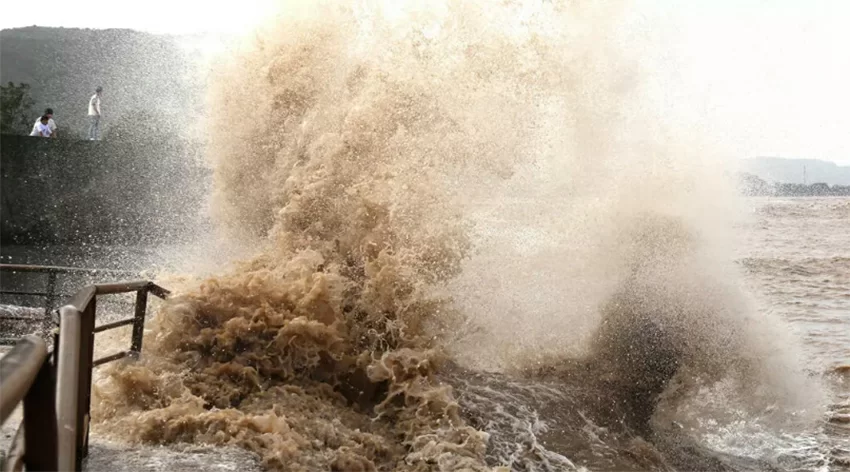
By Saturday, Chinese authorities had evacuated more than 1.7 million people ahead of Bavi’s expected landfall in the coastal province of Zhejiang, where the storm eventually came ashore on July 12 in the city of Yuhuan, packing maximum sustained wind speeds of up to 144 kilometers per hour near its center. In the days leading up to landfall, forecasters captured dramatic imagery of massive waves crashing into Wenling’s coastline on July 10, offering a stark preview of the storm’s impending force. After moving past northern Taiwan on Saturday evening, Bavi tracked northwest inland, bringing with it the threat of catastrophic flooding and wind damage.
Massive pre-emptive safety measures were rolled out across eastern China to mitigate risk. Beyond Zhejiang, surrounding regions including Fujian Province and the major metropolis of Shanghai also activated emergency protocols. Around 34,000 Shanghai residents living in high-risk coastal and flood-prone areas were relocated, while more than 17,000 trained rescue workers were placed on standby across Fujian. The China National Meteorological Center issued an orange typhoon alert — the second-highest warning level in the country’s alert system — and rolled out the first red heavy rain warning of 2026, signaling extreme flood danger.
Transportation across the region came to a near-standstill as hundreds of commercial flights were canceled and sections of China’s high-speed rail network suspended operations to protect passenger safety. To support emergency response and recovery, China’s central government has allocated 40 million yuan, equivalent to roughly $5.9 million USD, for disaster relief and response efforts in Zhejiang and Fujian. Hundreds of schools and ferry services across both provinces were also shuttered to keep residents out of harm’s way. Bavi marks the second major typhoon to impact China in just over a week, following Tropical Storm Maysak that made landfall in southern China on July 3.
The storm’s deadliest impact so far has been recorded in the Philippines, where Bavi amplified seasonal monsoon rains to trigger catastrophic landslides across the country’s southern regions. Official reports confirm at least 17 deaths: 10 people were killed in a single landslide that hit a village in Malapatan, Sarangani Province, with three more still listed as missing. A separate landslide in Calanogas, Lanao del Sur, killed five people and left six others unaccounted for, while two additional people drowned in flash floods in Bukidnon Province. More than 11,000 displaced residents have taken shelter in 77 emergency evacuation centers across the southern Philippines.
Taiwan also bore the brunt of Bavi’s force, as the storm brought torrential rain and fierce wind to the island. By Saturday evening, local health authorities had recorded at least 113 injuries, most linked to slippery road conditions and motorcycle accidents. Over 14,200 people were evacuated from high-risk areas, including communities in the eastern county of Hualien and the central city of Taichung. Schools and government offices across most of the island remained closed during the storm’s passage.
Further north, Japanese authorities issued urgent warnings for the country’s southern island chain, centered on Okinawa Prefecture. Officials warned residents to prepare for extreme high waves, powerful gusts, and storm surges, as the storm forced the cancellation of more than 200 domestic and international flights. Islands including Ishigaki have already recorded heavy rainfall and sustained strong winds as Bavi passes through the region.