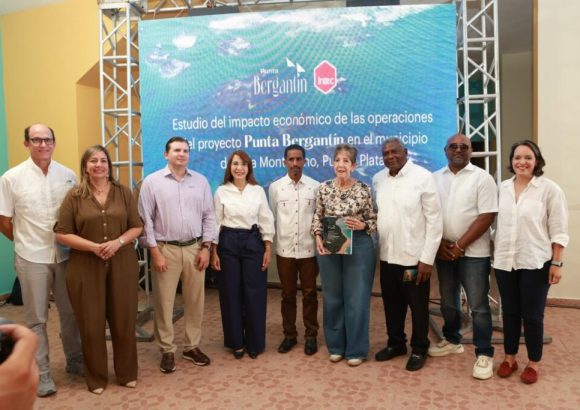
A new independent economic study led by researchers and consultants from the Technological Institute of Santo Domingo (Intec) has outlined sweeping positive socio-economic projections for the Punta Bergantín tourism development project in Villa Montellano, Puerto Plata, forecasting thousands of new local jobs, expanded business revenue, and broad-based growth for the entire regional economy.
Commissioned to map the full scope of potential impacts from the large-scale tourism initiative, the study titled *Economic Impact of the Operations of the Punta Bergantín Project in the Municipality of Villa Montellano, Puerto Plata* combines on-the-ground community input with rigorous econometric modeling to deliver its findings. Researchers collected primary data through interviews with 322 local households, 92 area business owners, and 15 community leaders, then cross-referenced that input with official statistics from the Dominican Republic’s National Statistics Office, Central Bank, Ministry of Tourism, Ministry of Finance, the Single System of Beneficiaries (Siuben), and global travel industry data from the World Travel & Tourism Council (WTTC) to build medium-term projections for the project.
The study’s core focus is breaking down the project’s direct, indirect, and induced impacts across the local economy, measuring effects on employment, household earnings, commercial activity, local production networks, and the overall municipal budget. It was framed as a data-driven tool to clarify the community’s existing socio-economic context, elevate resident input, and identify both opportunities and challenges tied to the project’s rollout.
Per the analysis, the Punta Bergantín project will generate robust employment gains for local residents from its earliest phases. During initial construction, the initiative is projected to create between 6 and 9 total jobs (counting direct, indirect, and induced positions) per hotel room. From 2025 to 2030, it will support an annual average of 7,000 to 11,000 direct jobs, most reserved for Villa Montellano residents. Phased hiring projections show 1,347 specialized roles will be available in the project’s current early stage, growing to 2,153 moderately skilled positions within six months, 3,709 roles within 18 months, and more than 8,187 local jobs within three years of breaking ground. To ensure local residents can access these opportunities, project leaders have committed to prioritizing Villa Montellano applicants over outside workers, and are already rolling out targeted training programs for language proficiency, technical tourism skills, and small business capacity building to help local artisans, restaurants, and entrepreneurs qualify as project suppliers.
Beyond employment, the study forecasts broad-based economic gains across the municipality. Annual total added value from the project is projected to hit roughly $200 million per year over the next decade. Local business sales are expected to jump between 25% and 30% as tourism activity drives increased consumer demand, while average household income for Villa Montellano residents will see a 14% to 17% increase from the project’s activity. Andrés Marranzini, executive director of Punta Bergantín, highlighted that the ripple effects will extend across nearly every sector of the local economy: increased local consumption, expanded retail and personal services, stronger transportation and logistics networks, growth in the regional real estate sector, and new productive partnerships with local agricultural, fishing, and manufacturing suppliers.
Survey data collected for the study underscores strong local buy-in for the project: 71.7% of participating local business owners reported they are eager to join the Punta Bergantín supply chain and capitalize on the new market opportunities created by tourism expansion. In addition to economic gains, the study identifies complementary opportunities for long-term community improvement, including upgrades to local road infrastructure and public services, the creation of permanent transparent communication channels to update residents on project progress, and intentional strategies to preserve Villa Montellano’s unique cultural identity through the region’s transformation.
Juan Carlos López Pérez, an Intec professor and lead researcher on the study, emphasized that the findings are grounded in empirical data collected directly from the community. “Our study shows and analyzes the various ways in which the Punta Bergantín project would impact the community of Villa Montellano, from both an economic and social perspective,” López Pérez explained. “The results—obtained through surveys and multiple econometric projections—demonstrate the positive effects that will materialize from the project’s implementation, yielding benefits and improvements for the municipality’s residents and the entire province. In short, Punta Bergantín has great transformative potential for the territory and the regional economy.”