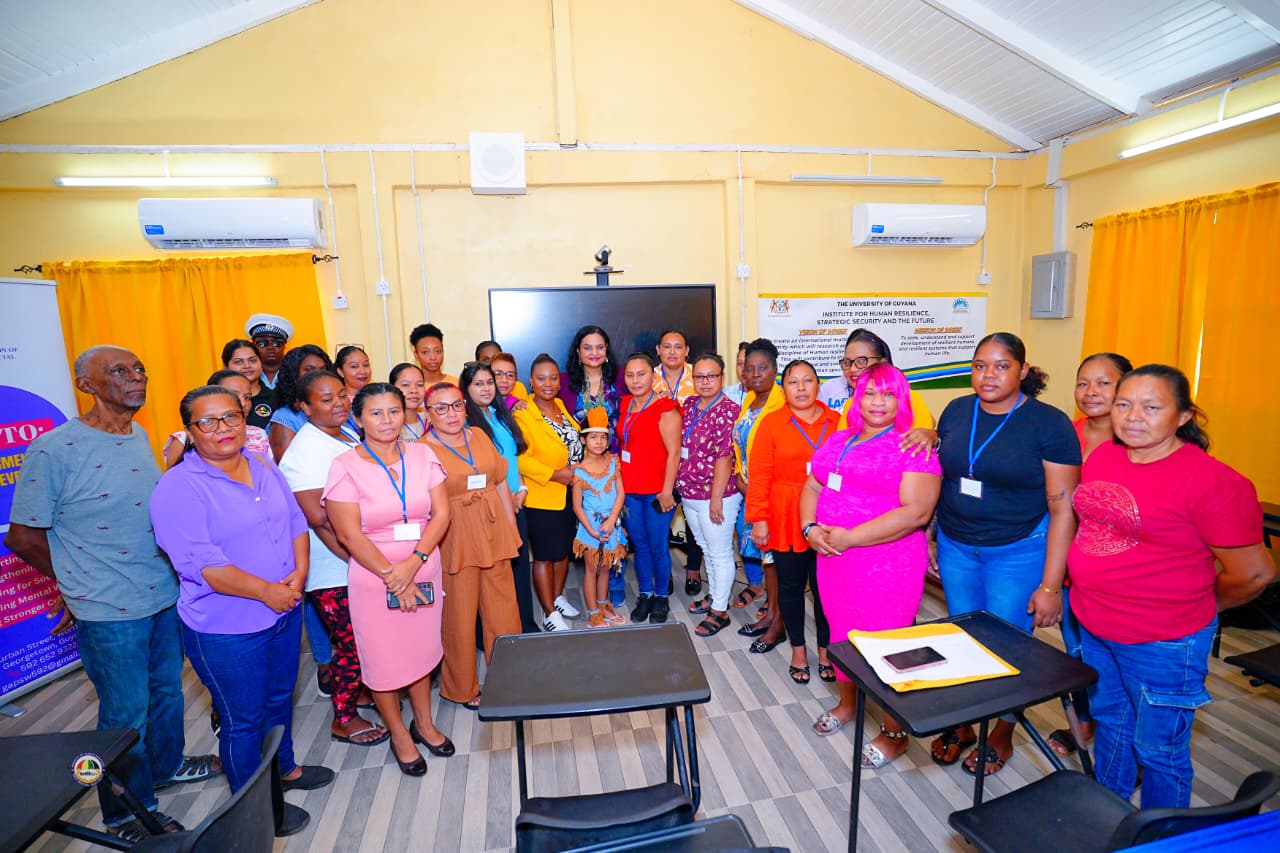
On Friday, Guyana’s Ministry of Human Services and Social Security officially launched a groundbreaking free training initiative to cultivate paraprofessional social workers, a response to the decades-long shortage of fully qualified social work professionals in the country’s remote interior, or hinterland, communities.
The Certificate in Paraprofessional Social Services (CPSS) program, launched in Mahdia, Region Eight (Potaro-Siparuni), aims to close a critical service gap that has left marginalized interior communities underserved for years. Speaking at the launch, Human Services and Social Security Minister Dr. Vindhya Persaud framed the program’s first cohort of trainees as pioneers trailblazing a new model of accessible social care for Guyana’s most remote regions.
For generations, key hinterland regions including Barima-Waini (Region One), Cuyuni-Mazaruni (Region Seven), Potaro-Siparuni (Region Eight) and Upper Takutu-Upper Essequibo (Region Nine) have lacked consistent access to specialized social services, a gap that has harmed outcomes for vulnerable groups across these areas. The new initiative directly advances the Guyanese government’s public commitment to expanding qualified social care coverage across the entire country, where demand for these critical services remains highest in remote interior zones.
Developed as a collaborative effort between the Ministry of Human Services and Social Security, the Guyana Association of Professional Social Workers (GAPSW), and the accredited University of Guyana, the program delivers no-cost foundational social work training that carries formal academic accreditation. Unlike ad-hoc community outreach, the initiative is designed to create long-term, meaningful career pathways for local hinterland residents, while simultaneously strengthening the country’s overall social services infrastructure. Upon successful completion of the course, graduates will be prioritized for open social services roles across government agencies, including the Childcare and Protection Agency, the central Social Services Department, and the Survivor Advocate Programme.
Minister Persaud emphasized that the program is far more than a short-term training course: it serves as a permanent launchpad for a lifelong career in social work, empowering local trainees to drive tangible, lasting change within their own communities. “This is more than free training. It is a launchpad into a career in Social Work. So, think about this as a lifelong path, where you will make a tangible impact on the future of the people of your community, your region, and your country,” she told participating trainees.
The minister also outlined the critical, multifaceted role that social workers play in advancing community well-being, from addressing child protection and family welfare to supporting survivors of gender-based and domestic violence and expanding access to mental health support. Strengthening these frontline services, she noted, is a non-negotiable foundation for building safer, healthier, more cohesive communities across Guyana.
She further stressed the importance of rigorous professional standards for the new cohort of paraprofessional social workers, including accurate case documentation, adherence to national standard operating procedures, and unwavering ethical conduct. Because social workers often serve as key stakeholders in the national justice system, contributing evidence and support during court proceedings and ongoing case management, upholding principles of integrity, transparency, and accountability is central to the role. “Justice must always be served, and as a social worker, you become part of that wheel of justice. So when you get into this profession, integrity, transparency and accountability is what will drive you further,” Persaud said.
Framed as a aligned investment paired with Guyana’s ongoing rapid economic expansion, the program reflects the government’s strategy to grow human capital in lockstep with national development. As Guyana experiences unprecedented economic growth driven largely by new offshore oil discoveries, the administration has prioritized ensuring that all communities — including remote interior regions left behind in past development cycles — gain access to the professional services and opportunities they deserve. “This programme is an investment in the education of the people of Guyana. As our country develops, we must ensure our human capacity develops alongside it, so that every community has access to the support and professional services it deserves,” the minister added.