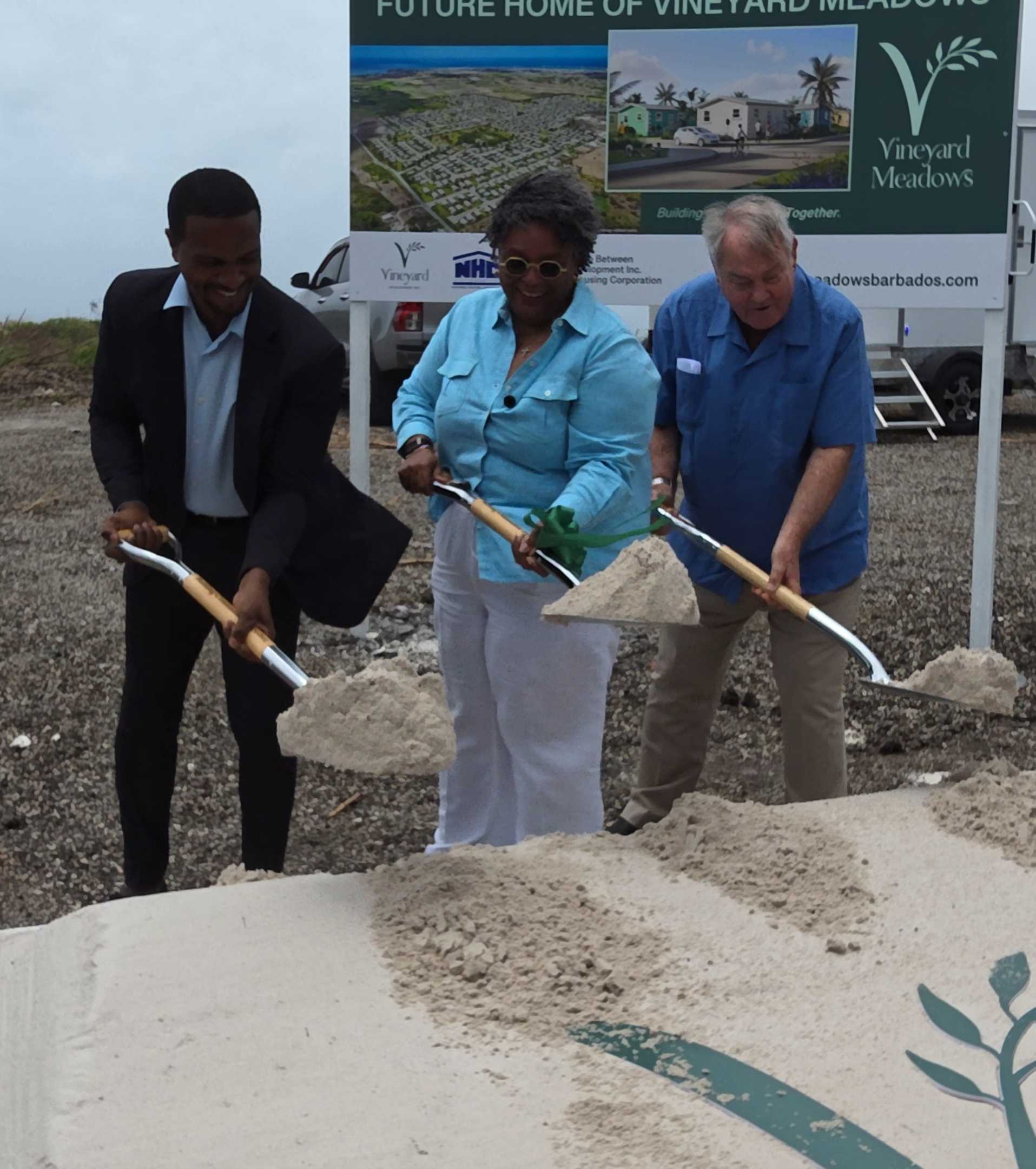
On a sunny Friday in Barbados, construction officially kicked off on what will stand as one of the largest affordable housing developments in the nation’s modern history. The 300-year-old former Vineyard agricultural plantation in St. Philip, once dedicated exclusively to growing commercial crops, will now be reborn as Vineyard Meadows, a planned 1,100-home community forged through a groundbreaking public-private joint venture.
The partnership pairs Barbados’ state-run National Housing Corporation with Vineyard Development Inc., a subsidiary of BJ Investments Ltd. led by Bjorn Bjerkhamn, a construction industry leader with five decades of experience delivering residential developments across the island, including the successful Ridge Meadows and Whitehall Meadows projects.
Spread across six construction phases that will unfold over five to six years, the development is centered on the last surviving landmark of the original plantation: the 300-year-old Pollards Mill, which will be preserved as a historic touchstone for the new community. Initial pricing for complete house-and-land packages will start at $170,000, a rate structured to meet the needs of middle- and low-income Barbadian families.
Speaking at the official groundbreaking ceremony, Prime Minister Mia Mottley framed the initiative as far more than a standard construction project, positioning it as a core driver of national transformation and long-term macroeconomic growth. She emphasized that the project marks a fundamental shift away from outdated, piecemeal housing strategies toward a model that builds complete, inclusive, and sustainable communities.
“This housing project is not just a housing project – it is the building of a community,” Mottley told the gathered crowd of government officials, private sector leaders, and parliamentary colleagues. “It is the ambition of this government to create opportunities for every Barbadian to be homeowners rather than renters and tenants in their own land. I have said too often that rent is dead money. When it leaves your pocket, it’s gone and you get back nothing from it. But that same sum of money when it leaves your pocket as a mortgage payment gives you equity that builds long-term wealth.”
Mottley also highlighted the unique financial structure of the joint venture that directly benefits homebuyers. Under the agreement, the Barbadian government contributes the land itself as its equity stake in the project, eliminating the need for private developers to take on costly land acquisition loans. This arrangement cuts out an estimated $10,000 to $15,000 in additional legal and financing fees that would otherwise be passed on to individual homeowners, making the properties far more accessible for first-time buyers.
Staying true to the government’s vision of an inclusive society, the development rejects the model of segregated gated communities, a stance Mottley reaffirmed during the ceremony. “Barbados is best when everybody lives together as a community, and that is why I have never supported gated communities,” she said. “We have had poor people and rich people live next to each other and work with each other for generations. That interconnection is the foundation of a strong, cohesive nation.”
Bjerkhamn, chairman of Vineyard Development Inc., noted that the project sets a historic precedent for Barbados as the first large-scale housing development delivered through a government-private sector collaboration. “Together with the National Housing Corporation, we share a common vision to make a meaningful contribution to the housing market by increasing the supply of affordable, quality homes for Barbadian families,” he said. “Beyond providing homes, Vineyard Meadows will create meaningful opportunities across the local economy.”
During the construction phase alone, the project is projected to employ roughly 500 Barbadian workers, with developers prioritizing locally sourced building materials to support domestic businesses and stimulate broader economic activity across the island. When complete, the formerly underutilized plantation land will become a vibrant, connected residential neighborhood.
To meet the diverse needs of residents from single young professionals to growing families, the development offers five distinct flexible architectural layouts ranging from 396-square-foot one-bedroom units (the Fern model) up to 936-square-foot three-bedroom, two-bathroom flagship units (the Laurel model). Unlike many entry-level affordable housing developments that force residents to relocate as their families or incomes grow, all Vineyard Meadows units are designed to be expandable. Owners can add space and upgrade finishes incrementally over time as their budgets allow, meaning homeowners can put down roots and stay in the community long-term as they move up economically.
Derek Edwards, chief operations officer of Vineyard Development Inc., emphasized the community-centered design philosophy that guides the entire project. “Today, on the lands of the Vineyard plantation, surrounding the historic property of Pollard’s Mill, we do more than turn soil; we turn a page,” Edwards said. “For generations, this land grew crops. From today, it will grow something far more valuable: homes, families, and community. Affordability should never mean one size fits all, and our one-bedroom homes are deliberately designed to grow with you. As your family grows, and as your means grow, that one-bedroom can expand to a three-bedroom. You will not have to leave Vineyard Meadows to move up in life.”
Neighborhood infrastructure is purpose-built to foster connection and active living, rather than the isolation common to many modern residential developments. Shared public amenities include road tennis courts, netball courts, a mini football pitch, children’s playgrounds, and an expansive walking track lined with outdoor fitness stations. A future on-site commercial village will add local dining, retail shops, and daily convenience services, cutting down on the need for residents to travel long distances for everyday needs. To address concerns from nearby communities in St. Philip, developers have adjusted road layouts and added green buffer zones to reduce the impact of construction and long-term traffic on existing residents.
Vineyard Meadows is the flagship project in Barbados’ broader national strategy to overhaul the country’s housing infrastructure, with additional planned developments including multi-storey condominium projects in urban Greenfields and Exmouth. The government is also pairing housing renewal with climate-smart vertical agricultural initiatives across the country to preserve national food security.
For stakeholders across both the public and private sectors, the project represents more than just a solution to the island’s affordable housing shortage: it is a proof of concept for how cross-sector collaboration can deliver inclusive, sustainable growth that benefits all Barbadians.