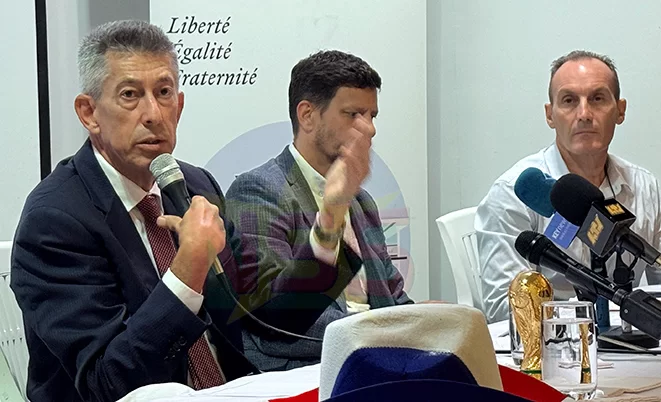
On the eve of France’s national Bastille Day celebrations, outgoing French Ambassador to Suriname Nicolas de Lacoste issued an urgent public call for Suriname’s parliament to finally ratify a border agreement signed by both nations five years ago, warning that continued inaction is blocking broader bilateral cooperation between Suriname and French Guiana, an overseas department of France.
Speaking at a press conference in Paramaribo on Thursday, de Lacoste outlined that parliamentary approval of the border protocol would clear the path for negotiations on a sweeping expanded partnership agreement covering multiple sectors of mutual interest. The ambassador, who will end his four-year posting to Suriname in just one month, noted that the draft ratification bill was first added to parliament’s agenda in 2023, and was revisited in November 2025, but has remained stuck in legislative gridlock ever since.
The agreement in question is the product of more than four years of renewed negotiations that began in 2017, under de Lacoste’s predecessor Ambassador Antoine Joly. It serves as a formal update to the 1915 Treaty of Paris, establishing a clear, digitally mapped border along the Marowijne River between Suriname and French Guiana. The new border is marked by 2,300 precise GPS points, running from the mouth of the Marowijne to the confluence of the Lawa, Litani, and Marowini rivers. Under the agreed terms, any river island closer to the Surinamese bank falls under Surinamese sovereignty, and vice versa, with one notable exception: the island of Jamaica, previously held by France, will be transferred to Suriname under the new framework. The agreement also makes the full GPS border data publicly accessible, allowing any citizen to view the exact boundary on consumer mapping tools such as Google Maps.
De Lacoste stressed that years of diplomatic work have already produced a fair, negotiated deal that resolves longstanding territorial ambiguities in the region. The push to finalize negotiations gained urgency after three high-profile incidents in the border region in the 2010s, in which French gendarmerie destroyed property belonging primarily to Surinamese gold miners operating in disputed territory. Five years after the protocol was formally signed by both countries’ foreign ministers, however, Suriname’s legislative branch has yet to complete the ratification process.
“Over my four years here, I have worked steadily to convince members of parliament of the benefits of this agreement, but so far those efforts have not yielded results,” de Lacoste said. He added that the border agreement is a foundational prerequisite to launch deeper collaboration across economic, security, and infrastructure sectors. The ambassador pointed to the successful cross-border partnership between French Guiana and Brazil as a model for what Suriname and France could achieve, highlighting the well-managed border crossing at Oiapoque, where a new bridge enables seamless travel, cross-border school attendance, and close security cooperation between the two sides.
De Lacoste expressed frustration that the bill has remained stuck after its initial parliamentary hearing, saying it has been nearly impossible to get the legislation re-scheduled for a final vote. When asked why Suriname’s parliament has delayed ratification, he replied, “You will have to ask them that question.” He also noted that currently, Suriname does not formally recognize the border with France, a gap that creates uncertainty even for planned infrastructure projects: “We hear about plans to build a bridge across the Marowijne, but this is a river whose border we do not even have formal agreement on,” he said.
As a direct result of the ongoing ratification delay, the planned December 2025 meeting of the bilateral Marowijne River Council in Saint-Laurent has been suspended, with talks on new cooperation formats put on hold until the border issue is resolved. De Lacoste emphasized that dialogue between the two neighbors will continue regardless, but warned that without a rapid resolution, his successor Benoît Denis will inherit the same cooperation gridlock that has marked his own tenure.
French officials have repeatedly pushed for ratification since 2023, when Michèle Ramis, Director for the Americas and the Caribbean at France’s Ministry for Europe and Foreign Affairs, publicly called for Suriname’s approval during an official visit to the country. De Lacoste reiterated that France remains fully open to continued political dialogue, pointing to recent talks between Surinamese Foreign Minister Melvin Bouva and his French counterpart Jean-Noël Barrot held in Fort-de-France, Martinique, but emphasized that no expanded cooperation can move forward until the border protocol is formally ratified.