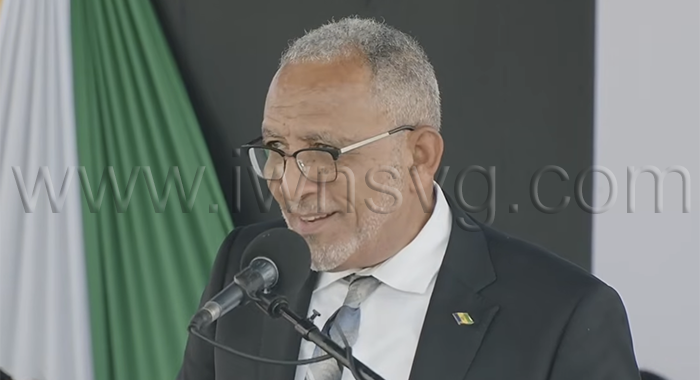
Shortly after taking office last November, the administration led by St. Vincent and the Grenadines Prime Minister Godwin Friday has laid out a clear, youth-centered policy core: to give young people the tools and opportunities to build prosperous careers and fulfilling lives without leaving their home country. The prime minister announced this commitment during a keynote address at the recent St. Vincent and the Grenadines Community College (SVGCC) graduation, where 961 graduating students crossed the stage to receive their certificates and diplomas.
Friday acknowledged that encouragement for young graduates, while meaningful, only goes so far. He understands that uncertainty about future prospects lingers behind every graduate’s celebration. “Alongside that excitement, there is often another question: ‘Will there be opportunities for me?’ That is a fair question,” he told the gathered graduates and attendees in the capital city of Kingstown. “My government understands that young people want more than encouragement, that you want opportunity. That is why job creation remains one of the highest priorities of our government.”
Central to the government’s agenda is a comprehensive restructuring of the national economy to better absorb the growing pool of skilled young talent exiting post-secondary institutions like SVGCC. Unlike traditional economic models that have pushed many young Vincentians to seek opportunities abroad through migration, Friday’s framework is designed to let young people build their futures locally. “We are working to create an economy that rewards initiative, encourages innovation, attracts investments, and creates opportunities for our people,” he explained.
To turn this vision into action, the prime minister outlined three interconnected priority pillars. First, the administration will roll out targeted support for emerging entrepreneurs, expand accessible and affordable skills training, and improve access to capital through new public financing mechanisms, including a planned national development bank. These measures are intended not just to create existing jobs for graduates, but to empower the next generation to become job creators themselves, growing the local private sector from within.
Second, the government is prioritizing the development of a forward-looking “new economy” centered on the untapped economic value of creativity, innovation, and sports. Friday noted that the modern global economy is fundamentally unrecognizable from that of previous generations: digital transformation has reshaped how people work, connect, and do business, creating entirely new career pathways that did not exist a decade ago. In this new landscape, narrow traditional definitions of success no longer apply, he argued. Creativity, original ideas, and cultural production all hold tangible economic value that the government is ready to support.
Key creative sectors highlighted by the prime minister range from music, film, fashion, writing, and visual arts to digital content creation, social media influence, and DJing. Alongside creative industries, expanding professional and commercial opportunities in sports is also a top strategic priority. Friday even predicted that the country’s next generation of global ambassadors is far more likely to emerge from these dynamic cultural and digital spaces than from traditional elite career tracks.
In closing remarks to graduates, Friday offered guidance for navigating this shifting economic landscape. He urged young people to be willing to step away from conventional career paths to seize emerging opportunities, noting that new openings rarely come with clear signposts. Success in the modern economy, he emphasized, requires an alert mind, adaptive mindset, and careful discernment to spot and act on chance.
The prime minister also stressed that graduation marks the start, not the end, of a graduate’s educational journey. Lifelong learning, he argued, is non-negotiable for maintaining long-term employability in a fast-changing economy. “The ability to adapt, to continue learning and to embrace new ideas will be among your greatest strengths and your challenges,” Friday said. “That is why education must be lifelong, must be continued throughout, and that you should take every opportunity possible to continue to learn and to develop yourself.”