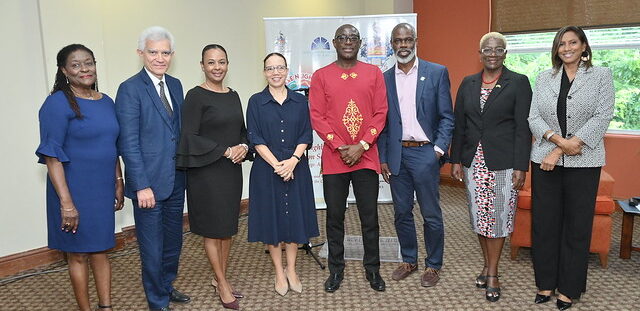
Against a backdrop of mounting global geopolitical tension and economic pressure on Cuba, The University of the West Indies (UWI) recently brought together leading diplomats, academics and policy specialists for a high-level virtual forum focused on unpacking the multifaceted crisis facing the island nation and its implications for the entire Caribbean region. Held on June 25 under the banner of the university’s Vice-Chancellor’s Forum series, the event titled “Perspectives on the Current Cuban Crisis: Issues, Impact, and Imperatives” aimed to bridge academic analysis, diplomatic insight and on-the-ground perspective to frame a collective regional response.
Chaired by Ambassador Gillian Bristol, director of UWI’s Latin American-Caribbean Centre (LACC) who served as programme chair for the gathering, the discussion was co-moderated by Pro Vice-Chancellor for Undergraduate Studies Professor Canute S. Thompson and Professor Don D. Marshall. In opening remarks delivered on behalf of UWI Vice-Chancellor Professor Sir Hilary Beckles, Thompson emphasized that the regional public university does not position itself as a detached bystander to pressing global and regional challenges. “We are not passive observers; we are activists,” he stated, reaffirming the institution’s longstanding commitment to confronting issues that shape the future of Caribbean nations.
Cuba’s Ambassador to Jamaica, Her Excellency Tania López Larroque, framed the root of the country’s current struggles in the context of 60-plus years of punitive U.S. sanctions. She noted that restrictions on economic, commercial and financial activity have been sharply ramped up since the start of this year, directly undermining access to basic necessities including food, fuel and life-saving medicine, while blocking critical foreign investment. Larroque rejected claims that sanctions serve the interests of the Cuban people, and called for renewed global commitment to multilateral cooperation and unwavering respect for sovereign national self-determination.
International relations scholar Professor Andy Knight of the University of Alberta characterized the current global order as an “interregnum,” a period of transition where long-accepted international norms are facing growing erosion. He warned that the erosion of sovereignty and non-intervention principles in the case of Cuba sets a dangerous precedent that threatens all small developing states. “If the principles of sovereignty and non-intervention are compromised… no small state can presume it will remain protected,” Knight argued, urging regional leaders to take a clear, principled stand in defense of Cuba.
Dr. Miriam Nicado, rector of the University of Havana, offered a firsthand account of the crisis, describing the country’s economic and diplomatic isolation as “a strangling.” She detailed the crippling impact of persistent electricity shortages on Cuba’s higher education sector, particularly disrupting online learning initiatives. Even amid these challenges, Nicado highlighted the ongoing UWI-Havana Centre for Sustainable Development as a powerful example of productive regional collaboration that continues to deliver shared benefits.
Professor Emerita Jessica Byron-Reid reflected on more than half a century of partnership between the Caribbean Community (CARICOM) and Cuba, recalling the island nation’s enduring contributions to regional education and public healthcare systems across the Caribbean. She emphasized that the region can never fully repay the debt of solidarity it owes to Cuba, arguing that the current crisis presents a critical opportunity for CARICOM to reciprocate that longstanding support.
UWI St. Augustine’s Dr. Indira Rampersad offered analysis of Cuba’s ongoing reform agenda, which includes 176 targeted economic adjustments. Rampersad noted that the reforms represent a deliberate effort to expand market-oriented policy flexibility while retaining the country’s core socialist political framework, drawing comparisons to the successful development models pursued by China and Vietnam.
Professor Bert Hoffmann of the German Institute for Global and Area Studies (GIGA) confirmed that the current reform package is the most ambitious and far-reaching Cuba has undertaken in its modern history. However, he stressed that meaningful economic recovery will remain out of reach unless the country regains access to global banking systems and sees meaningful relief from sanctions, which continue to deter all major foreign investment flows.
Throughout the discussion, participants united around a call for intentional regional engagement rather than the risk of turning away and ignoring the crisis. Byron-Reid outlined a clear path forward for CARICOM, urging the bloc to prioritize preserving the Caribbean as a neutral zone of peace, protecting Caribbean citizens residing in Cuba, delivering targeted humanitarian relief, and backing Cuba’s efforts to rebuild its economy. Echoing this call, Knight noted that the Caribbean’s collective response to Cuba’s crisis will ultimately shape the region’s own standing and future in the global order.
To translate the forum’s call for action into tangible support, UWI used the closing of the event to announce the launch of its One-UWI Humanitarian Effort, led by the university’s School of Graduate Studies and Research. The initiative is calling on staff, students, alumni and institutional partners across all five of UWI’s campuses to make financial contributions to fund essential supplies for the Cuban people, with donations open through an online fundraising platform until September 30.