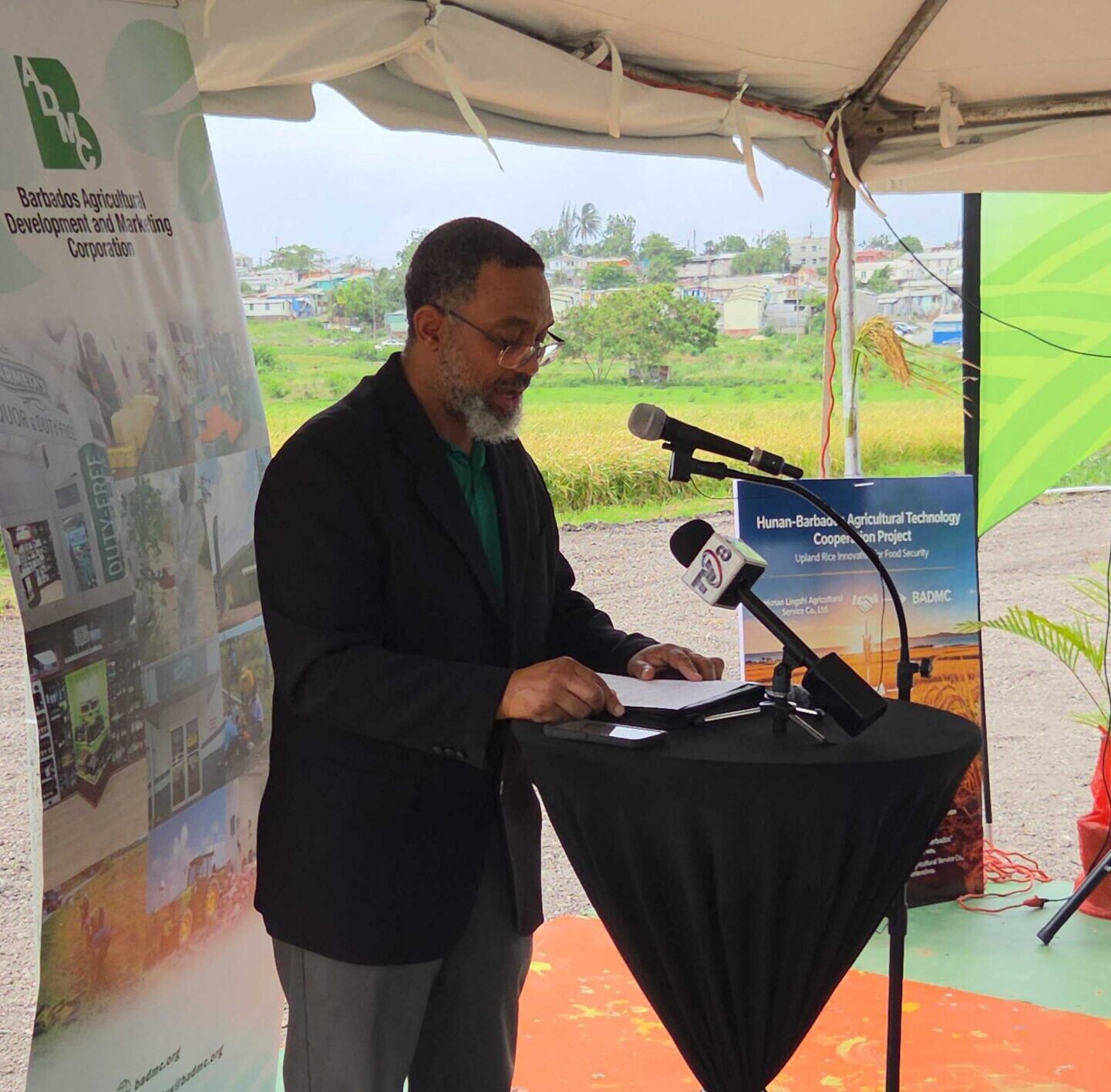
Barbados is set to make a landmark leap toward domestic food sovereignty, following the successful completion of the third phase of a bilateral agricultural cooperation project with China. Agriculture authorities announced plans to scale up commercial upland rice cultivation to 10 acres at the Pine Basin site, a move widely expected to cut the island nation’s longstanding dependence on imported staple foods.
The expansion plan was officially unveiled during the “Golden Sickle” shared food security harvest ceremony, an event that celebrated the successful outcomes of the hybrid upland rice demonstration initiative under the China-Barbados Agricultural Cooperation programme. The project is a three-way partnership between Barbados’ Ministry of Agriculture, the Barbados Agricultural Development and Marketing Corporation (BADMC), and China’s Hunan Lingshi Agricultural Service Company Limited, and has been hailed as a cornerstone of the island’s push for greater agricultural self-sufficiency.
Frederick Inniss, acting Chief Executive Officer of BADMC, explained that the existing 2-acre (1-hectare) demonstration plot at Pine Basin will act as the launchpad for full-scale commercial rice development. “Under the cooperation agreement, Hunan Lingshi Agricultural Group and BADMC plan to expand production to a total of 10 acres at this location for commercial rice production. This initial 1-hectare plot is just the first step in establishing full-scale commercial upland rice production across Barbados,” Inniss said during the ceremony.
Inniss emphasized that the bilateral partnership has evolved far beyond its original scope as a simple technology demonstration, growing into a comprehensive strategic alliance that builds long-term agricultural resilience for Barbados. The initiative has delivered tangible progress across three core areas: strengthening local technical capacity, introducing innovative climate-smart production systems, and expanding access to appropriate agricultural mechanization for small and medium-scale producers.
“Our demonstration trials have conclusively shown that upland rice can be grown successfully under Barbados’ local soil and climate conditions. This opens exciting new opportunities for domestic grain production and creates a clear pathway to reduce our reliance on imported staple foods over time,” Inniss added.
The breakthrough in the third phase of the project followed years of staged development laid out in the bilateral cooperation agreement. The first phase prioritized building climate-resilient agricultural infrastructure and boosting local human capacity through targeted training programs. Through hands-on farmer field schools, on-site practical demonstrations, and specialized technical workshops, more than 100 local farmers, agricultural extension officers, and Ministry of Agriculture professionals gained direct practical experience in modern sustainable farming practices. Training modules covered critical topics including protected greenhouse vegetable production, efficient irrigation management, science-based crop nutrition, and integrated pest and disease control.
Beyond the core upland rice trials, the cooperation program also successfully tested a wide range of specialty vegetable varieties provided by the Hunan-based agricultural team. These crops included sweet corn, pumpkin, eggplant, radish, assorted melons, cucumbers, tomatoes, and Chinese cabbage, all of which showed strong adaptive capacity and impressive yield potential in Barbados’ local growing conditions, project officials confirmed.
The partnership has also centered the needs of small-scale landholders, who form a core segment of Barbados’ agricultural sector, by introducing compact, affordable mechanization solutions such as micro-tillers. Inniss noted that these accessible mechanization tools align directly with existing national agricultural initiatives including the Ministry of Agriculture’s “Feed and Care” programme, whose participants typically farm small, fragmented parcels of land that are not suited for large industrial equipment.
The second phase of the project expanded the trial sites to larger demonstration plots, allowing the technical team to gather critical data on commercial viability and refine production practices ahead of full-scale expansion. This iterative development process set the stage for the successful third-phase harvest that triggered the approval for 10-acre commercial expansion.
Technical data from the Hunan agricultural technical team highlights the dramatic efficiency gains delivered by the project’s modern production systems. The initiative has adopted advanced mechanized strip drilling technology for sowing, an automated system that achieves a seedling uniformity rate of at least 95% and a germination rate of more than 90%. The system can complete sowing for a 3-acre plot in just five hours. When compared to traditional manual broadcasting methods, the mechanized approach cuts required labor inputs by more than 80% and boosts overall field operational efficiency by 500% to 800%.
Environmental sustainability has also been a central priority of the project from its inception. The hybrid upland rice variety used in the trials is adapted to rain-fed production, requiring only supplementary irrigation during extended dry periods. Over the crop’s 120-day growth cycle, the production system cuts irrigation water consumption by 50% to 70% compared to conventional flooded paddy rice farming, making it uniquely suited to Barbados’ water-scarce tropical environment where freshwater security is a persistent policy challenge.
To support the upcoming expansion to 10 acres, BADMC and its Chinese partners have already imported specialized field equipment for cultivation, as well as agro-processing machinery required to mill raw harvested paddy into finished, market-ready rice for domestic consumption.
Inniss closed the ceremony by extending formal gratitude to all teams involved in the project, including BADMC’s technical staff, the corporation’s tractor services and irrigation departments, and Hunan team leader Jiang Wang (also known as Alan) for their consistent collaborative efforts. “As we continue to deepen this bilateral agricultural cooperation, we remain committed to adopting innovative technologies and sustainable production practices that will boost farm productivity, strengthen national food security, and position Barbados as a regional leader in agricultural innovation across the Caribbean,” Inniss said.