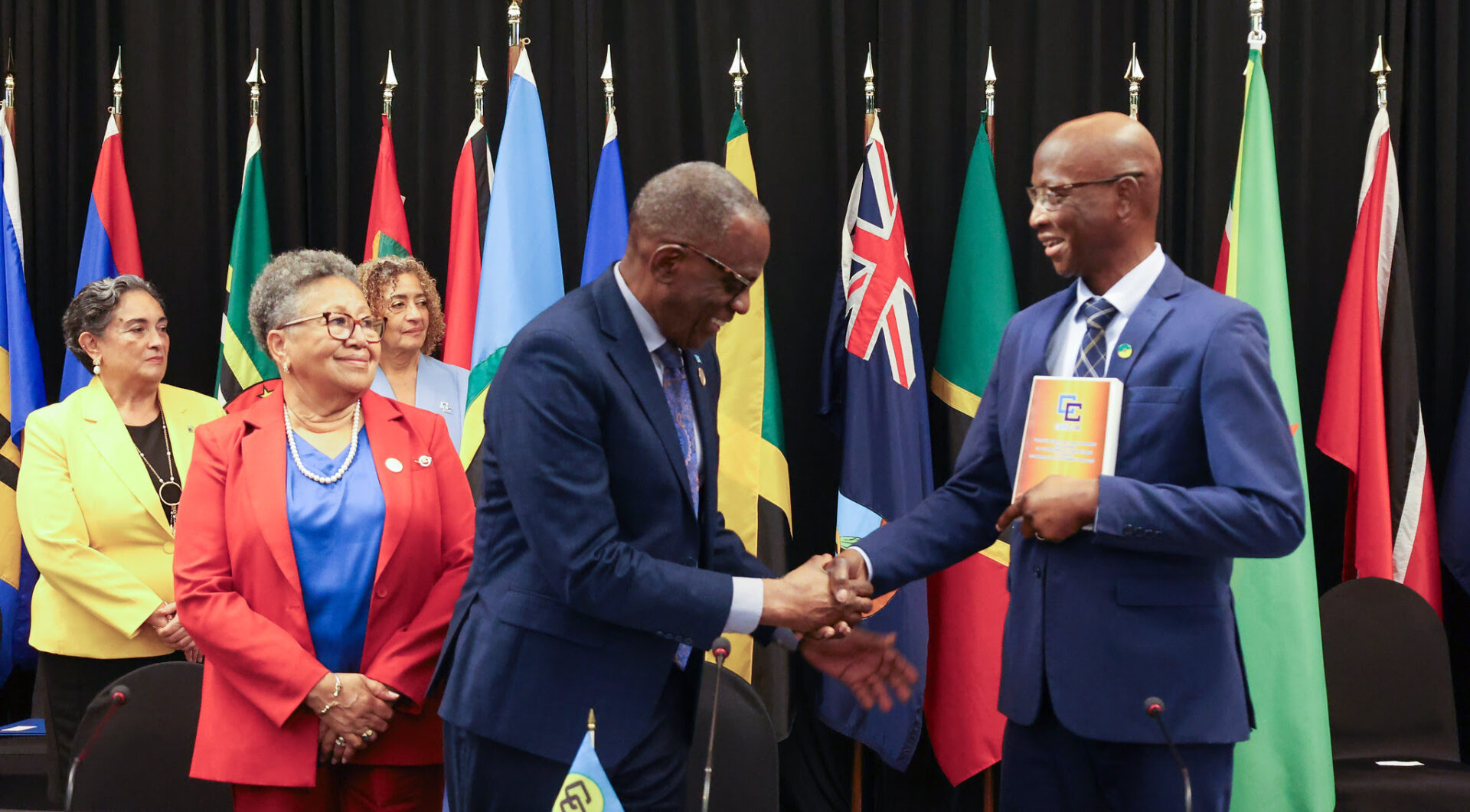
On July 7, a landmark agreement was signed in Saint Lucia that formally admitted French Guiana as the eighth Associate Member of the Caribbean Community (CARICOM), marking a major milestone in Caribbean regional integration.
The accession document was signed by two key regional leaders: Philip J. Pierre, Prime Minister of Saint Lucia and current Chairman of the CARICOM Conference of Heads of Government, and Gabriel Serville, President of the Territorial Collectivity of French Guiana. The agreement clearly outlines the terms and framework that will govern French Guiana’s participation in the 15-nation regional bloc. Immediately following the signing, French Guiana’s delegation took part in the opening proceedings of the 51st Regular Meeting of the CARICOM Conference of Heads of Government, which is being hosted this year by Saint Lucia.
In his ceremonial address to assembled regional leaders and delegates, Pierre extended a warm welcome to French Guiana, emphasizing the broad spectrum of collaborative opportunities that this new associate membership will unlock for both the territory and the wider CARICOM community. “French Guiana’s participation as an Associate Member will provide opportunities for closer dialogue and cooperation in areas of mutual interest,” Pierre noted.
As the sitting Chairman of CARICOM’s highest governing body, Pierre expressed his honor at formalizing the accession on behalf of the entire community. “May this signing open a new chapter of cooperation, friendship, and shared progress between French Guiana and the Caribbean Community,” he said in his closing remarks for the ceremony.
In his full remarks delivered during the event, Pierre framed the accession as far more than a routine institutional adjustment. He described it as a meaningful step toward expanding the scope of the Caribbean regional family, noting that the Caribbean has long been united by shared geographic ties, historical experiences, cultural connections, common economic and climate vulnerabilities, and collective aspirations for progress, regardless of differences in territorial size, official language, constitutional status, or development pathways.
“Today’s ceremony, therefore, represents not only a legal or institutional step but also a meaningful act of regional inclusion. It reflects CARICOM’s commitment to deepening cooperation with the wider Caribbean and ensuring that our regional architecture remains responsive to the realities of our neighbourhood,” Pierre stated.
He highlighted that associate membership will open new avenues for collaboration across a wide range of priority sectors, including sustainable regional development, expanded trade and economic integration, enhanced climate change resilience, cross-border security cooperation, cultural exchange, educational partnerships, public health coordination, environmental protection, and expanded people-to-people connections between Caribbean nations.
Pierre also emphasized that regional integration is an evolving, dynamic process rather than a static end goal. “Integration is not static. It is a living process. It grows when we create new bridges. It strengthens when we expand cooperation. It becomes more relevant when it reflects the real geography, diversity, and potential of the Caribbean,” he explained.
The CARICOM Chairman extended gratitude to the CARICOM Secretariat, led by Secretary-General Dr. Carla Barnett, for its sustained work to advance the accession process, as well as to the Government of France and French Guiana’s negotiating team for their collaborative engagement throughout the multi-year process of preparing for membership.
With French Guiana’s formal admission, CARICOM now counts eight Associate Members alongside its fifteen full Member States, bringing the regional body one step closer to its goal of building a deeply integrated, inclusive wider Caribbean community that reflects the full geographic and social diversity of the region.