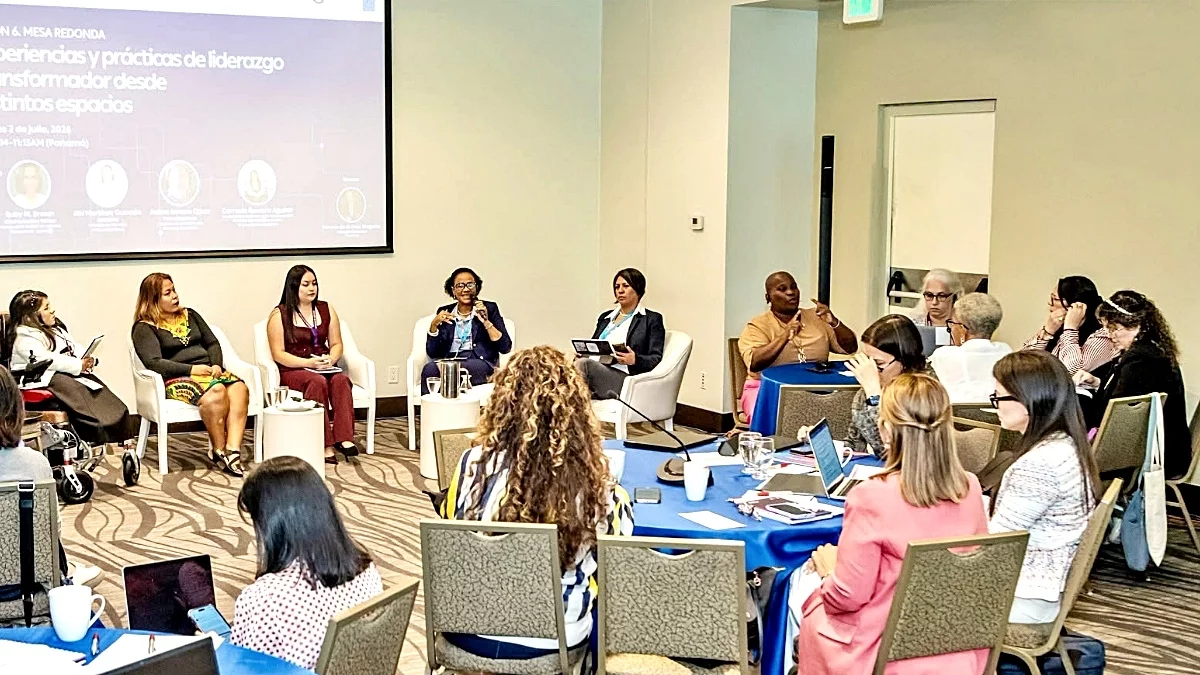
Across the globe, rapid digital evolution is reshaping how governments operate, how professionals deliver public services, and how key policy decisions are made. In this shifting landscape, investing in the capacity of current leaders is synonymous with building resilient, future-ready institutions that can adapt to changing public needs. It is this guiding principle that led the United Nations Development Programme (UNDP) Haiti to facilitate the participation of two senior Haitian public sector leaders in a landmark regional training event focused on women’s leadership in the digital era.
The two delegates are Magistrate Maguy Florestal, a sitting judge at Haiti’s highest court, the Court of Cassation, who also serves as Director of the National School of Magistrates (EMA), and Erna Royal, Divisional Commissioner of the Haitian National Police (PNH) and special advisor to the PNH Director General. Hosted in Panama by the global UNDP body, with financial and operational support from the Spanish Agency for International Development Cooperation (AECID), the event marked the first iteration of the Regional Academy for Women’s Leadership in the Digital Age.
Held from June 30 to July 2, 2026, the academy gathered more than 40 women in senior leadership roles across public office, political institutions, and civil society organizations, representing 24 nations across Latin America and the Caribbean. Over three days, participants centered their discussions on the most pressing challenges currently redefining public governance: widespread digital transformation, the rising influence of artificial intelligence in public administration, driving innovation in public services, inclusive governance frameworks, and women’s equitable representation in leadership shaping digital policy.
Far more than a conventional training workshop, the academy functioned as a collaborative think tank, where leaders could exchange on-the-ground experiences from their respective national contexts, build collective solutions to shared challenges, and formally establish a regional network of women leaders dedicated to reforming and modernizing public institutions across the region.
For Haiti, the participation of Florestal and Royal carries particular significance, as the two leaders hold senior roles in two institutions that are foundational to advancing the rule of law and sustaining public safety across the country—two priorities that remain central to Haiti’s long-term stability and development. Investing in the capacity of these two leaders, UNDP officials note, is equivalent to strengthening the ability of the institutions they lead to anticipate coming digital shifts, integrate innovative, data-driven approaches to governance, and meet the evolving expectations of Haitian citizens.
Florestal already partners with UNDP Haiti through the Canada-funded Justice Support and Anti-Impunity Program (PAJSLI), while Royal serves as the official PNH liaison to UNDP, which manages the ongoing PNH Institutional Support Program. The regional academy extends the long-standing targeted support UNDP has provided to Haitian public institutions, helping them evolve into more effective, inclusive bodies better prepared to navigate the digital and structural transformations reshaping the Caribbean region.