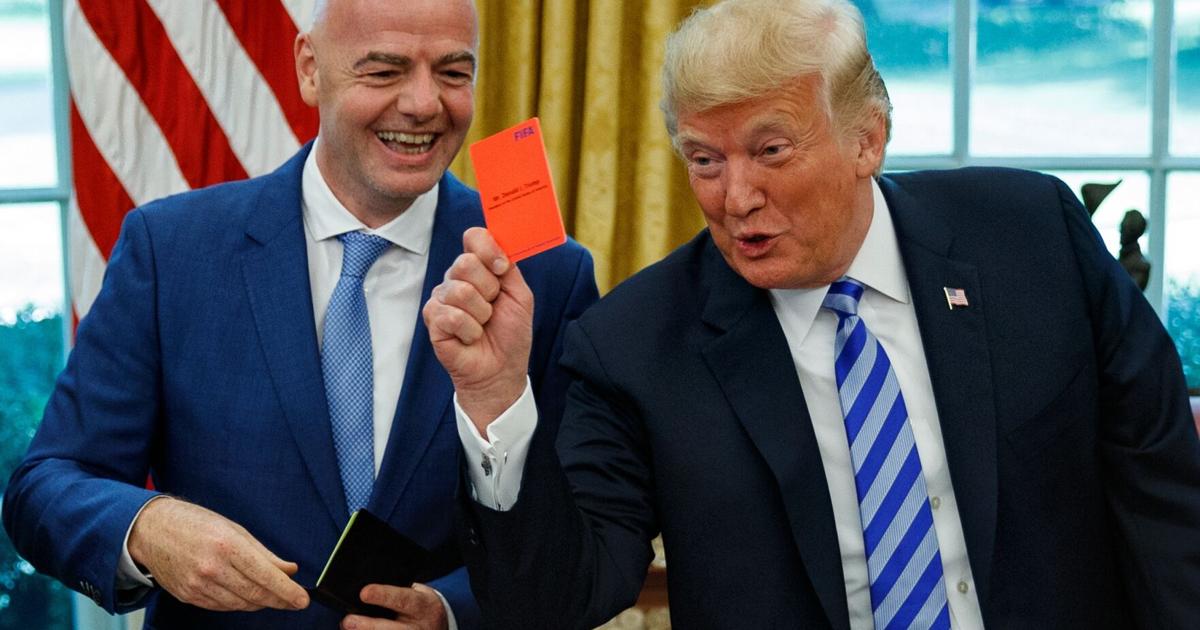
A fresh storm of controversy has engulfed FIFA ahead of the governing body’s 2027 presidential election, after a political intervention by U.S. President Donald Trump led to the overturning of a 2026 World Cup suspension, drawing fierce backlash from two of the organization’s most high-profile former leaders. At the center of the growing opposition is ex-FIFA vice-president Jack Warner, who has publicly pledged to lead a coordinated campaign to oust current president Gianni Infantino over the incident, accusing him of compromising the sport’s independence to accommodate political pressure.
The controversy traces back to the United States men’s national team’s Round of 32 World Cup clash against Bosnia and Herzegovina last Wednesday, when American striker Folarin Balogun was sent off for a dangerous sliding tackle. Per FIFA tournament rules, the dismissal carried an automatic one-match ban that would force the player to miss the critical Round of 16 fixture against Belgium. In an extraordinary step, President Trump personally placed a call to Infantino to argue the red card decision was incorrect and demand a formal review. Within days, FIFA reversed the suspension, clearing Balogun to suit up for the high-stakes knockout match.
Speaking in a telephone interview with Trinidad and Tobago’s *Express* newspaper on Tuesday, Warner launched a blistering attack on Infantino’s leadership, saying the FIFA president had “disgraced” the global sport by bowing to outside political pressure. “This is the most ridiculous thing I have ever seen in 30 years involved with FIFA,” Warner said. “FIFA is meant to be a non-political organization, and Infantino has destroyed its reputation. I am launching a campaign to remove him, and I will do everything in my power to ensure he loses next year’s election. He must pay a price for this failure.”
Warner pushed back against claims that his own controversial history with FIFA undermines his right to speak out. The Trinidadian administrator resigned from his post as vice-president in 2011 amid a large-scale bribery investigation; FIFA closed all ethics proceedings against him after his resignation and formally maintained a presumption of innocence. Warner insisted he “did nothing wrong” during his three-decade tenure at FIFA, and argued his decades of institutional experience give him full standing to criticize current leadership.
Dismissing claims that Trump only requested a procedural review rather than an immediate reversal, Warner said there was no meaningful difference between the two outcomes. He argued Infantino had a duty to reject the political interference outright, telling the *Express*: “Infantino should have been a man and told the U.S. President that competition rules cannot be changed for individual players. When a similar situation arose with Cristiano Ronaldo during my tenure, no presidential call changed the outcome. All decisions went through FIFA’s independent committee, there was no political meddling.” Warner added that Balogun was “extremely lucky” to have the suspension overturned, noting ironically that the player would likely have never been allowed entry to the U.S. under Trump’s immigration policies, were it not for the tournament.
The ex-vice-president warned that the incident has severely damaged the integrity of the 2026 co-hosted World Cup, arguing that if the U.S. goes on to win matches after this intervention, the fundamental sanctity and independence of football will be permanently compromised. He also expressed sympathy for match officials, saying the decision has left all referees open to intense scrutiny any time a call goes in the U.S.’s favor, casting a lasting shadow over the entire tournament.
Beyond the political controversy, Warner also criticized what he called widespread greed within modern FIFA, pointing to the exorbitant cost of 2026 World Cup tickets. He noted that some tickets for upcoming matches in Miami were reselling for more than $5,000, calling the pricing “mass extortion.” “FIFA already has hundreds of millions in its treasury, it does not need to charge these absurd prices,” he said. He also lamented the loss of universal free-to-air television coverage for the World Cup, a tradition that once made the tournament accessible to working-class and low-income fans around the globe.
When asked about his picks to win the 2026 tournament, Warner said he was supporting both France and Argentina, defending the two previous World Cup champions. He also criticized Brazil’s underperformance in their upset defeat to Norway, joking that “the Norwegians played like the historic Brazil we all know, and the Brazilians played like nobody.” On the topic of his home nation Trinidad and Tobago’s chances of qualifying for a future World Cup, Warner offered a grim assessment, saying he does not expect to see the country qualify again in his lifetime if current development trends continue. Noting that tiny nations like Cape Verde, with a population of just over 500,000, have proven competitive at this year’s tournament, Warner said Trinidad and Tobago has fallen far behind global standards and needs urgent, radical introspection to rebuild its national football program. “Across the Caribbean, our football has gone backwards while other small nations like Jamaica and Curacao have moved forward,” he said. “If nothing changes, we will never qualify again.”
Warner is not alone in his criticism of Infantino over the incident. Former FIFA president Sepp Blatter, who led the governing body between 1998 and 2015, echoed the condemnation in a post on his social media platform X. “Red cards are not overturned by political phone calls. They are overturned by rules, evidence and independent bodies,” Blatter wrote. “If a U.S. president intervenes with the FIFA president—and a player is suddenly cleared before a World Cup knockout match—the question is unavoidable: quo vadis, FIFA? Football must never become a playground for political power.” Blatter’s own tenure ended in 2015 amid ethics investigations, and he received a six-year suspension from FIFA in 2021 for rule breaches, though he and former UEFA president Michel Platini were acquitted of criminal charges in Swiss courts related to a controversial 2011 payment.