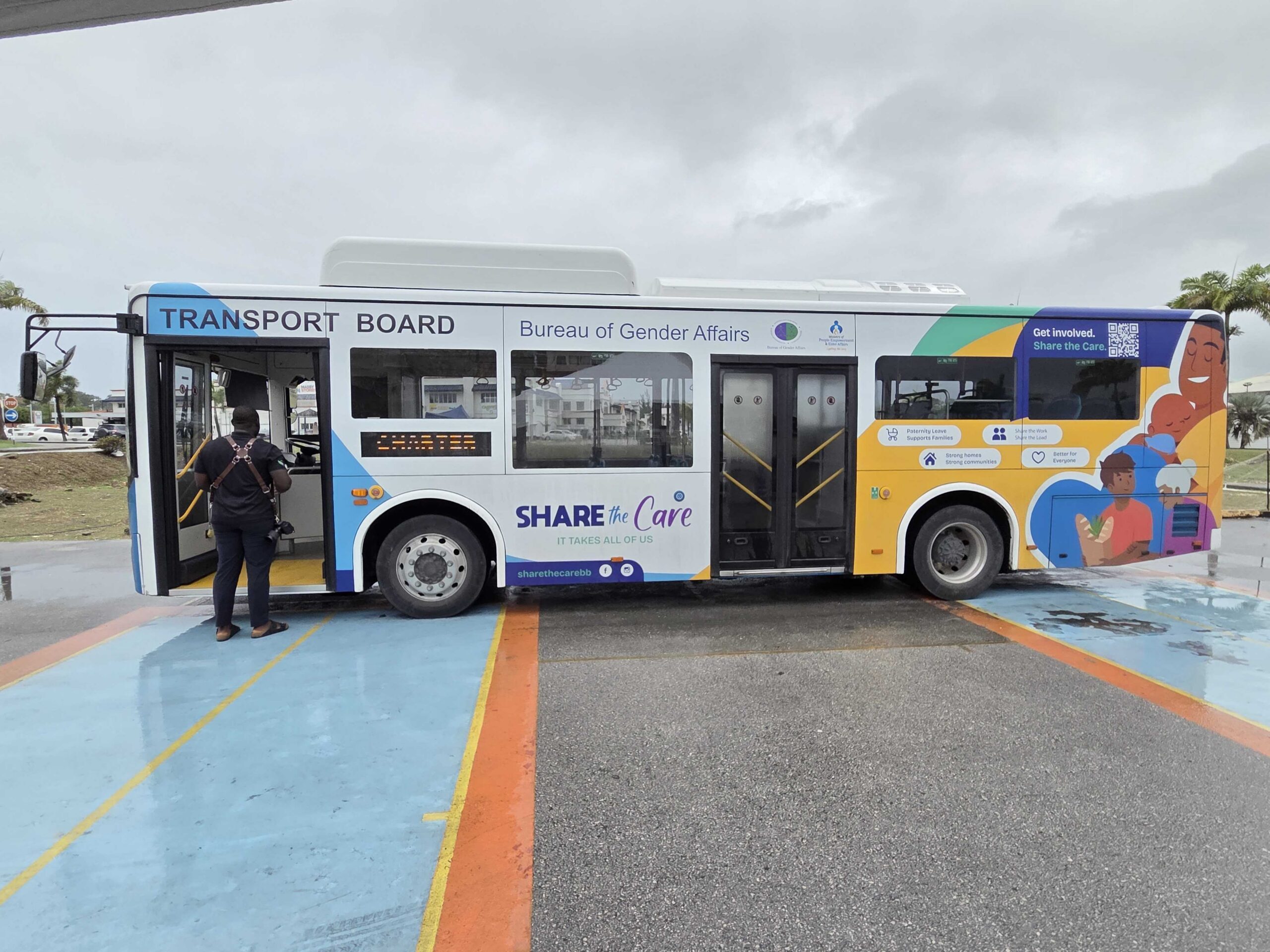
Barbados has ushered in a historic shift in family dynamics and gender equity, rolling out a national public awareness campaign called ‘Share the Care’ to encourage men and boys to take on more active caregiving responsibilities, paired with the country’s first-ever legislated paid paternity leave policy. The dual initiative, spearheaded by the Ministry of People Empowerment and Elder Affairs in partnership with the Bureau of Gender Affairs, aims to dismantle centuries-old entrenched gender norms that have long confined care work exclusively to women across the Caribbean island.
The campaign made its public debut on one of Barbados’ modern electric public buses, a deliberate choice to maximize visibility among everyday commuters as it builds support for the newly implemented paternity leave legislation contained in the updated Family Leave Act. Passed by the government in October of the previous year, the landmark law not only expands maternity leave from 12 to 14 weeks for single births and to 17 weeks for multiple births, but also guarantees all new fathers three weeks of paid paternity leave — a policy first for both Barbados and the broader CARICOM regional bloc.
Speaking at the official launch to journalists and government stakeholders, Minister of People Empowerment and Elder Affairs Adrian Forde stressed that building a truly progressive, inclusive society demands a nationwide cultural shift in how caregiving is framed and valued across all communities. He framed the ‘Share the Care’ campaign as an open call for Barbadian men to reevaluate their roles within their homes, extended families, and local neighborhoods.
“Share and care. We must understand and appreciate that sharing is caring, but equally, if you juxtapose it, caring is sharing as well,” Forde told attendees. “It is for us, especially our men, to be imbued with a sense and appreciation of caring — caring for their loved ones, caring for their extended family, caring for their neighborhoods, caring for their communities, and, by extension, caring for Barbados.”
Forde positioned the new paternity leave legislation as a foundational policy step toward closing gender equity gaps in domestic life, noting that the guarantee removes the structural barriers that once prevented fathers from being present for the earliest, most formative moments of their children’s lives. What was once a distant dream for many working fathers is now a protected right, he emphasized.
From the government’s earliest days in office, leaders have centered men as equal partners in national conversations around gender equity, Forde added. “We have said that paternity leave must not only be a part of men’s imagination, it must all be part of the active conversation, and that is why we moved a place to have paternity leave for men so that they take care of their little babies and share that love, care, and attention that is desperately needed.”
Local creative agency Visual Element has been tapped to lead the strategic and creative execution of the national campaign. Ardith Burgess, the agency’s marketing team lead, explained that the initiative’s core mission is to break down rigid gender stereotypes that have for generations assigned all care work — from childcare to elder care to caring for sick family members — to women. The need for more balanced caregiving has grown increasingly urgent as Barbados grapples with a rapidly ageing population, which has put growing pressure on women to take on unpaid care work, she noted.
“The whole focus of this campaign was generated by the legislation that has been recently enacted,” Burgess said. “We’ve been pigeonholed by gender roles where people only think that caring for children, caring for the elderly, caring for someone who’s ill, is a responsibility of our womenfolk. We want to move beyond that where anybody can share care and don’t have a complex about it or assume that that is the responsibility of the females in the household.”
Acknowledging long-standing societal challenges including widespread paternal absenteeism and a lack of positive male caregiving role models in many communities, Burgess said campaign leaders recognize shifting culture will take time. The initiative is designed to build a sustainable framework for long-term behavioral change, rather than offering a quick fix, she explained.
Looking beyond public media advertisements, the Bureau of Gender Affairs plans to integrate the campaign’s core values into national school curricula starting from primary education, to embed equitable caregiving norms in younger generations early on. “We want to be able to have our men and boys more engaged in terms of not just waiting for a partner or significant other to have a baby, but to be involved as their parents age, as their aunts age, that everybody puts their hand to the floor, in essence, to give care,” Burgess said. “Our whole intent is to spread the word, have people more aware of the legislation, and we would like to take it further into the school system — not just secondary schools, primary schools — to let boys know that sharing care starts at a young age.”
To reach broad audiences across the island, the campaign runs eye-catching mobile advertisements on Barbados’ national transit system, each equipped with scannable QR codes that connect commuters to free educational resources and the Bureau of Gender Affairs’ social media channels. In addition to transit ads, the ministry and its partner organizations will host community outreach pop-up events across every part of the island, featuring public information sessions and branded promotional materials to drive local engagement.
The official launch event brought together a cross-section of key leaders in policy and social development, including Wayne Marshall, Permanent Secretary in the Ministry of People Empowerment; William Warner, Director of the Bureau of Gender Affairs; Nicole Daniel, Social Project Development Manager from local non-profit One Family; and Kim Bobb-Waithe, Acting Director of the National Wellbeing and HIV Commission.