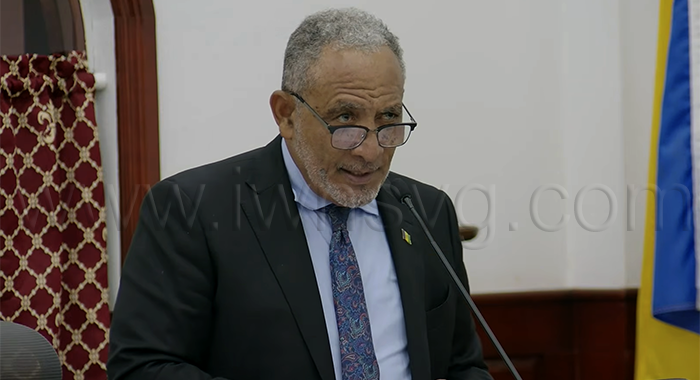
In a tense parliamentary session this week, St. Vincent and the Grenadines Prime Minister Godwin Friday has clarified that the government’s EC$11.8 million net outstanding debt to two major domestic fuel suppliers is the direct fiscal cost of a deliberate policy to protect ordinary citizens from the full impact of skyrocketing global oil prices driven by ongoing geopolitical instability.
Responding to questions from Opposition Leader Ralph Gonsalves, Friday explained that the accumulated liability to suppliers Sol EC Ltd. and Rubis West Indies Ltd. has formed under the country’s long-standing bonus-malus fuel price stabilization mechanism, a regulatory framework designed to smooth out sharp swings in domestic pump prices for consumers.
Breaking down how the system operates, Friday told the House of Assembly that the arrangement applies exclusively to dutiable sales of gasoline and diesel, excluding aviation fuel and liquefied petroleum gas. Under the framework, fuel importers first submit a detailed price build-up (PBU) — a full breakdown of all costs including freight, insurance, import duties, taxes and the company’s operating margin that sets the supplier’s actual wholesale price — to the Ministry of Finance, which then forwards the documentation to the Customs and Excise Department for review.
Each month, importers prepare bonus-malus statements comparing their actual wholesale price to the government’s regulated wholesale price, set under the Price Distribution of Goods Act. If a supplier’s actual price comes in below the government’s set price, the difference is paid to the government as a “bonus”. When the supplier’s actual cost exceeds the regulated price, the government must reimburse the difference to the company — a “malus” that counts as a liability for the state. Over time, these monthly credits and debits are netted to determine whether the government or the supplier owes an outstanding balance.
Friday presented detailed account figures updated through April 30, 2026, revealing a stark divergence between the two licensed importers. For Rubis West Indies Ltd., a surplus of EC$6,681,793 carried over from the end of 2025, combined with a January 2026 bonus of EC$125,103.04, offset malus charges recorded between February and April 2026 totaling EC$3,638,345.56. This leaves Rubis with a net credit of EC$3,168,551.22 payable to the government as of the end of April.
The situation is drastically different for Sol EC Ltd., where the government’s outstanding liability has grown rapidly in the first four months of 2026. Starting with a debt of EC$6,398,540.94 at the end of 2025, every month from January to April 2026 brought new malus charges, as regulated prices remained far below Sol’s rising wholesale costs. As of April 30, 2026, the government owes Sol a total of EC$15,022,621.67.
When the balances of both companies are combined, the government holds a net liability of EC$11,854,070.45 — approximately EC$11.8 million — to the two fuel suppliers.
Friday tied the rapid growth of this malus liability to ongoing global market volatility, specifically citing the Gulf war as the primary external driver of spiking landed fuel costs. He explained that rather than passing the full burden of international price increases directly to consumers through immediate pump price hikes, the government chose to absorb a portion of the higher costs through the bonus-malus framework, only passing a partial increase to domestic consumers to avoid excessive financial hardship for households.
“That $11.8 million effectively is what the government has been holding the price down, in a sense, and subsidising the public,” Friday told lawmakers. He added that while the policy has shielded Vincentian consumers from the worst of global oil shocks, neither the government nor the private fuel importers can absorb these elevated costs indefinitely if global oil prices remain volatile.
“The longer the war goes on, the more volatile the oil price situation becomes. The greater hardship it imposes on all of us, not just in St. Vincent and the Grenadines, but all over the world,” he said.
The parliamentary exchange grew tense when Gonsalves pressed Friday for projections of malus costs for May and June 2026, which he suggested could match or exceed April’s high figures, and asked for clarification on the pricing benchmark the government uses to set its regulated wholesale price. Friday rejected the request for future projections, noting that Parliament does not address hypothetical scenarios, and that no final figures for the two months are yet available.
“When we have those facts at our disposal, we’ll make a facts-based decision,” he said. Gonsalves pushed back, arguing his question focused on the pricing benchmark rather than speculative future figures, but House Speaker Ronnia Durham-Balcombe ruled that the Prime Minister had already responded and ordered parliamentary business to move forward.